 Downcoded
What Happens to a Drug That Never Gets Its Own Code?
CMS posted its third-quarter 2026 drug coding summary on October 2 with 25 applications in it. Across 2026's three cycles the count is 67, against 118 in the same three cycles of 2025, the thinnest stretch in the nineteen summaries CMS still publishes. The products that never get a code keep getting billed, at 95 percent of average wholesale price, priced by hand.
CMS posted the third-quarter 2026 drug and biological coding summary on October 2 and pointed providers at it in the October 8 MLN Connects. Thirty-one pages, 25 applications.
The same cycle a year earlier carried 38. The one before that, 37.
Pull every quarterly drug summary CMS still publishes, back to the first quarter of 2022, and the three 2026 cycles come to 67 applications against 118 in the same three cycles of 2025. Down 43%, and the 16 that landed in the second quarter is the smallest cycle of the nineteen (chart below).
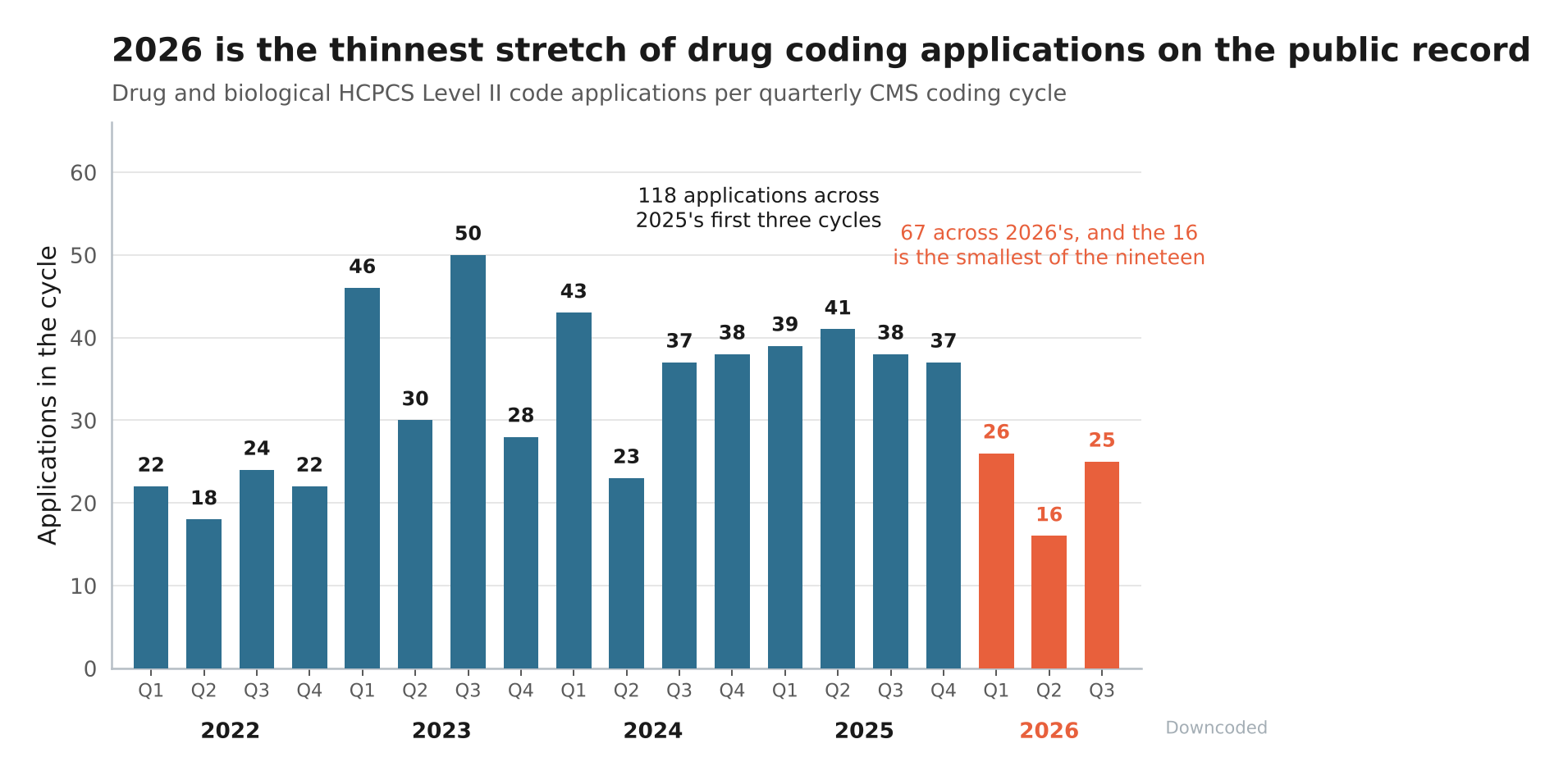
Across the twelve cycles of 2023, 2024 and 2025, only one came in under 28. All three of 2026's came in at 26 or below.
What the Quarter Actually Did
The determinations themselves are unremarkable, which is the point. Of the 25 applications, 20 produced at least one new HCPCS Level II code, 4 got a descriptor revision and nothing more, and 1 was denied: AVTOZMA subcutaneous, because CMS classed it a self-administered drug and Part B generally doesn't cover those.
The new codes are the usual mix:
- J9279 for pivekimab sunirine-pvzy, which also retires C9313
- Q5174 and Q5177 for a bevacizumab and a ranibizumab biosimilar
- J0332 for rocuronium bromide
- J0226 for eplontersen, retiring C9311
- A9696 for gadoquatrane
All of it effective January 1, 2027, all of it folded into the January 2027 HCPCS quarterly update.
So the approval rate held. The queue is what thinned.
Where the Uncoded Products Go
Now, the product that misses out on a code still gets administered and still gets billed. The difference lands in how it gets priced.
Section 621(a) of the MMA added paragraph (15) to section 1833(t) of the Act, and it sets the price: a drug furnished as part of covered outpatient department services with no product-specific HCPCS code assigned is paid 95 percent of average wholesale price. Hospital outpatient departments report it as C9399, "Unclassified drug or biological", starting the day FDA approves it.
Chapter 17 of the claims processing manual, section 90.3, spells out what that costs you:
- the NDC, the quantity in the drug's own unit of measure, and the date furnished, keyed into the 837I or written into the Remarks box of the CMS-1450
- "Contractors shall manually price the drug or biological at 95 percent of AWP"
- lines manually priced that way are not eligible for outlier payment
Manual pricing is a person at your MAC reading your documentation. The claim doesn't auto-adjudicate, the allowed amount isn't in any file you can check against before you bill, and the money sits while someone works the queue. Compounded products that aren't a mixture of commercially available drugs go to J9999 or J3490 instead, and the manual is explicit that C9399 is wrong for those, which is its own denial waiting to happen.
CMS prices the gap in its own documents. The standing item in the Q3 cycle, the one that discontinued six codes, revised two and established four, says in plain text that the effort exists to "help reduce use of the not otherwise classified (NOC) codes."
Final Thoughts
Three cycles is a short window and we wouldn't call a 43% drop a permanent shift yet. What it does tell you is what the January 2027 quarterly update will look like when it posts: a smaller batch of new J and Q codes than the last four Januaries trained you to expect, and more Part B drug volume riding unclassified codes into 2027 than your denial rate is budgeted for.
Worth a look at your C9399 and J3490 lines before year-end close. Those are the ones where the allowed amount is decided by a human you've never met, after you've already bought the drug.
Thanks for reading.