What Happens When the Speech Eval Slips Past Noon?
CMS made one word plural in the IRF basis-of-payment regulation and turned a therapy-scheduling detail into a condition of coverage for the entire stay. Two clocks, both effective October 1, both counting from different moments. The only dollar figure the agency ever attached to the package is $399.06 a week.
Here is the sentence that governs IRF therapy timing through September 30.
"The required therapy treatments must begin within 36 hours from midnight of the day of admission to the IRF."
And here is the sentence that replaces it on October 1.
"All required therapy treatments and/or therapy evaluations ordered must begin no later than 36 hours from midnight on the day of admission to the IRF."
One article became one adjective. "The" became "All."
One Word, Every Discipline
That edit lives in 42 CFR 412.622(a)(3)(ii), which is the basis-of-payment section, and CMS is explicit about what it does. From the final rule: an IRF claim "will not be considered reasonable and necessary (in accordance with section 1862(a)(1) of the Act) if it does not comply with this coverage criteria."
So the unit of failure is the stay, not the visit.
Your typical IRF admission carries orders for PT, OT, and speech-language pathology at minimum, because 412.622(a)(3) requires multiple disciplines and at least one of them to be PT or OT. Under the text in force today, one therapy starting inside the window has been a defensible reading. Under the text that starts October 1, the whole set has to be moving, and the claim rides on whichever discipline is slowest to the bedside.
CMS is candid about where the old reading came from. Sub-regulatory guidance the agency posted in 2010 "may have created ambiguous interpretation" of whether one therapy or all of them had to start, and although the document has been off the website "for quite some time, some providers still mistakenly refer to it."
There is one narrowing worth knowing, and it is real. The 36-hour requirement reaches only therapies ordered at admission, meaning those in the preadmission screening or ordered by the rehabilitation physician at admission.
Anything the physician adds after the window closes falls outside it.
Everything else asked for got refused. Commenters wanted:
- flexibility for smaller IRFs and for facilities carrying therapy or physician vacancies
- a 48-to-72-hour window instead of 36
- application to the patient's core therapy program rather than all ordered therapies
- a one-year delay to build the workflow
CMS finalized none of it: "we did not propose to allow for flexibilities and are not finalizing any such flexibilities." The agency also reminded commenters that claims for patients "who cannot tolerate an intensive therapy program may be denied." The only relief still on the table is the pre-existing contractor discretion to grant brief exceptions of no more than three consecutive days for unexpected clinical events, well documented, under Benefit Policy Manual 110.2.2.
Compliance is determined the way it always has been, by audit of the medical record.
Two Clocks, Two Different Midnights
The same rule moves the initial interdisciplinary team meeting from day 7 to day 4. Both changes take effect October 1, 2026, and both are conditions of the claim being reasonable and necessary.
Here is the part that will cost somebody a stay. The two deadlines do not count from the same moment (chart below).
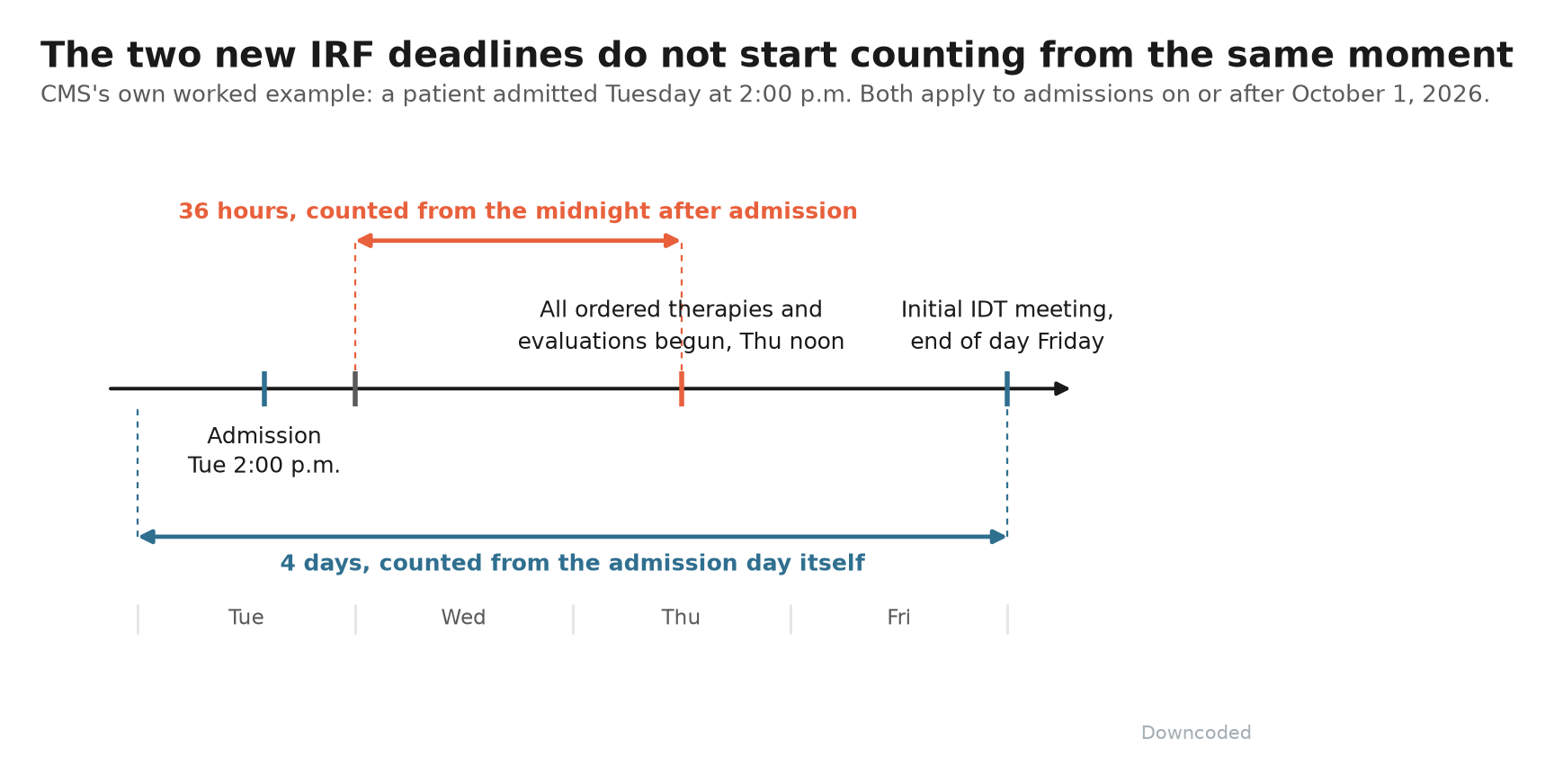
The 36-hour clock starts at the midnight after admission. CMS's own example: a patient admitted Tuesday at 2:00 p.m. has until Thursday at noon, because the relevant midnight is 12:00 a.m. Wednesday.
The IDT clock starts on the admission day itself. CMS proposed to write that deadline as "the fourth day from midnight on the day the patient is admitted," then declined to finalize the language, landing on "4 days from the date the patient is admitted."
Day 1 is the day of admission. Same Tuesday patient, meeting due by end of day Friday.
A Tuesday arrival at 2:00 p.m. therefore gets a 46-hour therapy window and an 82-hour meeting window, measured from the moment the patient hits the unit, out of one paragraph of one regulation.

The rest of this brief is for subscribers.
The impact tables, the code-level detail, and the rest of the analysis sit past this line.
$50 a month, or $500 a year.
Already a subscriber? Sign in