What Nine Contracts Do to the CGM Channel
CMS published its Round 2028 bidder fact sheets this morning. Buried in the rule behind them is a worked example where one unchanged array of bids produces three different Medicare prices, and the only thing that moves is how many contracts CMS decides to hand out.
Somewhere in the middle of a home health rule that runs 279 Federal Register pages, CMS works an example on a real past competition and gets three different answers.
Thirty-six suppliers win. Read the array at the median, the way Medicare did from 2011 through 2018, and the payment amount is $82.76. Read it at the 75th percentile, the rule CMS just finalized, and it is $105.00.
Cut the winning array by a quarter, from 36 contracts to 27, read it at the 75th percentile again, and it is $89.95 (chart below). Nobody's bid changed.
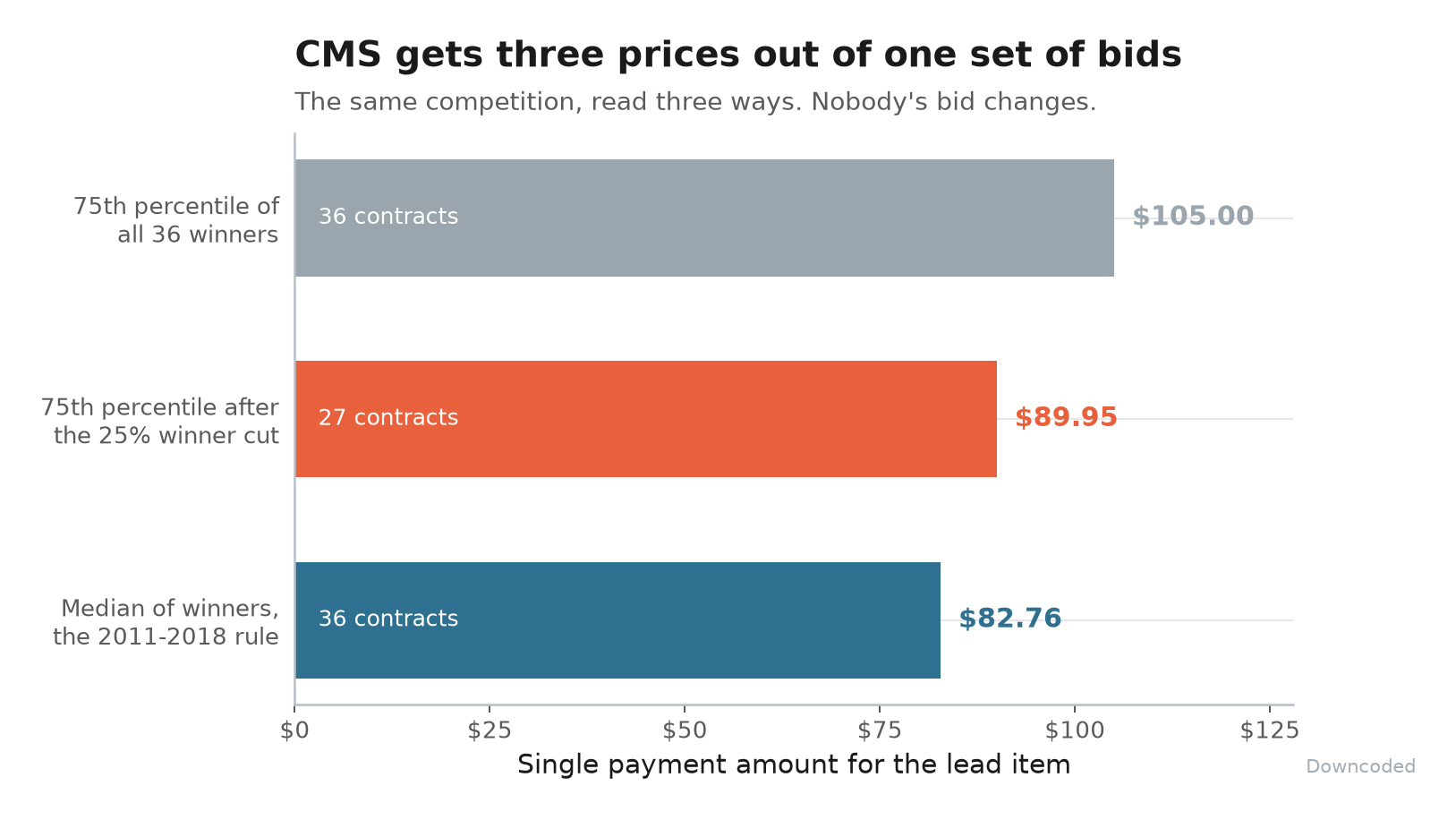
That spread is 27% top to bottom, and every dollar of it is a decision CMS makes before a single envelope is opened.
This morning's MLN Connects points bidders at four new CBIC fact sheets for Round 2028. One is titled "Determining the Number of Contract Awards & Calculating a Single Payment Amount." Those are the same thing now.
"If the price falls out of the winner count, what exactly is anyone bidding on?"
Three Rules, One Array of Bids
The single payment amount has been written three different ways since the program started, and the sequence tells you what CMS was solving for each time.
- 2011 through 2018: the median of winning bids. Set by the 2007 final rule at 72 FR 18045. Suppliers bid every item, the bids got weighted into a composite, and the SPA came off the middle of the winning array. It worked hard: CMS's own retrospective puts the result at 40 to 80 percent reductions in payment amounts, with suppliers accepting their contract offers about 92% of the time, round after round.
- Round 2021: the maximum winning bid. The 2018 ESRD and DMEPOS rule (83 FR 56922) introduced lead item pricing and moved the SPA to the top of the array. One bid per competition instead of a hundred, which killed the unbalanced bidding that had priced a manual hospital bed above a semi-electric one.
- Round 2028: the 75th percentile. Finalized at 42 CFR 414.416(b)(1), replacing "maximum bid" with "75th percentile of bids."
The middle one is why we are here. CMS says it plainly in the impact analysis: the maximum-bid rule "did not generate the savings required to award contracts under the Act."
Section 1847(b)(2)(A)(iii) forbids awarding contracts unless total payments come in under what the fee schedule would have paid. Round 2021 could not clear that bar, contracts expired at the end of 2023, and the program has sat in a gap period ever since, paying CPI-adjusted 2023 rates.
So CMS needed a number between the median that worked and the maximum that didn't. The 75th percentile is the arithmetic midpoint, and the stated reason for picking it is a fairness argument: it "pays more contract suppliers above their bid amount than below their bid amount."
Here's the catch. Reading higher in the array raises the price, and the statute still requires savings.
Something has to come back down.

The rest of this brief is for subscribers.
The impact tables, the code-level detail, and the rest of the analysis sit past this line.
$50 a month, or $500 a year.
Already a subscriber? Sign in