 Downcoded
Where Does Medicare Think Home Dialysis Happens?
Aetna starts denying professional claims on CPT 90963-90966 for an inappropriate place of service on November 14, cites CMS guidance as the authority, and never names the code it wants. We pulled every CY2025 Part B row on those four codes: 24 different place-of-service codes, 86.96 percent of the volume at an ESRD treatment facility, and 6.16 percent at Home. The CMS chapter that governs these claims does not mention the four codes once, and the section that itemizes the claim form skips the place-of-service box entirely.
Aetna's August bulletin carries a sentence that tells you to do something and never says what.
"You should review your billing processes to ensure that you report CPT codes 90963-90966 with the appropriate POS before claim submission."
Those are the ESRD home dialysis monthly management codes, one per patient per calendar month. Starting November 14, a claim submitted with an inappropriate place of service gets denied, for commercial and Medicare members both.
The notice names the four codes. It names the age bands, it names the date, and it cites CMS guidance as the authority.
It never names the POS.
"Which two-digit number is the appropriate one?"
So we went and counted what Medicare's own claims already say.
Twenty-four answers in one code family
The CY2025 Physician/Supplier Procedure Summary is the Part B file that carries a place-of-service code on every row. Filter it to 90963 through 90966 and you get 2,231 rows spanning 24 distinct POS codes.
Twelve of those have volume you can read. The other twelve are masked on every row, meaning the rows exist and the counts are too small to publish.
Of the 264,978 unsuppressed submitted services, 86.96 percent came in on POS 65, End-Stage Renal Disease Treatment Facility (chart below). POS 12, Home, takes 6.16 percent, one fourteenth of the bar above it.
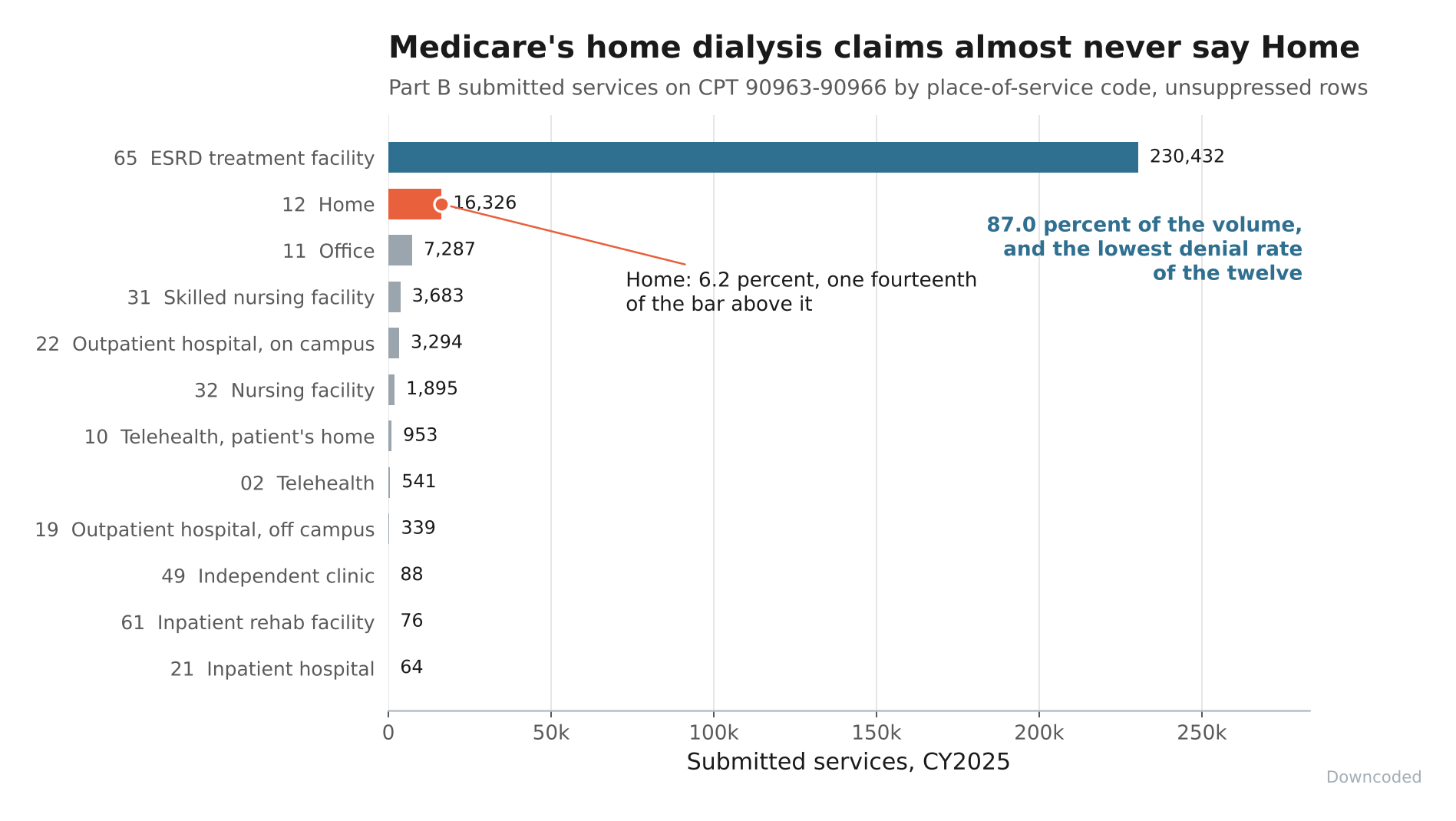
The tail is the strange part. 3,683 services from a skilled nursing facility, 3,294 from an on-campus hospital outpatient department, 1,895 from a nursing facility, 953 from telehealth in the patient's home, and 64 from an inpatient hospital bed, all on a code that pays for managing a patient who dialyzes at home.
What the manual actually says
Chapter 8 of the Claims Processing Manual governs ESRD physician claims. The current revision, 13740, issued April 17, does not contain the string 90963, 90964, 90965 or 90966 anywhere in it.
It uses the phrase "place of service" twice, both times about 90935, 90937, 90945 and 90947 needing an inpatient hospital setting. Different code family.
Section 140.3 is the one that itemizes the claim form, and its title is literally "Data Elements Required on Claim for Monthly Capitation Payment." It walks elements 1 through 13, declares 14 through 20 omitted, then specifies 32 and 32a, 21, 19 and 24A.
Element 24B is the place of service, and Chapter 26 calls it a required field. Section 140.3 skips it.
What 140.3 does say is that Element 32 must contain the name and address of the facility involved with the patient's maintenance care or training. CMS instructs this claim to carry a dialysis facility's address in its service-location field, then goes silent on the box two columns over.
Why the field drifted
Place of service moves money on most codes. On this one it never has.
Chapter 26's code set assigns every POS a payment-rate indicator. Office is NF. Home is NF. End-Stage Renal Disease Treatment Facility is NF. Three answers, one rate.
POS 65's own definition was written to cover exactly this patient: "A facility other than a hospital, which provides dialysis treatment, maintenance, and/or training to patients or caregivers on an ambulatory or home-care basis." The monthly face-to-face visit that section 140.1.1 requires usually happens in that building, and the claim follows the visit.
Medicare's adjudication agrees, quietly. The denial rate across the twelve POS codes with readable volume is 6.11 percent, and the lowest of the twelve is POS 65 at 5.69 percent. Home runs 8.53 percent, office 9.66 percent, telehealth-in-the-home 15.11 percent.
If the appropriate POS Aetna has in mind is 12, it is asking for the field value Medicare's own contractors deny half again as often as the one most practices are already using.
Final Thoughts
Allowed charges on these claims average $284.88 a paid service, and a nephrology practice bills one per patient per month, every month, for as long as the patient is on the modality. A validation edit on a field nobody has had to think about is a slow leak on a recurring charge, and it comes back as a claim error rather than a coverage dispute, which is the kind that sits in a work queue for a quarter before anyone adds it up.
Aetna published this once, in August. The September, October and November bulletins do not mention it again. The date is Saturday.
Pull your own 90963-90966 history, group it by box 24B, and count how many different answers your practice has been giving. If the spread looks anything like Medicare's, the answer is more than one.
Thanks for reading.