Which of Your 2026 Patients Was Never Actually Covered?
CMS cancelled 315,000 Plan Year 2026 Marketplace policies on August 31, covering more than 760,000 people. Under 45 CFR 155.430 a cancellation reaches back to the original effective date, which means those policies were never in force at all. The reason your aging report didn't move is one clause in the rule CMS filed this morning: it picked the enrollments where issuers could not identify a claim.
On August 31, CMS ended coverage for more than 760,000 people, and nobody's aging report moved.
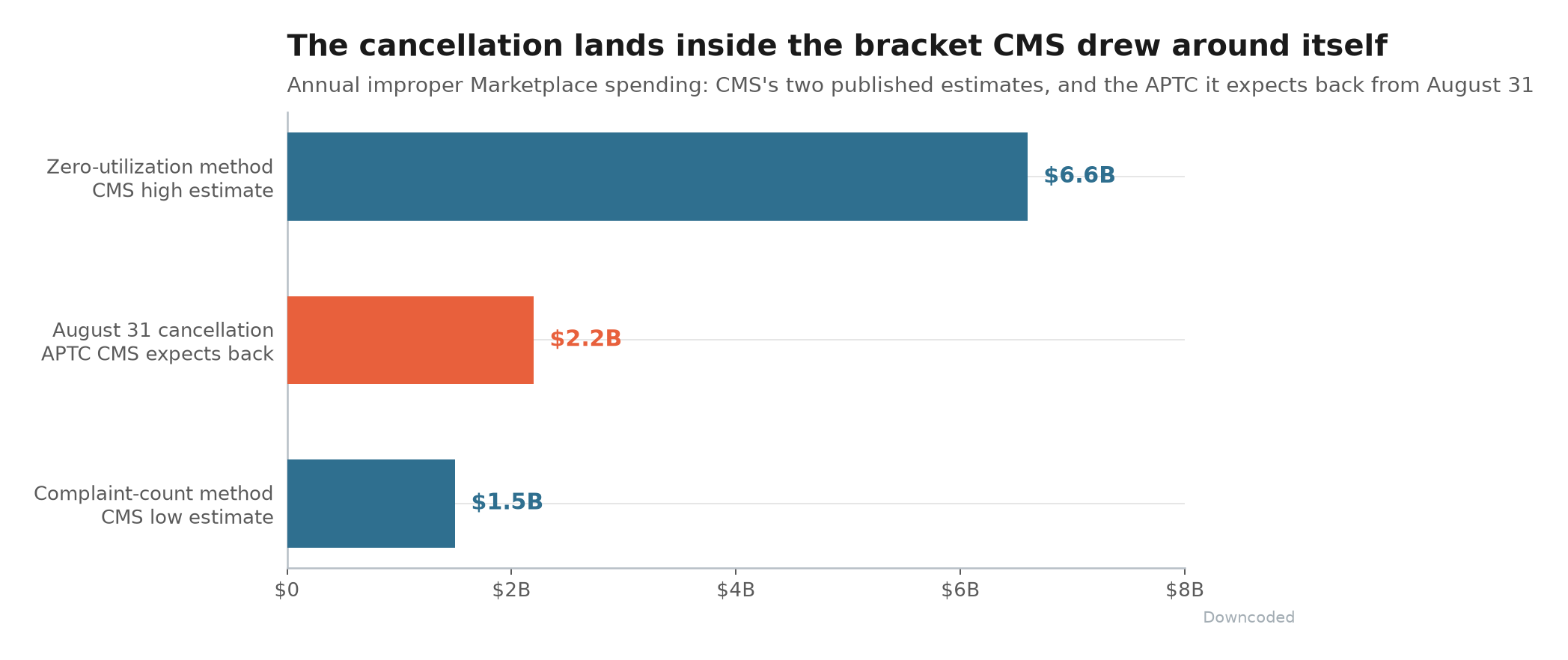
The agency said so this morning, in a press release, a fact sheet, and an interim final rule filed for public inspection at 8:45 Eastern. 315,000 Plan Year 2026 policies, cancelled, with about $2.2 billion in advance premium tax credits expected back. That recovery sits between the two estimates CMS published in the same rule for what improper Marketplace spending runs in a year (chart below).
Read the verb carefully, because the regulation treats it as a term of art.
"Cancelled" Has a Definition, and It Is Brutal
45 CFR 155.430(e) defines three actions the Exchange can take, and they are not interchangeable. A termination "ends an enrollee's enrollment through the Exchange for a date after the original coverage effective date, resulting in a period during which the individual was enrolled in coverage." A cancellation ends the enrollment "on the date such enrollment became effective resulting in enrollment through the Exchange never having been effective."
For a Plan Year 2026 policy, that reaches back to January 1.
CMS has a purpose-built paragraph for this fact pattern. Under 155.430(b)(2)(vi), the Exchange may act when "the enrollee was enrolled in a QHP without his or her knowledge or consent by a third party," and 155.430(d)(11) sets the date: "The termination date will be the original coverage effective date." Paragraph (d)(8) then requires the Exchange to make "necessary adjustments to advance payments of the premium tax credit, cost-sharing reductions, premiums, claims, and user fees."
Claims is in the list. CMS did not cite the paragraph it used, and it does not have to, though the mechanics are the only ones on the books that produce what it described.
So a practice that treated one of these patients in March billed a policy that, as of August 31, was never in force. The issuer paid on coverage that legally did not exist for a period that ran eight months, and (d)(8) is the instruction to unwind it.

The rest of this brief is for subscribers.
The impact tables, the code-level detail, and the rest of the analysis sit past this line.
$50 a month, or $500 a year.
Already a subscriber? Sign in