 Downcoded
Who Gets to Rehearse the January Prior Auth Deadline?
ONC and CMS opened a voluntary testing program on Wednesday for the three FHIR specifications behind the Prior Authorization API, run as 10 to 12 week sprints inside a virtual environment operated by Drummond Group. Interest closes November 20, the sign-up page says you do not need a finished build to get in, and CMS prices the work being tested at $33,800 a physician a year.
The sign-up page for the federal government's new prior authorization testing program answers the question every revenue-cycle shop asks before it asks anything else.
"Do we need a production-ready implementation?"
No.
That is the whole answer, and it is in writing: "Participants with working or in-development implementations can register." The thing standing between a practice and a seat at the table is not a finished FHIR stack. It is a contact form, and it closes November 20.
ONC and CMS announced the initiative on November 12. So the window to raise your hand is seven business days wide, and it opened the day before yesterday.
What You Are Actually Signing Up For
Testing runs in sprints of 10 to 12 weeks, inside FHIRplace, a virtual environment operated by Drummond Group that the company says is already running and will expand to carry this program. The MITRE-led Health Federally Funded Research and Development Center works alongside Drummond on the unglamorous half: stakeholder recruitment, readiness discussions, participant matching, and coordinating the tests themselves.
Participants are matched with counterparties they would otherwise have to go find. Drummond's page lists the pool as payers, providers, health IT developers, and intermediaries.
What you bring is your own workflow. The sprints trace how a prior authorization request and the decision that comes back actually move across connected systems, using coordinated scenarios built on high-volume clinical services that require prior authorization.
The point is to surface the gaps in a production-like environment first.
Four things worth knowing before you fill in the form:
- Participation is voluntary, and ONC says so twice.
- Testing is not certification under the ONC Health IT Certification Program, and it is not a determination of CMS compliance. Nobody gets a certificate to wave at an auditor.
- First-round space is limited, with more opportunities promised later.
- Smaller and rural organizations are encouraged to come, which is the line that makes this worth forwarding to a practice that assumed this sort of thing was for Epic and Elevance.
Tom Keane, M.D., the National Coordinator for Health IT, framed it this way in the announcement: "Federal regulations and industry standards have laid important groundwork for ePA, but our work is not done."
The Three Specs on the Table
The sprints test the HL7 FHIR Da Vinci implementation guides for Coverage Requirements Discovery, Documentation Templates and Rules, and Prior Authorization Support. CRD asks the payer what it needs, DTR collects it, PAS sends the request and carries the answer back.
PAS currently sits at v2.2.1, status STU 2, built on FHIR R4. Readers who went through the CRD guide with us in September already know the house rule about these documents: they are free, they are public, and the reader's EHR vendor is building against them whether or not anyone in the billing office has opened one.
Here is the detail that makes the sprint list feel less arbitrary. CMS's own electronic prior authorization page already points providers at the ONC-supported Da Vinci Inferno test kits for Coverage Requirements Discovery, Documentation Templates & Rules, and Prior Authorization Support. Same three guides, same three names. The sprints are the live-fire version of a test suite CMS has been telling people to run by themselves.
What the Rehearsal Is Worth
CMS puts a number on the work being rehearsed, and it is a strange one.
The agency's page says requesting prior authorizations costs providers $20 to $50 per hour and takes an average of 13 hours per week, which it rounds to "approximately $34,000 and 700 hours of administrative time each year" per provider.
Run the arithmetic yourself. Thirteen hours a week across fifty-two weeks is 676 hours, which is where the rounded 700 comes from.
Multiply 676 by the bottom of the band and you get $13,520. Multiply it by the top and you get $33,800 (chart below).
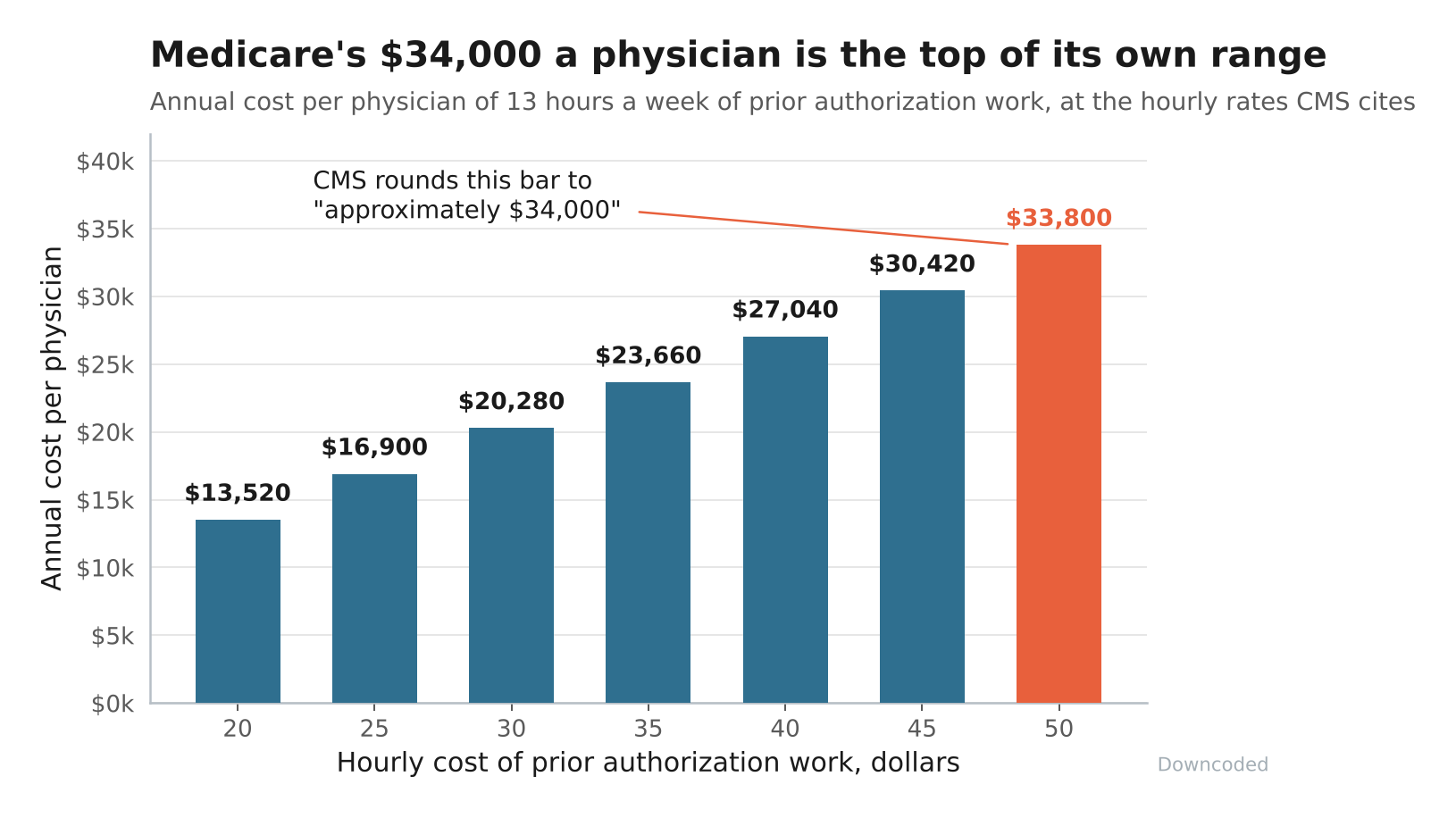
So the headline $34,000 is the fifty-dollar end of CMS's own range, not the middle of it. Useful to know before the number goes into a slide.
The practical version for a ten-physician group: somewhere between $135,200 and $338,000 a year of clinician and staff time spent asking permission. That is the pile the January work is aimed at.
And January is the clock. Starting January 1, 2027, certain CMS-regulated plans have to stand up and maintain the Prior Authorization API along with the Patient Access, Provider Directory, Provider Access, and Payer-to-Payer APIs. CMS-0057-F, the rule behind all five, published at 89 FR 8758 on February 8, 2024 and took effect that April. It reaches Medicare Advantage organizations, state Medicaid and CHIP fee-for-service programs, Medicaid and CHIP managed care plans, and QHP issuers on the federally facilitated exchanges.
Neither ONC's release nor its blog post names that rule or that date. The two calendars sit next to each other anyway.
Final Thoughts
Interoperability programs usually reach the revenue-cycle office as a fait accompli, announced by a vendor, scheduled by a payer, and explained after the fact. This one is open, it is free, it tells you plainly that it will not hand you a compliance letter, and it asks for in-development work rather than finished work.
Seven business days is a short runway for a decision like this, and the organizations that already have a half-built PAS connection are the obvious first call. The quieter opportunity is the one ONC wrote down on purpose: a small or rural group that has never sat in a room with its own payers' integration engineers can be in that room by the end of the month, for the price of a form.
Thanks for reading.