Who Pays First When OPM and CMS Disagree?
CMS issued Change Request 14603 on Friday to end a four-year standoff with the Office of Personnel Management. For a federal retiree drawing workers' compensation, Medicare pays first and the FEHB plan pays second, starting November 2. OPM's own public guidance still says the opposite, the change request tasks no claims system and orders no provider education, and the definition it leans on is cited to a part of the Code of Federal Regulations that does not exist.
In 2022 the Office of Personnel Management edited a line in a benefits booklet. CMS answered on Friday.
The answer runs five pages, revises one section of one manual, and reverses who pays first for every federal retiree who is drawing workers' compensation and still carrying an FEHB plan.
"Which card does your front desk bill first, and which federal agency are you believing when you decide?"
Transmittal 13981, Change Request 14603, Pub. 100-05, issued October 2.
Effective date and implementation date are both November 2, by date of service.
The Four-Year Round Trip
CMS wrote its own history into the background section, and it is worth reading in full. Change requests almost never talk like this.
"During 2022, the Office of Personnel Management (OPM) applied a minor change to its annual benefits booklet with respect to Federal annuitants who also have Federal workers' compensation coverage through the Office of Workers' Compensation Programs (OWCP). The change, which reversed all OPM direction for 2021 and prior, indicated that, for Federal annuitants with FEHBP coverage and who also have Federal workers' compensation benefits through OWCP, Medicare is now the secondary payer to FEHBP coverage. This position contradicts CMS's regulatory guidance in 42 CFR 411.104."
Then the next sentence: "After thorough internal deliberations, CMS has decided it needs to publish its guidance."
The deliberations ran roughly four years.
What they produced is one sentence of policy: "Medicare is the primary payer relative to FEHBP coverage for Federal annuitants who also have Federal workers' compensation benefits through OWCP."
The chain underneath it is tight, and it runs in three steps:
- A compensationer is an employee or former employee the Department of Labor has determined cannot return to duty.
- 5 U.S.C. 8901(3)(C) makes that person an annuitant for FEHB purposes, the same word the statute uses for a retiree drawing a pension.
- 42 CFR 411.104(a)(2)(i) grants current employment status to someone not actively working only while "receiving disability benefits from an employer for up to 6 months," and no longer.
Past six months the coverage stops being employment-based, and employment-based is the only thing that ever makes a group health plan primary to Medicare for the working aged.
So the FEHB plan is retiree coverage. Retiree coverage pays second.
The Part of Title 5 That Isn't There
The new manual paragraph opens on a citation: "Pursuant to 5 CFR § 809.101, a 'compensationer' is an employee or former employee who is entitled to compensation and whom the Department of Labor determines is unable to return to duty."
There is no part 809 in title 5.
The eCFR API returns HTTP 404 for it, body {"error":"No matching content found."}. The structure document for title 5 enumerates 420 parts, and in that stretch of the numbering it goes 772, then 792, then 831.
The definition CMS quotes is real, and the quotation is word-perfect. It lives at 5 CFR 890.101, in the Federal Employees Health Benefits Program definitions, which adds the sentence that does the actual work: "A compensationer is also an annuitant for purposes of chapter 89 of title 5, United States Code."
The six months is not in 890.101 either. That comes from 411.104, which the paragraph cites correctly two sentences later.
The instruction is right and the address is wrong, which matters only when somebody downstream has to defend it.
OPM Still Says the Opposite
Pull up OPM's "Understand which insurance pays first" page today and read the list headed "When is FEHB the Primary Payer?"
The fourth bullet: "Receiving Workers' Compensation. You are a federal employee receiving workers' compensation and determined unable to return to duty." Live this morning, carrying no date stamp, and the two orders sit side by side below.
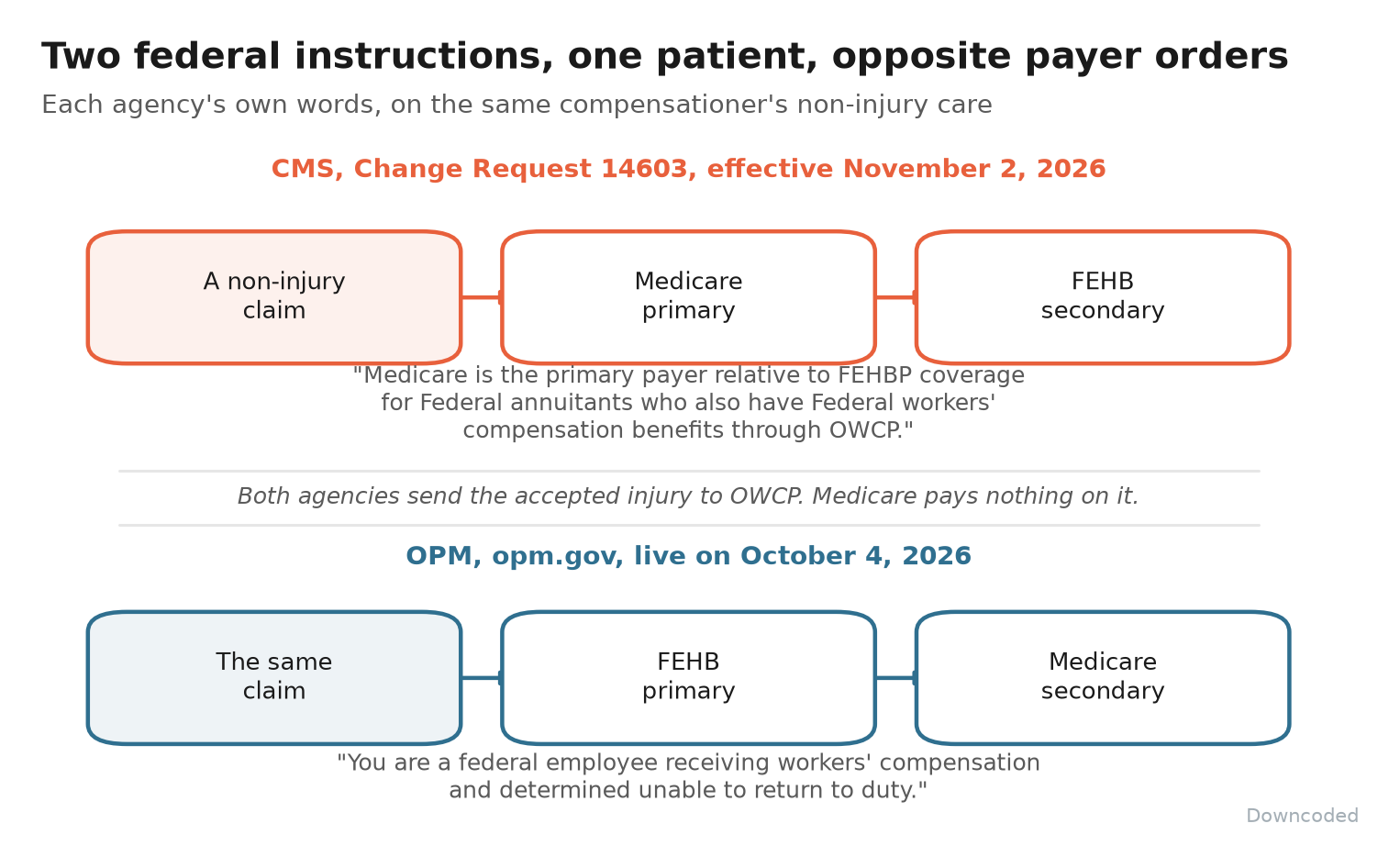
Note the word OPM picked. It calls this person a federal employee, while 8901(3)(C) calls the same person an annuitant and OPM's own Medicare-primary list on that page is headed "Annuitant."
The page even concedes the tiebreaker it is about to lose: "Medicare rules determine whether Medicare or FEHB is primary in any given scenario."
CR 14603 asks nothing of OPM. No joint statement, no coming correction, and no instruction about what to do when the enrollee arrives holding the other agency's answer.

The rest of this brief is for subscribers.
The impact tables, the code-level detail, and the rest of the analysis sit past this line.
$50 a month, or $500 a year.
Already a subscriber? Sign in