 Downcoded
Who Takes the Denial After the Second Appeal Fails?
Revecore put in-house attorneys behind the denials that survive two rounds of appeal letters, and named ERISA as one of the five categories it will work. The federal rule those appeals run under gives the appealing side 180 days and gives the plan no more than 60 to answer, which is most of the reason the money is still there.
Every hospital has a pile of denials that went out twice, came back twice, and stopped.
Authorization after the fact. Experimental and investigational. The out-of-network claim where the plan and the patient disagree about what the patient was told.
Somebody eventually writes those off, and the write-off is usually a staffing decision rather than a legal one.
On September 22 Revecore launched a service aimed squarely at that pile. It is called Legal Appeals, it is staffed with the company's own attorneys, and it runs on the same ReClaim platform the company already uses for claims scoring and clinical review.
"Who is actually authorized to argue a denial once the letters stop working?"
Five Categories, Named Out Loud
The launch is specific about what it takes, which is rarer than it sounds in this corner of the vendor market. Five denial types:
- authorization disputes
- non-covered service determinations
- out-of-network claims
- investigational and experimental denials
- ERISA-governed appeals
That last one is the interesting entry, and we will come back to it.
Chad Powers, the company's Chief Legal Officer, framed the gap the way a revenue cycle director would frame it: "Too many hospitals write off complex denials, not because the money isn't recoverable, but because internal teams don't have the necessary expertise and time to specialize in the recovery of these denial types."
Revecore says it works with more than 1,300 hospitals and health systems and has taken Best in KLAS for Complex Claims Services six times. Those are the company's own figures, offered here as the company offers them.
The part we can check independently is the legal ground the new tier is standing on, and that part holds up well.
The Clock Nobody in Patient Accounts Is Running
An ERISA appeal runs on a federal claims procedure with its deadlines written into 29 CFR 2560.503-1, and those deadlines are lopsided in a direction most billing offices never exploit (chart below).
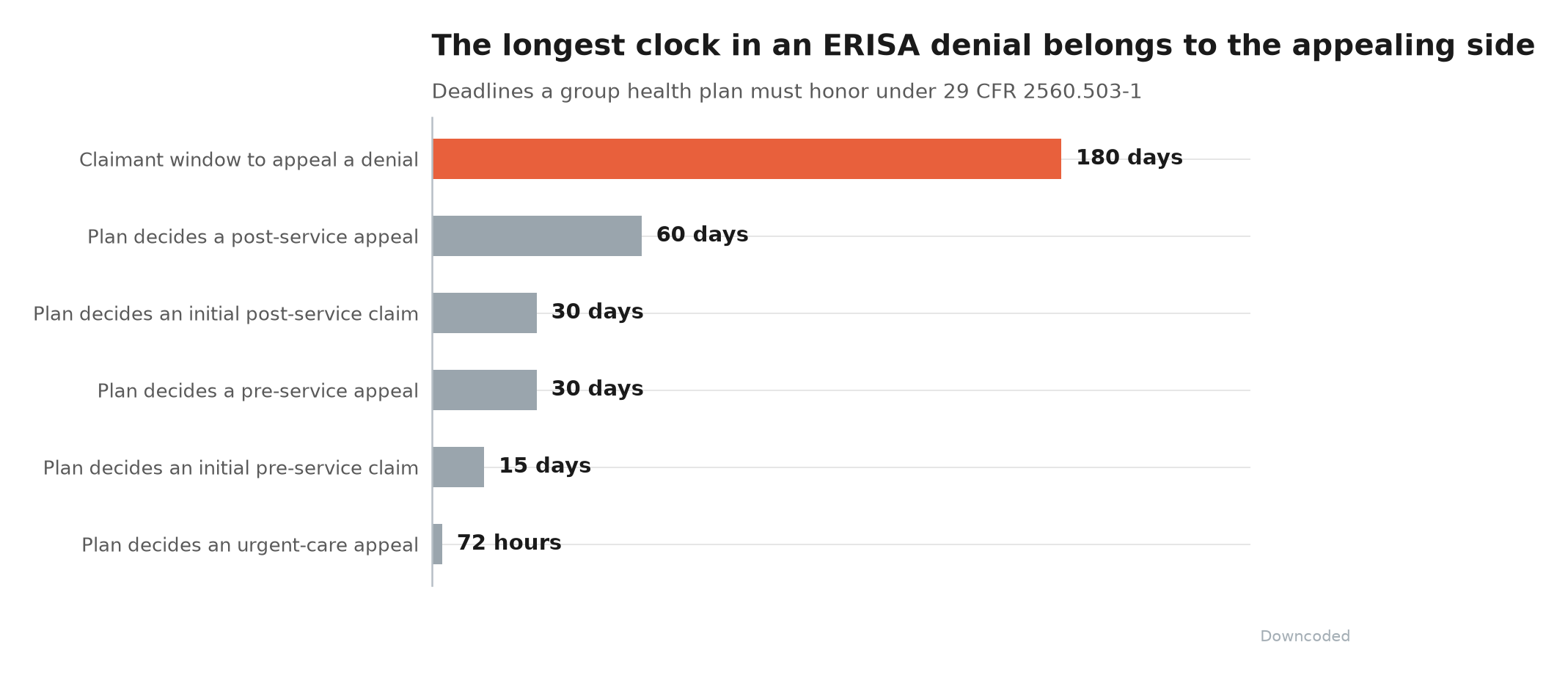
A group health plan has to give the claimant at least 180 days from the adverse benefit determination to appeal it.
Every clock running the other way is shorter. Post-service appeal, 60 days. Pre-service appeal, 30. Initial post-service claim, 30 days with one 15-day extension available.
Urgent care gets decided in 72 hours, both at the initial claim and on review.
So the denial sitting in your 240-day bucket is frequently still inside its appeal window, and the plan that has been quiet for five months has already blown through three of its own.
Two provisions do more work than the deadlines:
- Paragraph (b)(4) says a plan's procedures cannot preclude an authorized representative from pursuing the claim or the appeal on the claimant's behalf. That is the hook an assignment of benefits hangs on.
- Paragraph (h)(2)(iii) entitles the claimant, on request and free of charge, to reasonable access to and copies of every document, record, and piece of information relevant to the claim. The medical necessity criteria. The internal guideline. The reviewer's rationale.
And paragraph (l)(1) is the one that changes the posture of the conversation. Where a plan fails to establish or follow claims procedures consistent with the rule, the claimant is deemed to have exhausted the administrative remedies and can go straight to section 502(a).
A procedural failure by the plan is itself the exit from the plan's process.
Why This Is Federal Law for Most of Your Commercial Book
Here is the part that decides whether any of this is worth staffing.
KFF's 2025 employer survey puts 67% of covered workers in self-funded plans, including 80% at firms above 200 workers. Another 37% of covered workers at firms with 10 to 199 workers sit in level-funded arrangements, which are self-funded with stop-loss wrapped around them.
Your commercial inpatient book is mostly self-funded, which means the appeal is mostly governed by federal claims procedure rather than by your state's insurance code, and the state external review your team knows how to invoke is frequently not the remedy on the table. The card in the patient's hand says the same three letters either way.
That gap is what an attorney-staffed tier is selling into, and the argument it brings is contractual and procedural well before it is clinical.
Final Thoughts
We would rather see a vendor name ERISA on a launch page than promise a lift percentage, and Revecore named it. Whether the tier earns its fee on any given account is an open question, and the answer will be in recovery per case against contingency, which nobody has published yet.
The rule underneath it is free, and it has been on the books far longer than any platform selling against it.
Anyone can read 29 CFR 2560.503-1 this afternoon, count the days on the last twenty denials their team wrote off, and find out how many were closed early. Our guess is more than the team would like.
Thanks for reading.