 Downcoded
Who's Left to Run Medicare's Home Infusion Benefit?
CMS proposes to open the DME benefit to infusion pumps a patient cannot run alone, effective April 1, 2027, and the second of the three statutory criteria requires a qualified home infusion therapy supplier. There are 321 of them left in the country, the lowest count on any file CMS still publishes.
Congress built Medicare a home infusion therapy benefit in section 5012 of the 21st Century Cures Act, effective January 1, 2021.
Five years and eight months in, 321 suppliers in the entire country are enrolled to furnish it.
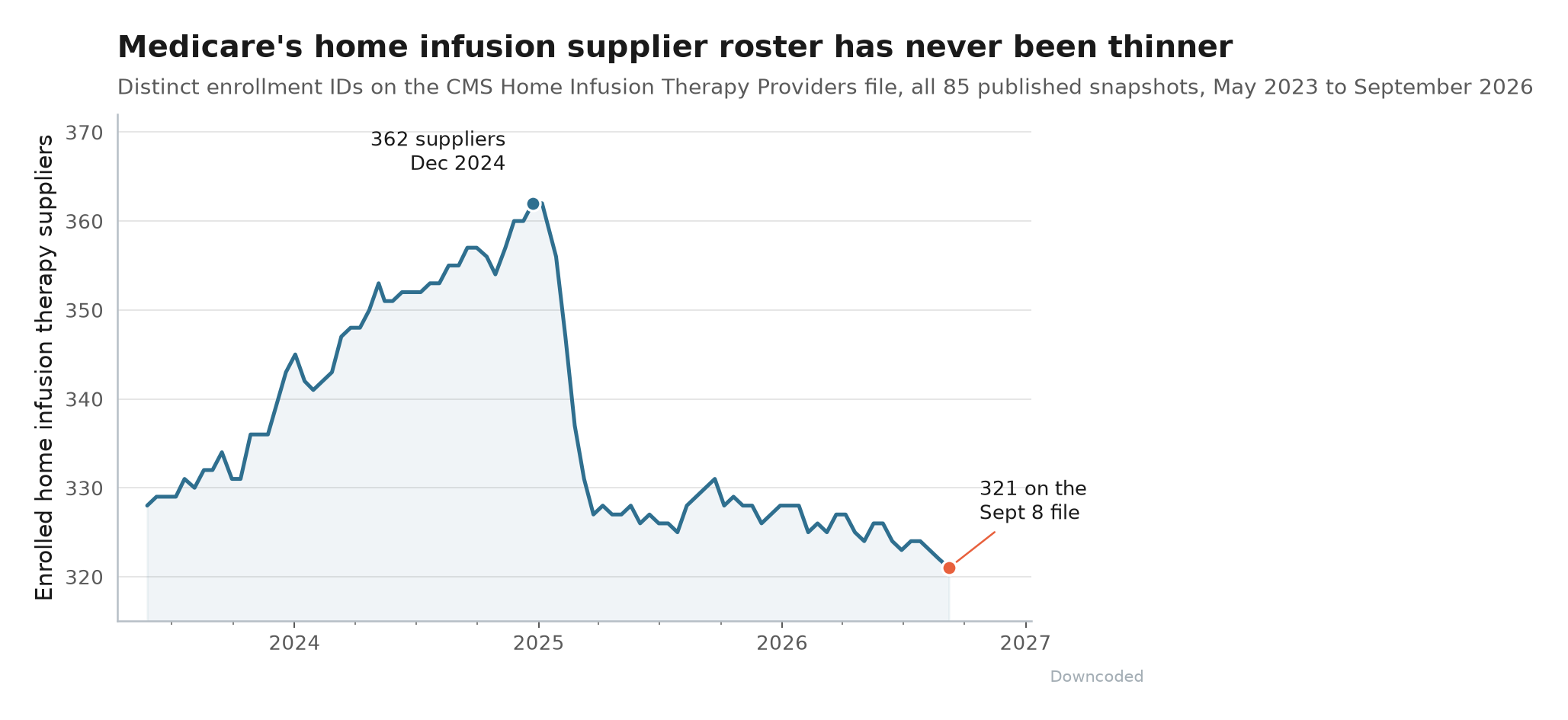
That is the count on the file CMS published on September 8, and it is the lowest reading in all 85 snapshots of that file the agency still serves, going back to May 2023 (chart below).
The roster peaked at 362 in December 2024. It is down 41 suppliers, 11.3%, and has not read above 331 on any file since March 2025.
Where the 41 went
Almost all of it happened in eleven weeks.
Across five consecutive snapshots between January 6 and March 24 of 2025, the count went 362, 356, 347, 337, 331, 327.
Thirty-seven enrollment IDs came off the file in that window. Two came on.
Twenty-four of the 37 carried a Coram name.
CVS Health said in October 2024 that it was exiting its core infusion services business and would close or sell 29 regional pharmacies. Its statement then: "Providers of infused medications have continued to face a challenging environment for their most highly specialized, complex services, and Coram has not been immune to these challenges."
The enrollment file caught up a few months later.
The twenty months since the peak have gone sideways and slightly down. 81 enrollment IDs have left over that stretch and 40 have arrived, so the benefit has replaced fewer than half of what it lost.
Why 321 is suddenly a coverage number
"What happens to a brand-new coverage pathway when the only firms allowed to walk it are a list that keeps getting shorter?"
Section 6222(a) of the Consolidated Appropriations Act, 2026 amended the DME definition so an external infusion pump and its drug can be covered even when the pump fails the "appropriate for use in the home" requirement at 42 CFR 414.202, which CMS reads to mean the beneficiary or a caregiver can run the equipment safely without a clinician there. CMS proposed the implementing language in CMS-1844-P (FR Doc 2026-13602, published July 6, 91 FR 41216). Comments closed August 31. The expansion applies to items furnished on or after April 1, 2027.
Three criteria have to be satisfied, and the second one is the supply constraint. Verbatim: "A qualified home infusion therapy supplier, as defined in section 1861(iii)(3)(D) of the Act, administers or supervises the administration of the drug or biological in a safe and effective manner in the patient's home."
A qualified home infusion therapy supplier is a specific enrollment under 42 CFR 486.505. It has to:
- furnish infusion therapy to patients with acute or chronic conditions requiring home infusion drugs,
- ensure safe and effective provision and administration on a 7-day-a-week, 24-hour-a-day basis, and
- hold accreditation from an organization the Secretary designates under section 1834(u)(5) of the Act.
It may subcontract with a pharmacy, physician, provider or supplier to meet those requirements. It still has to be on the list, and the list is what the chart counts.
What the new pathway is worth
CMS sized the expansion in the rule's own impact section, and the number is small.
"At this time, we expect that there is only one drug that did not previously meet the requirements for coverage through home infusion but does meet the requirements as modified by section 6222 of the Consolidated Appropriations Act, 2026, and will be used by a sufficient number of Medicare beneficiaries to warrant consideration: patisiran."
Claims data for 2025 show 69 beneficiaries received patisiran infusions, at roughly $313,000 a year each across about 17 infusions.
The cost-sharing math points the wrong way for the patient.
In the outpatient department the coinsurance on each infusion is capped at the Part A deductible, $1,736 in 2026, so a year costs the beneficiary about $29,500. At home nothing caps it, and the same year costs about $62,900.
CMS assumes roughly a third of the 69 switch anyway. Per switcher, Medicare books $31,000 of savings and the beneficiary books $34,000 the other way, which is where the agency's estimate of about $800 thousand a year in aggregate program savings comes from.
Twenty-three people, on our arithmetic.
Final Thoughts
Six jurisdictions have no home infusion supplier with a practice location inside them: the District of Columbia, North Dakota, New Mexico, South Dakota, Vermont and Wyoming. Every state is listed as somebody's service area, thinly in places: two suppliers name North Dakota, two name South Dakota, three each name Alaska, New Mexico, Vermont and Wyoming, against 38 for California. CMS's own read of the field, in the same rule, is that "almost all home infusion therapy suppliers are, similarly, small entities."
None of that makes the April expansion wrong. It does set what to expect from it.
Congress widened a door, and the number of firms standing on the other side has been falling for twenty months, mostly because one large operator left the complex end of the business and nobody took its place.
If you route patients into home infusion at discharge, the roster is public, it is short, and it is worth re-pulling before the plan of care goes out the door.
Thanks for reading.