 Downcoded
Why We Price the Paper Trail
Downcoded machine-reads the documents payers already publish, diffs every one against its prior version, and models what each change costs by specialty. An introduction to the desk and the record it keeps.
If you own a revenue number, July gave you homework.
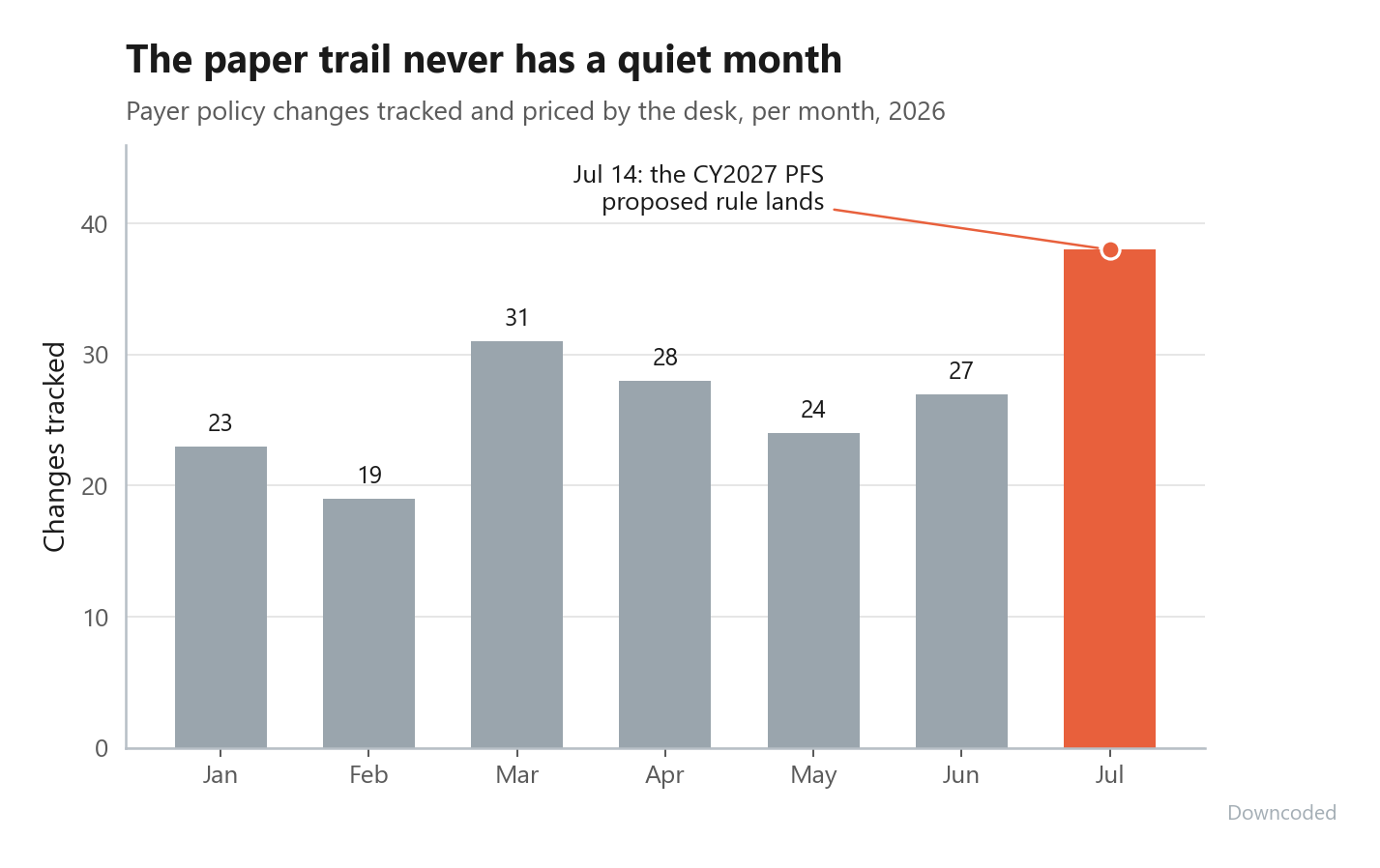
On July 14, CMS released the CY2027 Physician Fee Schedule proposed rule. The proposed conversion factor for most practices is $32.84, down $0.56 from this year, a 1.68% cut.
Qualifying APM participants do slightly better at $33.17, down 1.19%. The updates inside the rule are positive on paper (+0.75% or +0.25%, plus an estimated +0.53% work-RVU adjustment), and they lose anyway, because the 2.5% increase Congress passed for 2026 expires at year end.
Comments close September 14. That's the homework.
The trade press covered the release the same day, and covered it fine: the percentages, the quotes, the specialty societies' disappointment. What nobody handed you is the number that matters in your building: what $0.56 per RVU does to your specialty mix, your volumes, your payer split.
That number is the entire reason this publication exists.
What we read so you don't
Payers publish far more than most of the industry ever reads:
- The Federal Register docket, where CMS rulemaking lands before the press releases do.
- CMS transmittals and MLN articles, where operational policy actually changes.
- The Medicare Coverage Database, where LCD and article revisions across all twelve MAC jurisdictions surface in download files that refresh every Thursday.
- The monthly commercial bulletins: UnitedHealthcare's Network Bulletin, Aetna's OfficeLink Updates, Cigna's coverage policy updates. All public, none read end to end.
- The quarterly fee-schedule and RVU files that quietly reprice thousands of codes.
Downcoded runs automated pipelines over all of it. Every document gets diffed against its prior version, every diff gets mapped to the codes it touches, and every touched code family gets a modeled dollar impact by specialty.
Then we write up the changes that move real money.
The gap we sit in
Change detection exists today, at two price points that don't work for a practice.
The enterprise policy platforms do it well and sell it behind a sales call, priced for pharmaceutical market-access teams and health-system contract shops. The paid Medicare letters interpret policy carefully, in prose, and never price a change for a given practice.
And the free trade press tells you a rule dropped. Which you already knew.
A revenue-cycle department should be able to expense the answer to "what does this cost us" without a procurement cycle. So that's the price point.
The Downcode Record
The desk keeps a running record: every payer policy change we track, each with its modeled dollar impact. It's the publication's namesake and its spine, and July is already its heaviest month of the year (chart below).
The record compounds. Every entry makes it a little more useful and a little harder to reconstruct from scratch, and it's built to be cited: in your own board deck, your own budget memo, your own payer negotiation.
What we can't see, said plainly
The denial-outcomes data everyone wants, the payer-by-payer rates of what actually got denied and what got overturned, lives in proprietary datasets. Kodiak Solutions builds its benchmarks from 2,300+ hospitals on its own platform, and that data stays with its clients.
We don't have it, and we won't pretend otherwise.
We also can't see your contracts, your negotiated rates, or your payer mix. The model prices the rule as written, on public fee-schedule data, and you apply the local knowledge.
What the public record supports, though, is bigger than the industry gives it credit for. The paper trail is complete, versioned, and free.
It just needs a reader that never gets bored.
Final Thoughts
Kodiak's own numbers say provider organizations lost $48 billion to final denials and uncollected patient balances in 2025, up roughly 25% in a year. Behind a meaningful share of those denials sits a policy document that changed, publicly, weeks or months earlier, and nobody caught it in time to re-code, re-document, or re-negotiate.
Catching it is a reading problem. Reading problems automate.
We'll get things wrong occasionally, and when we do, the fix is a dated correction in the post, never a quiet rewrite. A percentage on its own is trivia, and we won't publish trivia.
If a policy changed and it touches your codes, the version of that news worth your time arrives priced.
Thanks for reading.