Your Patch Monitor Just Inherited an Event Recorder's Rules
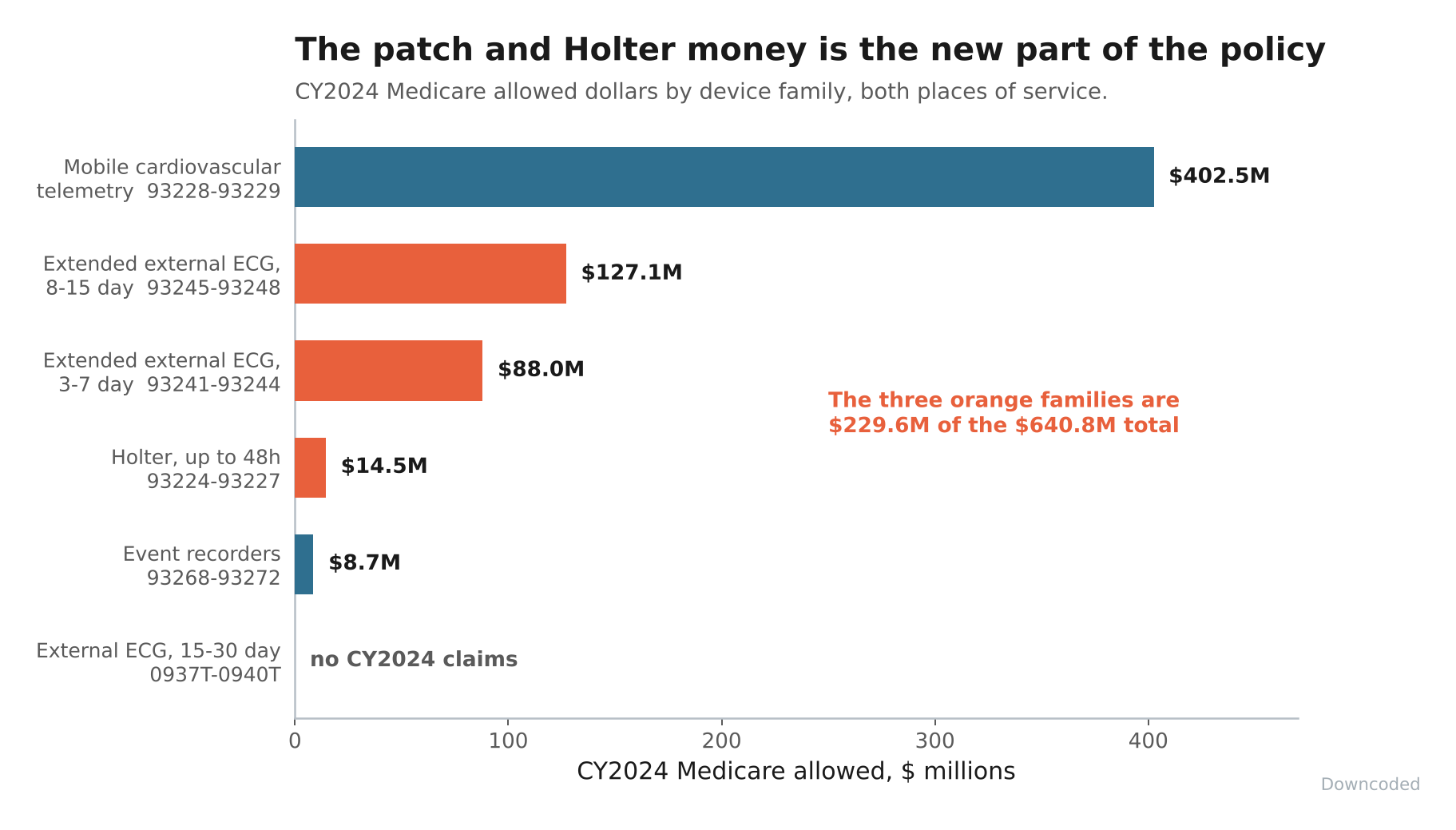
CGS and Palmetto retired an eleven-year-old Cardiac Event Detection LCD on June 27 and replaced it with a policy whose own device table names Holter and both extended-wear patch tiers. The payable diagnosis list went from 60 codes to 238, the fourteen acute-MI codes called out as non-covered are gone, and the exclusive-use and overlapping-billing denials came across intact onto $229.6 million a year of patch volume.
L40244 runs 12 systematic reviews, 9 randomized trials, and a GRADE appraisal of a Medicare cohort of 287,789 beneficiaries before it decides that patch monitors detect atrial fibrillation.
The four sentences in it that will actually generate denials were written in 2015, and none of them is about the patient.
"What happens to a monitoring program when the rules written for a loop recorder get pointed at a fifteen-day patch?"
Three MACs have now answered that.
CGS and Palmetto GBA retired their Cardiac Event Detection LCDs on June 27, 2026 and replaced them the next day with "Temporary Nontherapeutic Ambulatory Cardiac Monitoring Devices." Noridian stood its version up a week earlier, on June 21, with no predecessor policy to retire.
So if you bill ambulatory monitoring in Kentucky, Ohio, the seven Palmetto states, or anywhere in Noridian JE and JF, you have been adjudicating under a different rulebook since the summer. Four months of claims, already paid.
What the Scope Sentence Used to Say
The old CGS policy, L33952, had been in force since October 1, 2015. Its scope was narrow and it said so in one sentence: the services in the LCD "require a 24-hour attended monitoring station" and the devices must be "patient/event activated," must "provide either presymptom memory loop or post-symptom recording," and must be non-insertable.
Holter was not in that description. The old policy named it as something to compare against, telling you the service "should be coordinated with results from standard EKGs, Holter monitor tests, and stress tests."
Continuous extended-wear patches were not in it either. A device that records every beat for fifteen days is not patient-activated and has no memory loop.
The replacement opens with a table. A60292, the billing and coding article CGS published on October 23, lists six device types and the CPT family that goes with each:
- External ECG (Holter), up to 48 hours: 93224-93227
- Extended external ECG, more than 48 hours to 7 days: 93241-93244
- Extended external ECG, more than 7 days to 15 days: 93245-93248
- External patient-activated event recording, up to 30 days: 93268-93272
- Mobile cardiovascular telemetry, up to 30 days: 93228-93229
- External ECG, more than 15 days to 30 days: 0937T-0940T
Two of those six families are what the old scope sentence described, and they carry $411.2 million of CY2024 Medicare allowed charges.
The three it did not describe carry $229.6 million (chart below). The sixth, the Category III tier, paid nothing at all in CY2024.

The rest of this brief is for subscribers.
The impact tables, the code-level detail, and the rest of the analysis sit past this line.
$50 a month, or $500 a year.
Already a subscriber? Sign in