 Downcoded
Your Remit Can Now Offer You a Peer-to-Peer
CMS refreshed the free software that reads your 835 on October 5, and the code list behind it had picked up 18 new remark codes on July 1. Nine are dental imaging. One tells you a claim is already being reprocessed and to stop resubmitting it, and one tells you a peer-to-peer is available. The claim adjustment reason code list, meanwhile, has not moved since November 2025.
Since July 1 there has been a standard, payer-neutral, machine-readable way to say this on an 835: "Alert: You may contact us for a peer-to-peer review."
It is N939. It is one of 18 new remittance advice remark codes ASC X12 published that day, and Medicare's contractors had to have all 18 loaded by October 1.
So did the software CMS gives you to read the file.
The two programs nobody sends you an invoice for
If you take Medicare Part B or DMEPOS claims, the viewer is Medicare Remit Easy Print. CMS's own page describes it in one line as software "to view and print the" HIPAA 835 "for professional providers and suppliers," and says it is "available for free to Medicare providers and suppliers."
Part A institutional providers get PC Print, which the agency's remittance fact sheet calls "a Personal Computer (PC)-based ANSI (American National Standards Institute) ASC X12 835 translator interactive program."
The free part is a contract term. That same fact sheet tells providers "Your A/B MACs is required to make PC Print software available to providers for downloading at no charge."
And then it concedes the one price in the whole arrangement: the MAC "may charge up to $25.00 per mailing to recoup cost if the software is sent to provider on a CD/DVD."
Neither program is new and neither is marketed. MREP ships from CMS as Version 4.6.
CGS, the Jurisdiction 15 MAC, lists PC Print v9.4 as a free download on an EDI software page stamped Published: 10.05.2026, which is the exact implementation date of the change request that drove this cycle.
What a code update actually is
The paperwork is Transmittal 13791, change request 14492, issued May 27 and effective October 1, implementation October 5.
It is a recurring update notification against Pub. 100-04, chapter 22, sections 40.5, 60.2 and 60.3, and it carries zero manual changes and zero attachments.
What it carries instead is a schedule. CMS tells contractors to run code updates "three times per year (approximately March 1, July 1, and November 1)," and this CR points them at the lists "published July 1, 2026, by the official ASC X12."
Note the dates. The change request was written on May 27 and binds every MAC to a list that did not publish until July 1.
Two of the business requirements name the software directly. Requirement 14492.7 assigns MREP to the ViPS Medicare System, and 14492.8 assigns PC Print to the Fiscal Intermediary Shared System.
Both carry the same sentence: update the software by October 1, based on the lists published on or about July 1.
Eighteen new sentences, nine of them about x-rays
The July cycle was the largest batch of new remark codes since March 2022, against a list where the median cycle adds four and five cycles since 2018 added nothing at all (chart below).
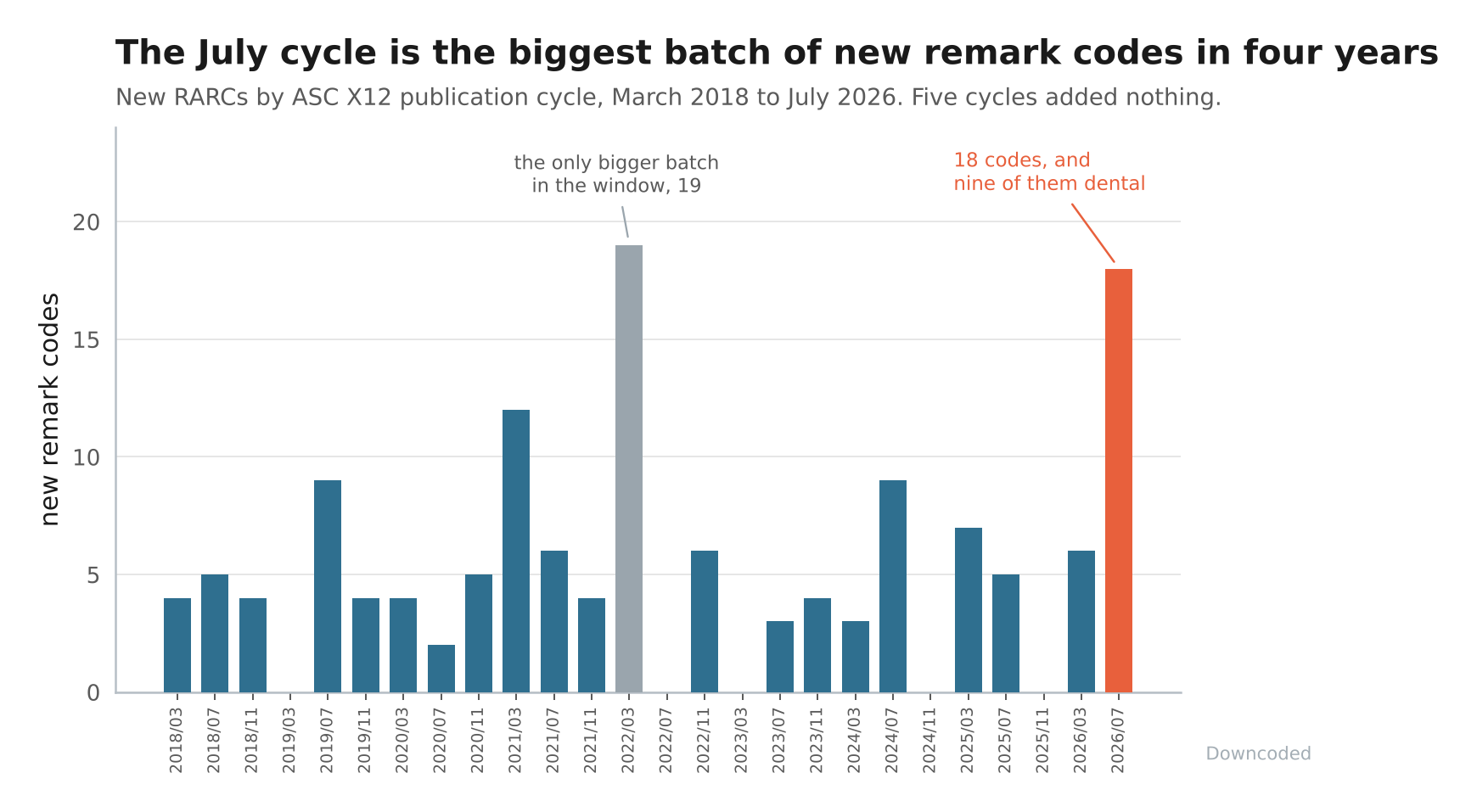
The 18 split three ways:
- Nine are dental documentation, N927 through N934 plus N940: missing or invalid x-ray, bitewing or periapical x-ray, full mouth x-ray, pre- and post-operative versions of each, photos, and the quadrant identifier.
- Four are Medicare Advantage encounter determinations, N923 through N926, which let an MAO say not denied, pending, denied, or "Partially Denied" on a service at the time the encounter record was submitted.
- Five are the ones a general revenue cycle will actually see: N935 flags that a patient is no longer a Qualified Medicare Beneficiary, N936 marks a line as the secondary or tertiary procedure under MPPR, N937 says "The service line denial threshold was exceeded," N938 says "Alert: Do not resubmit. This claim will be automatically reprocessed," and N939 offers the peer-to-peer.
N938 and N939 are the two worth routing. One of them retires a follow-up task.
The other turns a clinical appeal into something your work queue can trigger on, because it arrives as a code in the 835 rather than as a sentence in a letter somebody has to open.
The list that stayed still
Remark codes are only half of what a remittance says. The other half is the claim adjustment reason code, and the CARC list has not moved since November 1, 2025.
That is two publication cycles with no new codes, no modifications and no deactivations.
The current list runs 407 entries, 297 of them active and 110 retired, and the newest one is 308, "Payment is adjusted due to contracted funding agreement between the payer and provider."
One request is sitting in the queue. Number 483, filed June 26, asks for a new code described in full as "Potentially Fraudulent code request."
It was still pending at the last status review on August 1.
Final Thoughts
A free 835 reader on a three-times-a-year release schedule is the least interesting thing in your stack, and that is rather the point of it. The code lists are public, the maintenance calendar is public, the change requests that bind every MAC to the calendar are public, and two shared system maintainers are under standing instruction to keep the viewer current with all of it.
Most of what that machinery produced this quarter is dental imaging detail. Some of it is a payer telling you, in a field your software can read, that it would take a call from your physician.
Thanks for reading.