Almost Half That Biosimilar Payment Is the Brand's Price
CMS posted the final October Part B payment limit file on September 17. Thirty-six biosimilar codes carry an add-on computed on the reference product's ASP, not their own, and on Q5116 it is 46.1% of the whole payment. We priced all thirty-six, and put a date on the cliff twelve of them hit.
On September 17 CMS replaced the preliminary October Part B payment limit file with the final one. Same URL pattern, no transmittal, no MLN item, a 301 where the preliminary used to be.
It prices every separately payable Part B drug from October 1 through December 31. And on 36 of its 918 rows, a piece of what Medicare pays you has nothing to do with the drug on the claim.
"How much of a biosimilar's payment limit is actually the brand's price?"
On one code, 46.1%.
The Arithmetic the File Does Not Print
Part B pays a biosimilar its own ASP plus a percentage of the reference biological's ASP. Section 11403 of the Inflation Reduction Act pushed that percentage from 6% to 8% for qualifying biosimilars, meaning any biosimilar whose ASP is "not more than the ASP of the reference biological," in CMS's words.
The file flags those rows in the Notes column and stops there. It never prints the add-on as a number.
You can recover it in one line. A reference product's published limit is its ASP plus 6%, so its ASP is that limit over 1.06, and the add-on riding on every flagged biosimilar is 0.08 / 1.06 x reference limit.
Run it across all 36 and the add-on turns out to carry between 7.9% and 46.1% of the published payment (chart below).
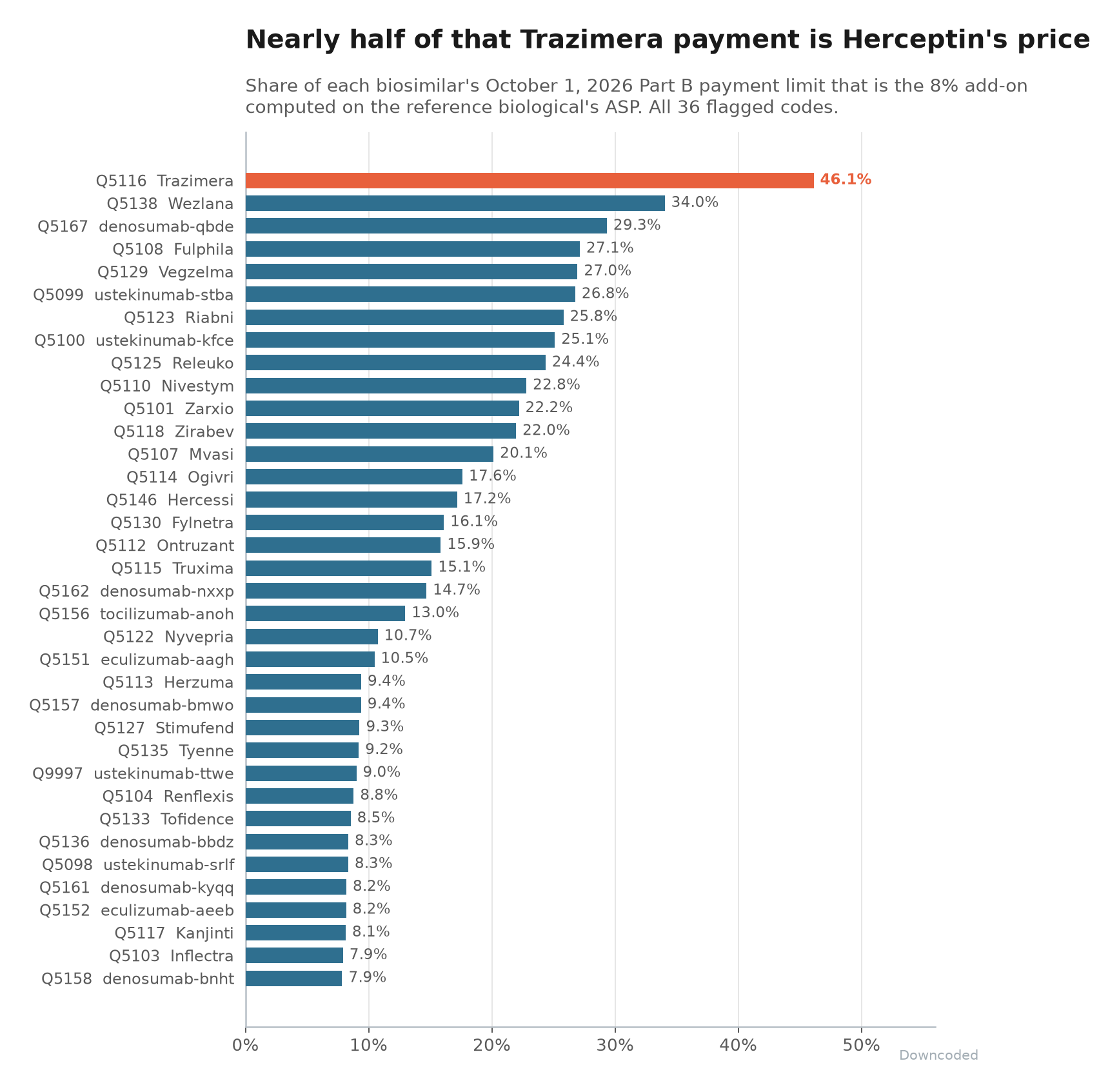
Q5116 is Trazimera, trastuzumab-qyyp. Medicare pays $11.271 per 10 mg.
Herceptin's own ASP contributes $5.1978 of that.

The rest of this brief is for subscribers.
The impact tables, the code-level detail, and the rest of the analysis sit past this line.
$50 a month, or $500 a year.
Already a subscriber? Sign in