 Downcoded
Why Medicare Scored 22,496 Clinicians on Nothing and Paid Them in Full
CMS published every 2024 MIPS final score. 22,496 clinicians were scored on zero performance categories and landed on exactly 75.00 for a neutral adjustment, while 4,771 landed on a flat zero and are taking negative 9 percent on every Part B claim they bill this year. 17.62 percent of the podiatrists in the file are in that second group.
CMS put the 2024 MIPS final scores in the Provider Data Catalog and gave them one sentence in Thursday's MLN Connects. The file is 520,011 score records, one per clinician-group pair, covering 461,358 unique NPIs, and the last column in it already decided what each of those clinicians gets paid this year.
Plot it and there is no bell curve. There is a wall at 75 and one spike stuck to the floor at zero (chart below).
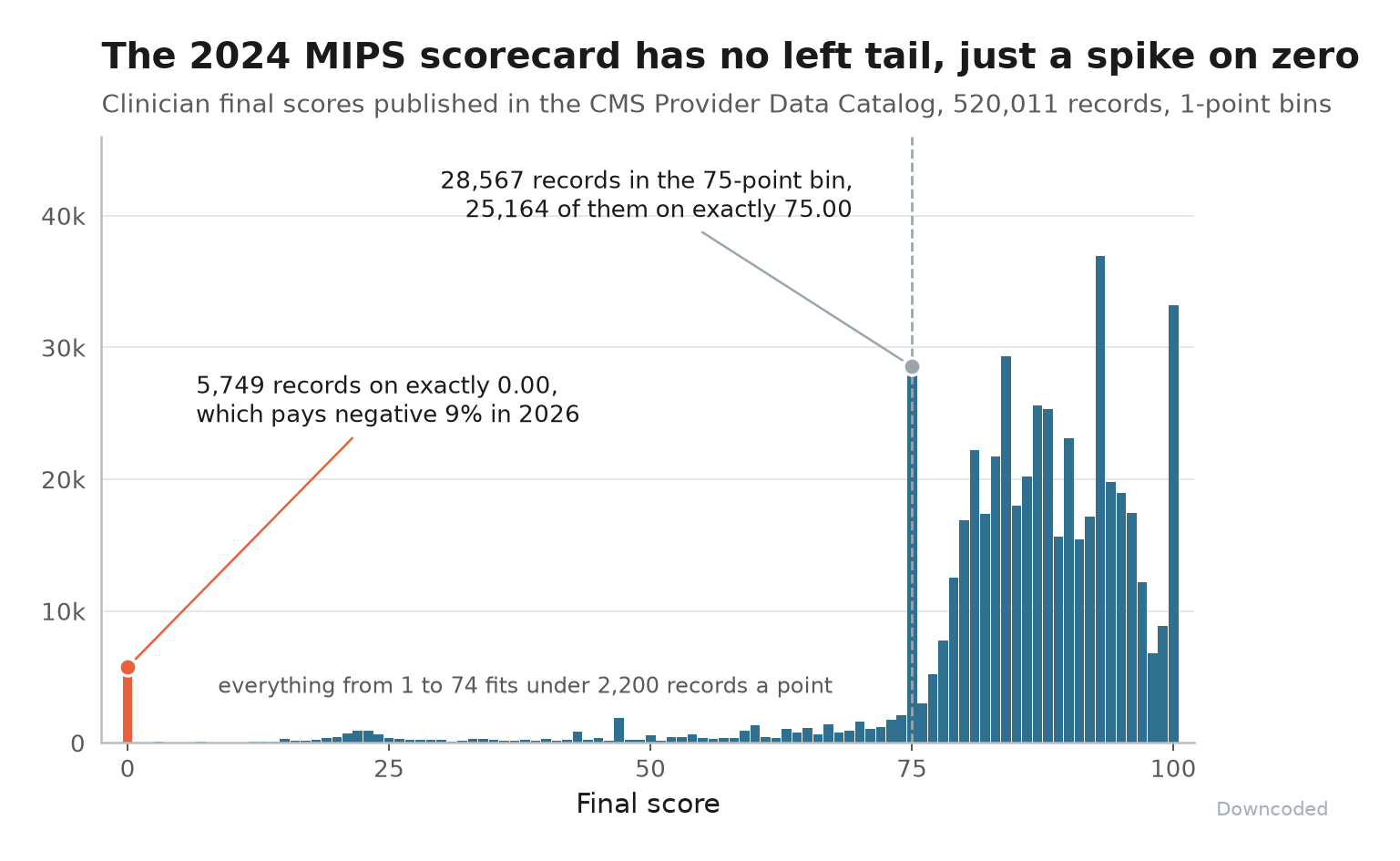
The median final score is 87.65. Only 7.79% of records came in under the performance threshold, and every one-point bin from 1 through 74 holds fewer than 2,200 of them.
Then 5,749 records sit on exactly 0.00.
Zero pays the floor. The CMS payment adjustment table for the 2026 payment year puts everything from 0.00 to 18.75 points at a flat negative 9%, applied claim by claim to covered professional services furnished in 2026.
The Rule That Decides Which Nothing You Got
Now the other pile. 25,164 records came in on exactly 75.00, and 25,147 of those have all four performance category columns blank.
The data dictionary is explicit about what blank means: the category "was weighted to 0 such that it did not contribute to their MIPS final score." CMS scored those clinicians on nothing at all. And 42 CFR 414.1380(c) says what happens next:
"If a MIPS eligible clinician is scored on fewer than 2 performance categories, he or she receives a final score equal to the performance threshold."
The threshold is 75.00. Neutral adjustment, full payment, no data.
Take each NPI's highest final score, which is the hierarchy CMS itself applies when a TIN/NPI carries more than one, and 22,496 clinicians finish 2024 on a reweighted 75.00 with nothing better anywhere in the file.
What Put the Other Group on Zero
Here's the catch: 5,691 of the 5,749 zero records were scored on two or more categories, so the threshold rule never reached them.
And 5,425 of those carry a cost category score, the one category nobody submits. CMS calculates cost off claims that were already billed.
The most common single pattern in the zero pile, 4,530 records, reads quality 0, promoting interoperability blank, improvement activities 0, cost 0.
What splits the two groups is whether CMS could find a second category to score. Two clinicians can put the identical amount of data into the program, which is none, and the one whose volume cleared a cost measure's case minimum gets scored on three categories and eats the full 9%.
Who Is Standing in the Zero Pile
Join the 4,771 NPIs whose best 2024 score is a flat zero to the CY2024 Medicare physician utilization file and 4,551 of them match, carrying $586,810,859 of non-drug Medicare payments. Nine percent of that is $52.8 million on 2024 volume.
The concentration is the part worth forwarding. Podiatry holds 1,308 of those 4,551 NPIs, which is 17.62% of all the podiatrists in the score file, against 1.09% across every specialty.
Otolaryngology is next at 6.35%, dermatology at 6.29%, optometry at 5.96%.
The reweighted group runs the other direction: 22,315 matched NPIs, $4.59 billion of non-drug payments, and roughly $413 million of downside that one sentence of regulation waived.
Final Thoughts
We ran the other end of this program on September 7, off the CY2027 proposed rule's impact tables, where a perfect 100 buys 1.34% in the 2029 payment year. That was CMS modeling a future year. This is CMS reporting a finished one, and what it reports is a program whose teeth are all on the downside and all bunched into a few specialties where enough practices still treat the whole thing as optional.
Your 2026 remittance already knows which pile you are in. Pull the file, find your NPIs, and read the four category columns before you decide whether last year's zero was a submission that failed or a cost measure you never knew you had been attributed.
Thanks for reading.