 Downcoded
California Kept the Notes on 42,749 Denied Appeals
The Department of Managed Health Care has published every independent medical review it has decided since 2001, with the physician reviewer's full written reasoning attached to each one. We pulled all 42,749 rows. The plan lost 72.3% of them last year, 81.7% of the pharmacy cases, and 91.5% of the weight-control drug cases.
Every row in the file carries the reviewer's written reasoning, in full.
Here is one from last year, compressed. The patient asked for Wegovy.
The reviewer worked through the endocrinology guidance on pharmacotherapy above a BMI of 30, noted this patient's pre-surgical BMI ran above 40, and found the drug medically necessary. The plan's denial was overturned.
There are 42,749 of those, and the state published all of them.
California's Department of Managed Health Care runs the independent medical review a Knox-Keene enrollee gets after the plan says no, and every determination the director has adopted since January 1, 2001 sits on the state open data portal as a single CSV. No key, no registration, nothing to click through.
We pulled the whole file this run. 85 megabytes, last refreshed June 1, and across every year in it the health plan lost 52.5% of the cases.
"Which denials actually survive somebody else reading the chart?"
What a Row Actually Is
Fourteen columns, one per decision, de-identified down to an age band and a gender.
The structured half is what you would expect and better than you would expect: report year, a diagnosis category and sub-category (48 and 532 distinct values), a treatment category and sub-category (58 and 498), whether the case ran as Standard or Expedited, whether the dispute was medical necessity or experimental and investigational, days to review, days to adopt, and the determination.
The other half is the Findings text, populated on all 42,749 rows, averaging 1,811 characters. That is 77.5 million characters of board-certified specialists explaining, case by case, why a specific denial did or did not hold up.
The clocks in it are real clocks. On 2024 and 2025 cases the median expedited review closes in 4 days and the median standard review in 20, with medians of 18 and 48 days to the director adopting the result.
The Plan Loses, and It Keeps Losing More
In 2014 the plan won these. The overturn rate that year was 38.3% on 1,433 reviews.
The drift since has been one way (chart below). The rate first crossed half in 2015, slipped back under for 2017 and 2018, settled into the low sixties through the pandemic years, and hit 72.3% in 2025 on 2,730 reviews.
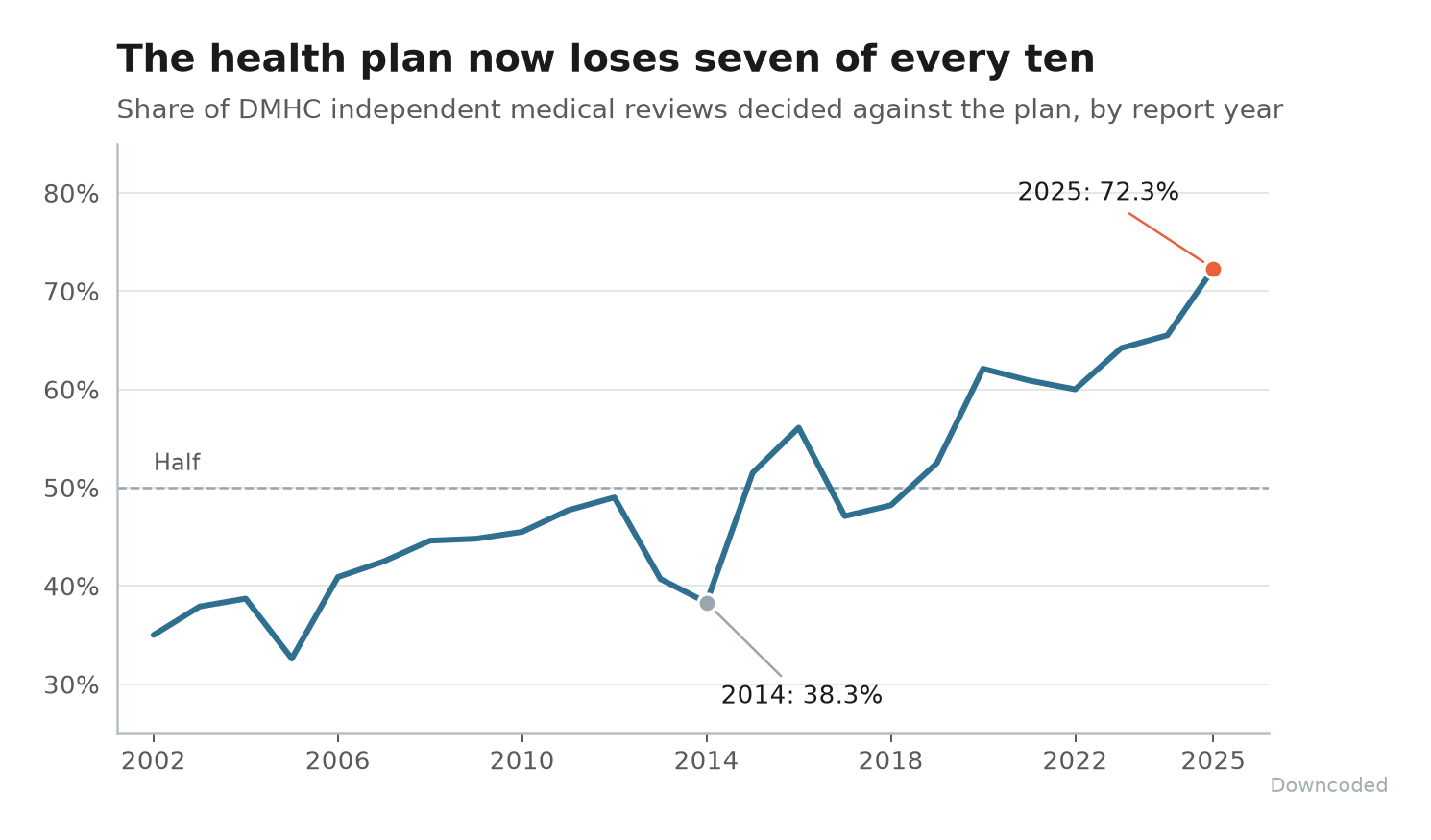
Worth saying once, because it is the honest reading: this is a measure of the contested pile. The cases that reach an IMR are the ones a patient cared enough about to push through a plan grievance first, which selects hard for the denials that were shaky to begin with.
That pile has gotten steadily worse for the plans anyway.
The split by dispute type tells you where. Medical necessity cases run 75.1% overturned in 2025, against 53.7% for experimental and investigational cases, where the plan is arguing the evidence base rather than this patient's chart.
Where the Denial Comes Apart
Sort 2025 by what was actually denied and the number stops being one number (chart below).
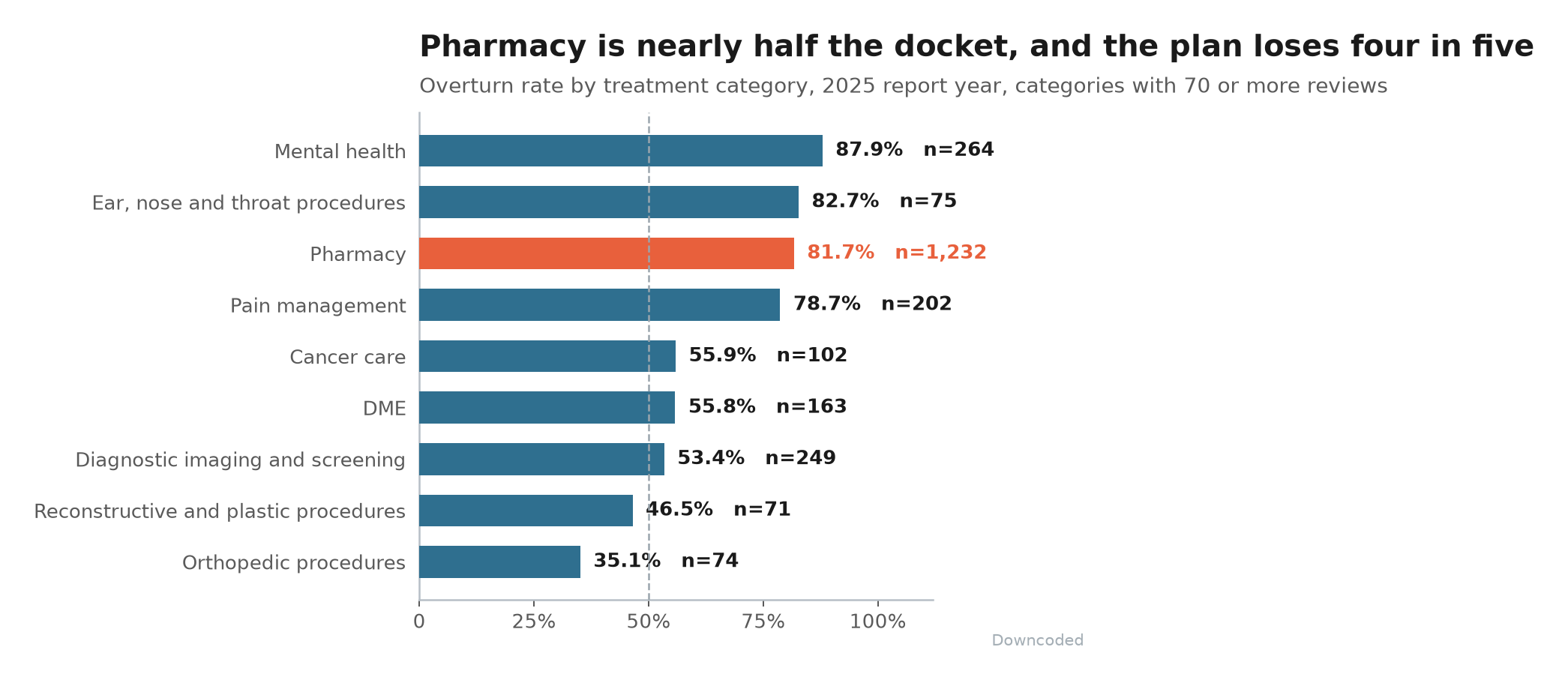
Pharmacy is 1,232 of the year's 2,730 reviews, nearly half the docket, and 81.7% of it comes back overturned. Mental health runs 87.9%.
At the other end, orthopedic procedures hold at 35.1% and reconstructive and plastic at 46.5%, the only two categories the plan wins more often than it loses.
Go one level down into pharmacy and the surge is a single sub-category:
- Weight Control was 31 reviews in 2022. It was 258 in 2023, 612 in 2024, and 520 in 2025.
- Those 520 are 91.5% overturned, and they are 42% of all pharmacy reviews for the year.
- Zepbound is named in 338 of the 2025 pharmacy narratives, 315 of them overturned. Wegovy is named in 208, with 184 overturned.
Take every weight-control row out and 2025 still lands at 67.8%, against 52.4% on the same basis in 2019. So the GLP-1 wave is the loudest part of the trend and not the whole of it.
Five Working Days
The part that makes this a revenue-cycle file rather than a policy curiosity is what happens after the director signs.
Under Health and Safety Code §1374.34, the plan "shall promptly implement the decision." For services already rendered it reimburses the provider or the enrollee within five working days. For services not yet rendered it authorizes them within the same five. A plan may not engage in conduct that prolongs the review, and failing to implement carries an administrative penalty of not less than $10,000 for each day it goes unimplemented.
The review clocks are statutory too: 30 days for the independent review organization on a standard case, three days on an expedited one, and the enrollee pays "no application or processing fees of any kind."
So each overturned row in that CSV is a payment obligation with a five-day fuse, and there were 1,975 of them last year.
Final Thoughts
Most of what a payer knows about how its denials perform on appeal, it knows privately. California decided twenty-five years ago to keep the receipts in public, at decision-level granularity, with the reviewer's reasoning attached, and then kept doing it long enough for the series to have a shape.
The obvious caveats apply. One state, Knox-Keene plans only, and a docket selected by which patients had the stamina to appeal.
None of that makes the 77.5 million characters less useful the next time you are drafting an appeal on a denied biologic and want to know what argument moved an actual reviewer on an actual chart.
Thanks for reading.