Eleven Years On, Modifier 59 Is Still Gaining
CMS built four modifiers in 2014 to retire the most abused one in Part B. The CY2025 claims summary says providers went the other way, and that on the same code the swap moves your denial rate by as much as forty points.
In August 2014 CMS wrote down, in a transmittal, what modifier 59 was costing it. A projected $2.4 billion in physician fee schedule payments rode on lines carrying 59 in 2013, with a $320 million projected error rate, and another $11 billion billed on 59 lines in the facility world with $450 million of error behind it.
The agency's own description of the modifier, verbatim: "it is the most widely used modifier. It is also associated with considerable abuse and high levels of manual audit activity, leading to reviews, appeals and even civil fraud and abuse cases."
So CR 8863 created four narrower modifiers, XE, XP, XS and XU, effective January 1, 2015, and told the industry what it wanted: "the rapid migration of providers to the more selective modifiers is encouraged."
The CY2025 Physician/Supplier Procedure Summary posted last month. Migration went backwards.
Nobody Switched
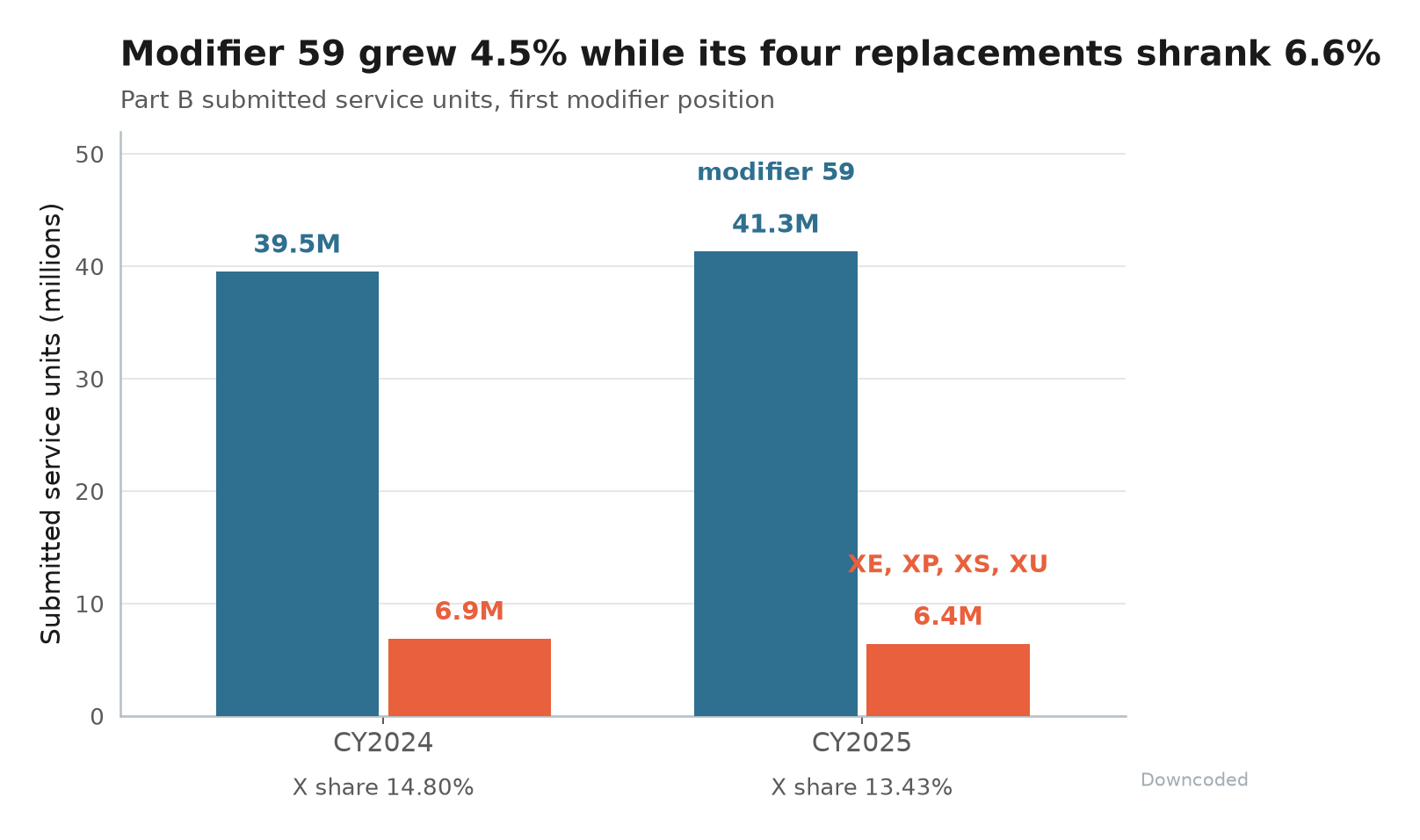
Across all of Part B in CY2025, modifier 59 sits in the first modifier position on lines carrying 41,298,482 submitted service units. All four X modifiers together carry 6,406,922.7.
That is not a slow start. It is a reversal.
Against CY2024, modifier 59 grew 4.5% while the X set shrank 6.6%, so the X share of the combined 59-plus-X universe fell from 14.80% to 13.43% in a single year (chart below).
Two of the four are effectively dormant. XE carries 284,197.6 units nationally and XP carries 38,391, which is not a modifier so much as a rounding error on a code set that moved 7.88 billion service units last year. XU does most of the work in the X set at 4,504,641.1 units, and XS most of the rest at 1,579,693.
Worth knowing where 59's volume actually lives before you assume this is a physician-behavior story.
Clinical laboratory (specialty 69) carries 25.14% of all modifier-59 units by itself, up from 24.35% the year before, and dermatology is next at 14.62%. The modifier CMS built to stop surgical unbundling is, in practice, largely a lab and skin-procedure instrument.

The rest of this brief is for subscribers.
The impact tables, the code-level detail, and the rest of the analysis sit past this line.
$50 a month, or $500 a year.
Already a subscriber? Sign in