 Downcoded
Every Part D Plan Wants a Prior Auth on Negotiated Semaglutide
The first CMS formulary file carrying contract year 2027 landed on October 15, and it is the first look at how Part D plans will handle the fifteen drugs whose negotiated price starts January 1. Semaglutide goes from presentations listed on as few as 16 of 328 formularies to all 286, and all 5,495 plans put a prior authorization in front of every strength of it.
If you work patient access anywhere near a semaglutide prescription, the file that tells you what January looks like has been sitting on a CMS page since October 15.
It is the Monthly Prescription Drug Plan Formulary and Pharmacy Network Information release, and this is the first edition carrying contract year 2027 formularies. Which makes it the first public look at how Part D plans intend to handle the fifteen drugs whose negotiated maximum fair price switches on January 1.
For semaglutide the answer is unanimous. All 5,495 Part D and Medicare Advantage drug plans in the file require a prior authorization on all fifteen of its listed presentations: the Ozempic pens, the Ozempic oral tablets, the Wegovy auto-injectors, the Wegovy orals.
No exceptions, at any strength, on any plan.
What the Negotiation Actually Moved
CMS negotiated semaglutide down to $274 for a 30-day supply against a $959 2024 list price, a 71% cut on the drug that ran $15.2 billion through Part D in 2024 and reached 2,282,000 enrollees. That is the largest line in the second negotiation cycle by both measures.
What the statute buys with that price is shelf space. Section 1860D-4(b)(3)(I) of the Act requires every Part D formulary to carry a selected drug once its MFP is in effect, and CMS reads it to reach "all such dosage forms and strengths of the selected drug that constitute a covered Part D drug and for which the MFP is in effect."
The file shows that requirement biting hard.
In the contract year 2026 edition, Wegovy's four oral strengths appeared on 16 of 328 formularies, reaching 49 plans in the entire country. The five Wegovy auto-injectors reached 175.
In the 2027 file every one of them is on all 286 formularies, which is all 5,495 plans.
Wegovy orals went from 49 plans to 5,495. Call it a 112-fold jump in shelf space.
The prior authorization did not move at all. On the plans that carried semaglutide in 2026, it was already 100%, and it is 100% now.
"What does a negotiated price change at the pharmacy counter?"
Fifteen Drugs, Fifteen Different Answers
Run the same count across the rest of the cycle and the spread is the whole story (chart below).
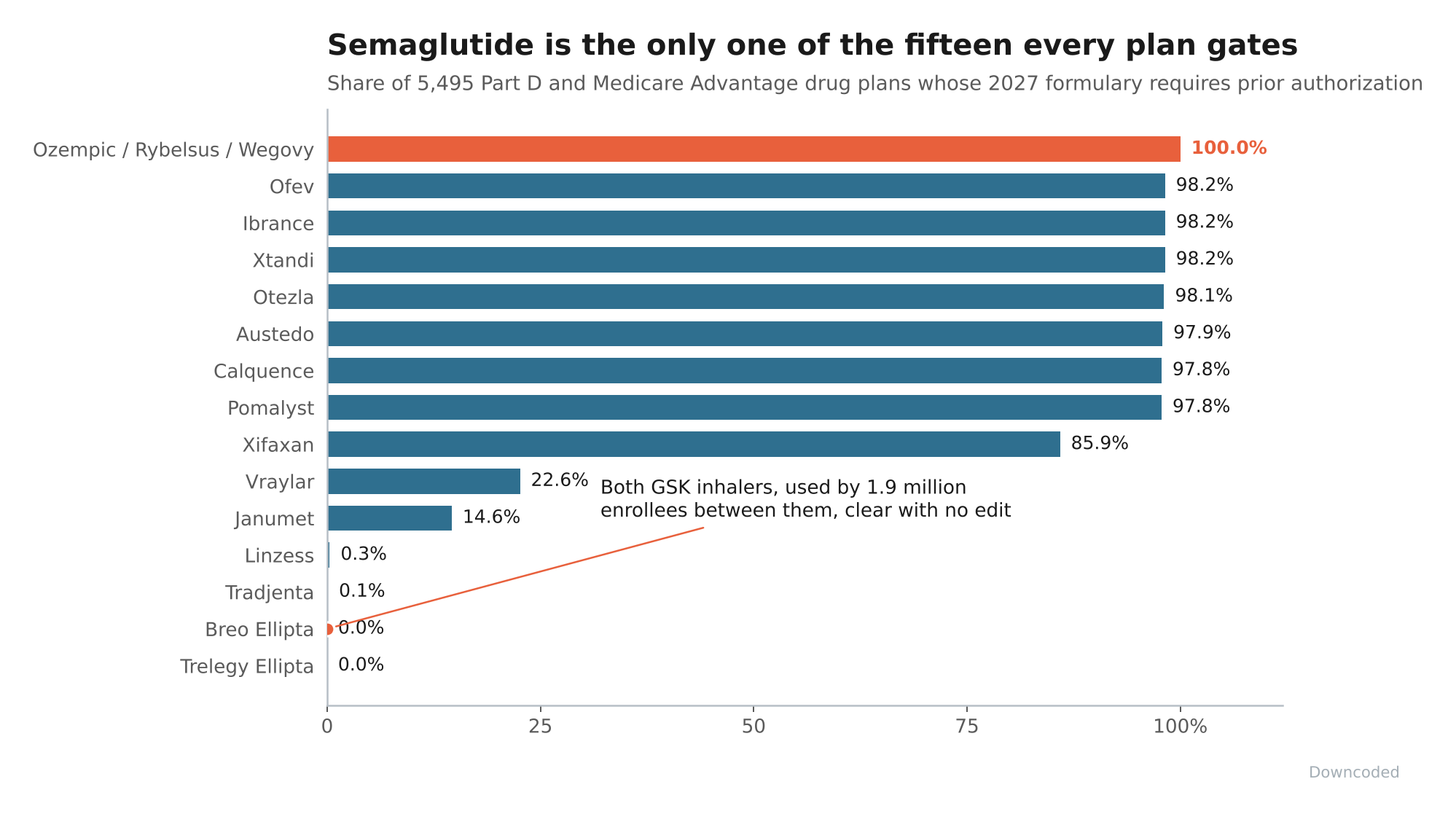
The seven specialty and oncology drugs cluster at the top, 97.8% to 98.2%, and nobody in revenue cycle is surprised that Pomalyst and Calquence come with an edit. All seven were at 97.7% or higher in the 2026 file too.
The bottom is the interesting end.
Trelegy Ellipta and Breo Ellipta, the two GlaxoSmithKline inhalers used by 1.9 million Part D enrollees between them, clear at 0.0%. Linzess, with 632,000 users, sits at 0.3%, and Tradjenta at 0.1%.
Four drugs in this cycle were used by more than half a million Part D enrollees in 2024. Semaglutide is one of them, and it is the one sitting at the ceiling while the other three sit at the floor.
Step therapy barely registers anywhere in the cohort, topping out at 9.3% of plans on one Janumet strength and sitting at 0.0% on semaglutide.
The gate is the authorization, and the authorization only.
The Sentence That Explains the Spread
CMS wrote this outcome into its own guidance two years ago, in one line of the final guidance for the 2027 cycle:
"For contract year 2027, CMS will not implement explicit tier placement or utilization management requirements that apply uniformly across selected drugs in all formularies but will apply the process described below."
What CMS set up is a review. It says it will look for four things at bid review, including "any instances where Part D sponsors impose more restrictive utilization management (i.e., step therapy and/or prior authorization) for a selected drug compared to a non-selected drug in the same class," and will expect a "reasonable justification" where it finds them.
Every 2027 bid in this file cleared that review. Whatever the justifications said, the formularies CMS approved put an authorization in front of negotiated semaglutide on all 5,495 of them.
Two more things in the file are worth a look before January.
Four of the first cycle's ten lost their selected-drug flag for 2027: Xarelto, Entresto, Stelara and NovoLog. Under section 1192(c) a drug stops being a selected drug once CMS determines a generic or biosimilar is approved and marketed, and all 23 of their presentations are still sitting on 2027 formularies with the flag off.
Farxiga and Jardiance held at 0.0% prior authorization through their first negotiated year. They now show 8.7% and 17.5%, with step therapy on up to 32.5% of plans for Farxiga.
Final Thoughts
Negotiation was built to move price, and on semaglutide it moved price by 71%. Price and access get set by different people, in different documents, on different clocks, and only one of those got rewritten this year.
Your patients will be told, correctly, that Medicare negotiated their drug. The money moved.
The paperwork in front of it did not.
To be fair to the file, it says an authorization is required and never what it takes to win one, so none of this tells your team how hard January will actually be. What it does give you is the plan-by-plan answer, 66 days before the first of those claims adjudicates.
Thanks for reading.