 Downcoded
Half the 2027 Part B Rate Is a Managed Care Line
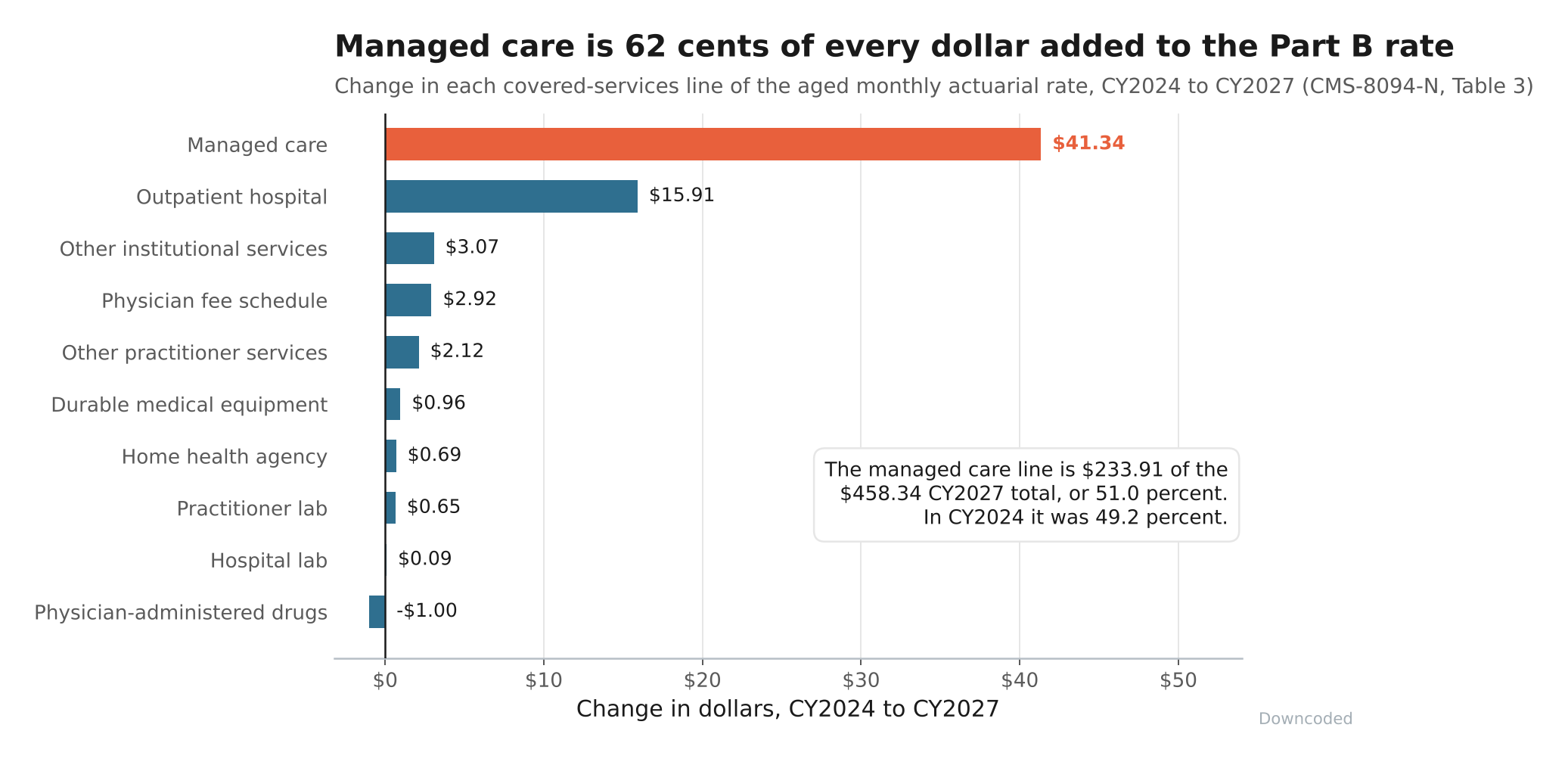
CMS published the CY2027 Part B actuarial rate notice on Thursday. Page 74578 carries the table that builds the rate out of ten service lines, and the managed care line is $233.91 of the $458.34 total. Of the $66.73 the actuaries added since CY2024, $41.34 is managed care and $2.92 is the physician fee schedule.
If you are writing a 2027 payer-mix assumption this week, Medicare's actuaries have already published theirs.
It sits in CMS-8094-N, the notice that landed Thursday at 91 FR 74570 with next year's Part B premium of $209.40 and the $292 deductible.
Those two numbers got the coverage. Page 74578 did not.
That page carries Table 3, where the actuaries derive the aged monthly actuarial rate from ten service lines and print four years of each, CY2024 through CY2027.
The whole table is stated at one-half of the monthly per-enrollee amount, which is how the statute defines the rate. Shares and growth come out the same either way.
In the CY2027 column the managed care line is $233.91 against a covered-services total of $458.34.
Everything else Part B pays for, the fee schedule and the hospital outpatient department and the labs and the drugs and the DME, adds to $224.43.
"Which line is absorbing the growth in the Part B rate?"
The level is one story. The increase is a blunter one.
Of the $66.73 the actuaries added to covered services between CY2024 and CY2027, $41.34 is the managed care line (chart below). The physician fee schedule contributes $2.92 of it.
Five Cents Off the Fee Schedule
Read the physician fee schedule row across and it does almost nothing: $65.41, $65.41, $68.38, $68.33.
The CY2027 figure is five cents lower than CY2026. Over that same year the managed care row rises $13.74.
As a share of covered services the fee schedule line falls from 16.70 percent in CY2024 to 14.91 percent in CY2027. Managed care goes from 49.17 percent to 51.03 percent and crosses half on the way.
Outpatient hospital is the only other line doing real work, at $15.91 of the four-year increase. Managed care and the outpatient department together are 86 percent of everything the actuaries added.
Where the Missing Point Went
Table 2, one page earlier, prints the cost-growth assumptions underneath all of it. For aged enrollees in 2027 the physician fee schedule factor is 1.1 percent, outpatient hospital is 9.3, home health is 9.8, managed care is 5.2.
Those factors do not match what the rows actually do, and the table's own footnote says why: "All values for services other than managed care are per fee-for-service enrollee. Managed care values are per managed care enrollee."
So run each line against its own assumption, CY2026 to CY2027:
- Physician fee schedule: factor 1.1 percent, the row falls 0.1.
- Outpatient hospital: factor 9.3, the row grows 8.0.
- Home health agency: factor 9.8, the row grows 8.5.
- Durable medical equipment: factor 5.7, the row grows 4.5.
- Managed care: factor 5.2, the row grows 6.2.
Every one of the nine fee-for-service lines lands between 1.1 and 1.5 points below its own projection factor. Managed care lands 1.0 point above its own.
That spread is the enrollment shift showing up as arithmetic.
Per-patient cost assumptions move these rows less than the denominator underneath them does, and that denominator shifts about a point and a quarter a year.
Which is a bit of an oversimplification for time, since the factors are themselves rounded to a tenth. The sign is unambiguous on all ten rows.
Final Thoughts
Nothing here changes a claim you drop today. It does settle an argument that gets re-run in every 2027 planning meeting, and it settles it with CMS's own actuarial work rather than an enrollment projection from a trade association.
The document that sets what your Medicare patients pay in January has the majority of the aged Part B rate running through a plan next year, and the fee schedule line flat in nominal dollars across four years. The disabled table on the same page says it harder: $354.29 of $560.75, or 63 percent, is managed care.
Which way Part B is going stopped being the interesting question a while ago. What is left is how much of your front end, your authorization desk and your appeals capacity is still built for the half that is shrinking.
Thanks for reading.