 Downcoded
How a Patch Gets Into a Code Written for a Vest
CMS posted the agenda for its November 2 HCPCS meeting with 63 preliminary determinations on it, and two of them belong to Element Science. The ask was to strike the words 'garment type' from K0606 so a patch-based wearable defibrillator fits the code. CMS's preliminary answer is yes, plus a descriptor change nobody requested, and written comments close November 4.
Nine words decide whether a device has a code.
K0606 reads "Automatic external defibrillator, with integrated electrocardiogram analysis, garment type." Two of those words describe a shape.
Element Science, Inc. makes a wearable defibrillator that is not that shape. It adheres to the torso with two electrode patches, the lower one carrying the battery, and the whole supply kit gets swapped after up to 8 days of wear.
So the company filed a HCPCS Level II application asking CMS to strike "garment type" and put "wearable" in its place.
CMS posted its answer this month, in the agenda for the public meeting it holds in Baltimore on November 2.
We have carried that meeting date twice as a one-line radar item. This is the first look at what is actually on it.
The Paper Trail Behind the Ask
The device cleared FDA on the long road. Premarket approval P230022, received July 3, 2023 and approved April 30, 2025, which is 667 days inside the agency with no expedited-review flag on the record.
What the approval covers is narrow and worth reading in the original, because it is the sentence any medical-necessity conversation will eventually turn on: adults 18 and older "who are at risk for Sudden Cardiac Arrest, and either are not candidates for or refuse an Implantable Defibrillator."
Five supplement actions have landed on that same PMA since, the most recent on March 4, 2026. Keeping a Class III file moving at that rate is what a company does when it plans to be billed for.
What CMS Preliminarily Said
The agenda carries 63 preliminary coding determinations across 48 numbered items. The great majority go one of two ways: twenty-four end with CMS saying an existing code already describes the product, and nineteen are skin substitutes routed through FDA's Tissue Reference Group.
Only five of the 63 rewrite an existing code descriptor. Two of the five are Element Science's.
Here is what CMS preliminarily agreed to do, and it is more than the applicant asked for:
- K0606 becomes "Automatic external defibrillator, with integrated electrocardiogram analysis, wearable, includes all necessary supplies and accessories." The form factor comes out and the supply kit goes in.
- E0617 picks up the same "includes all necessary supplies and accessories" language.
- K0607, K0608 and K0609, the replacement-accessory codes, go invalid for Medicare.
- The benefit category determination stays where it was: Durable Medical Equipment, under the policy already established for K0606.
That last line is the one that matters most for a company in this position. A new code with no benefit category is a code you cannot bill.
Element Science asked to be let into a code that already has one, and CMS preliminarily agreed that the current K0606 policy "apply to this item."
What the Code Already Pays
K0606 is a capped rental item, Pricing Indicator 36, and it must carry the KF modifier because the equipment is Class III.
CMS states the 2026 average fee schedule amounts in the determination itself: $3,588.90 a month for months 1 through 3, then $2,691.68 for months 4 through 13, which totals $37,683.50 after thirteen months of continuous use.
Almost nobody reaches that number. CMS's own claims data, quoted in the same paragraph, says more than 90% of K0606 rentals run five months or fewer, and more than 99% never go the full thirteen (chart below).
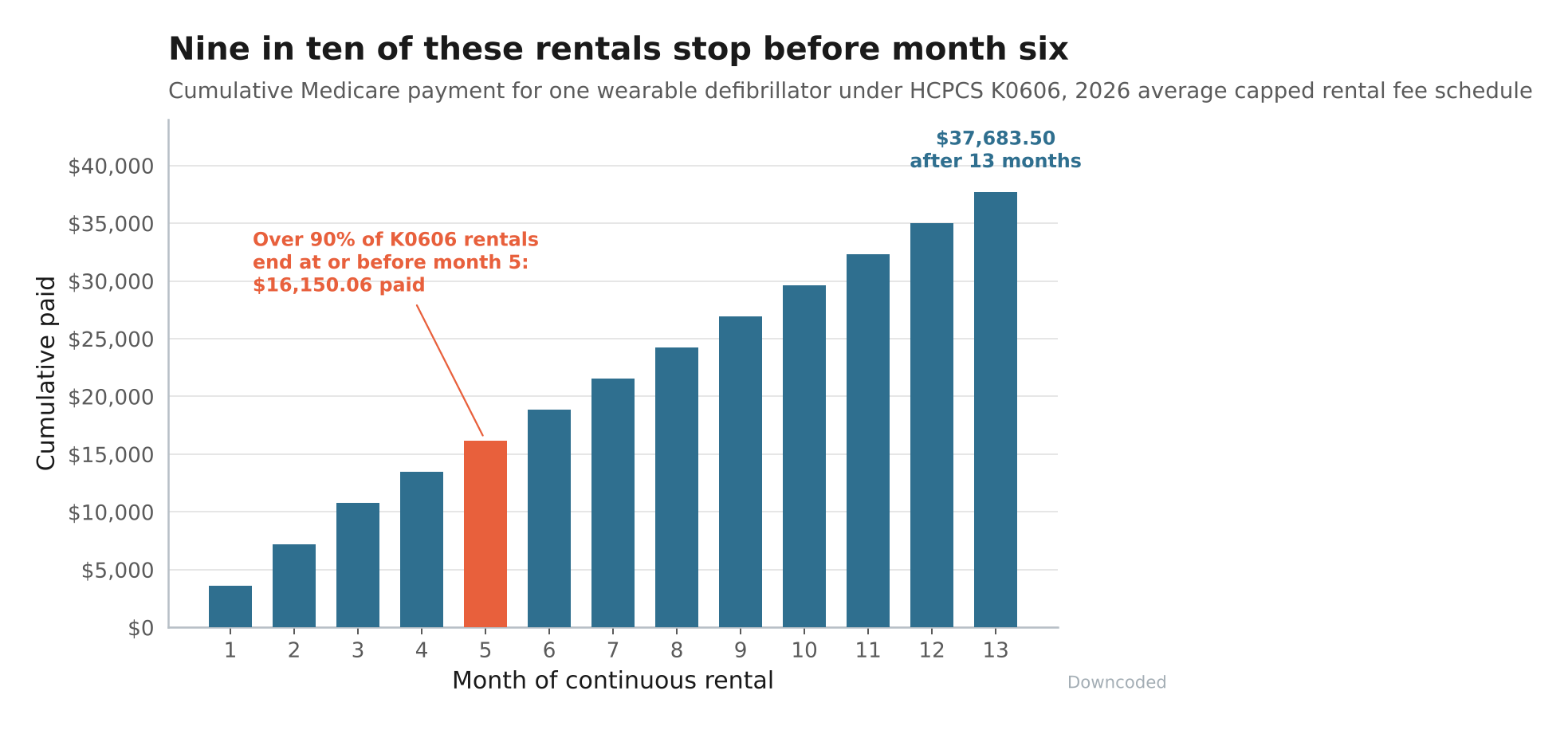
Five months of rental is $16,150.06, about 43% of the headline figure. The other $21,533.44 sits in months six through thirteen, where the claims data says the patients mostly are not.
That is also the arithmetic underneath the accessory decision. Title transfers at month thirteen, almost no one gets there, and section 110.3 of the Benefit Policy Manual only pays for replacement accessories on equipment the beneficiary owns.
So the supplies ride inside the rental, and the patch kit gets described by the same revised K0606 as the device it attaches to.
Final Thoughts
None of this is final. The agenda says so in its own voice: preliminary determinations "are not final or binding upon any insurer and are subject to change," and CMS publishes the real ones around February 2027 for an April 1, 2027 effective date.
Written comments go to HCPCS@cms.hhs.gov before 5 p.m. ET on November 4, two days after the meeting and the last door open to anyone who bills these codes.
If you supply wearable defibrillators, the K0607 through K0609 invalidation is the line to read twice.
The wider thing worth noticing is how a coding descriptor ages. A descriptor written around the only product that existed becomes a wall around the category, and the way through is an application, a PMA number, and a paragraph of claims data showing the existing payment rules still hold.
Element Science filed that application. The two words it wanted gone are, preliminarily, gone.
Thanks for reading.