How a Rate Takes Effect Sixteen Days Before Your MAC Can Pay It
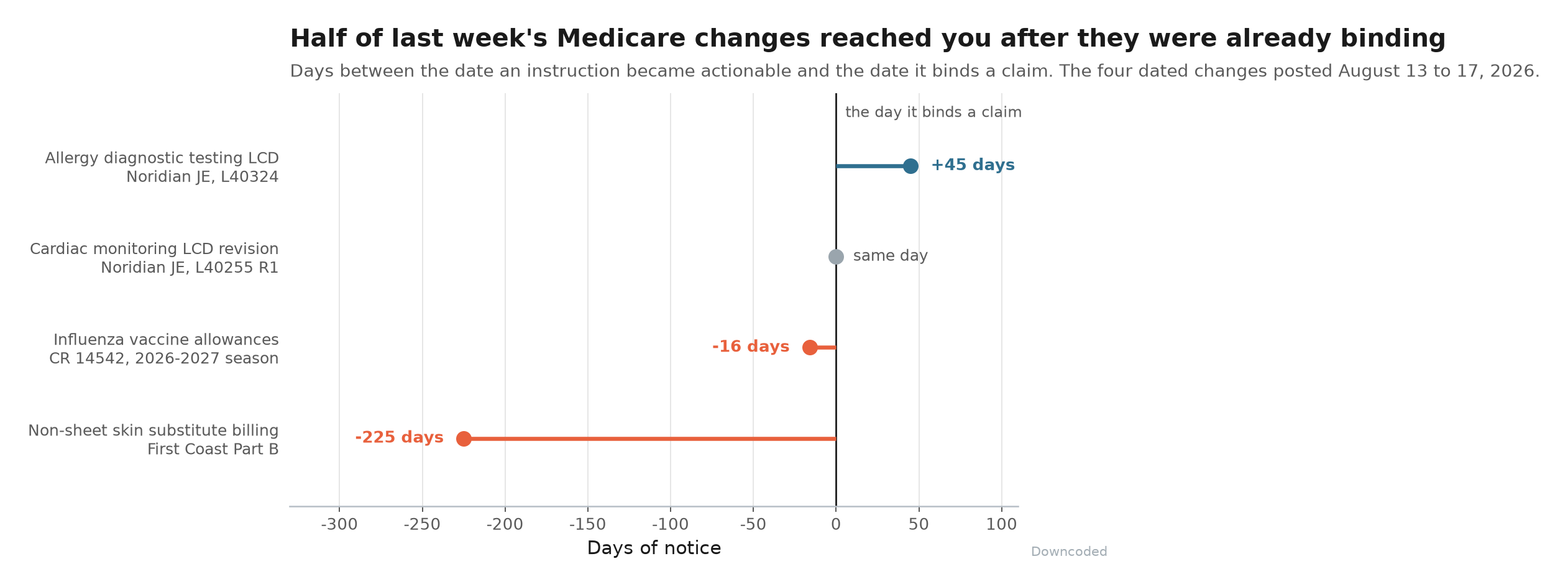
This season's influenza vaccine allowances carry an effective date of August 1 and an implementation date of today, so sixteen days of flu claims priced against last season. The Federal Register published nothing from CMS all weekend, and every change that actually reached a provider came from a contractor: a finalized allergy LCD in Jurisdiction E, a skin substitute billing rule First Coast wrote down 225 days after it started, and an OIG finding that three New York Medicaid plans are still out of parity six years past the deadline.
Transmittal 13859 went up on the CMS website on July 16. Your MAC installs it today.
It carries the seasonal influenza vaccine payment allowances for 2026-2027, the ones we priced on August 4 when the high-dose line moved. The transmittal states the effective date plainly: August 1, 2026, and adds the standard qualifier that unless otherwise specified, the effective date is the date of service.
The implementation date is August 17. That is this morning.
"What is an effective date worth when the system that pays you gets the instruction sixteen days later?"
So every flu shot with a date of service since the first adjudicated against a claims system that did not hold this season's numbers. Sixteen days, at the front edge of the season, on a code family that runs at volume in exactly this window.
None of that makes the transmittal late by CMS's own rules. Change Request 14542 is a recurring update notification against Pub 100-04, chapter 17, section 20.5.9, and recurring updates are built this way on purpose.
The gap is structural. It is also money you have to go find later instead of collecting the first time.
It was not the only change last week that landed behind its own effective date (chart below).

The rest of this brief is for subscribers.
The impact tables, the code-level detail, and the rest of the analysis sit past this line.
$50 a month, or $500 a year.
Already a subscriber? Sign in