 Downcoded
How a Spine Stimulator Got Its Own Code and a Price
FDA created a device category from scratch in December 2024, and three companies have cleared devices into it since. Not one of those devices has a code of its own. CMS's preliminary answer to ANEUVO's July application is the first: a new E code, a durable medical equipment benefit category, and a capped rental schedule worth $542.70 over thirteen months.
FDA invented a device category in December 2024 and wrote it a name: transcutaneous electrical spine stimulator to improve skeletal muscle strength and sensation. Product code SDO, 21 CFR 890.5851, Class II, physical medicine panel.
Twenty-three months on, FDA's database carries four clearances in that category, covering three devices from three companies.
Not one of those devices has a code of its own.
The first one is on the calendar for April 1, and the application behind it was filed by a company on Wilshire Boulevard.
Ninety-Six Days From Clearance to Deadline
ANEUVO calls itself "a medical technology company advancing non-invasive neuromodulation for people living with spinal cord injury," and its product is the ExaStim Stimulation System, a portable multichannel stimulator that delivers current through a pad laid over the cervical spine, with the channel map built per patient from a motor mapping session.
The cleared indication is the improvement of hand sensation and strength in people 18 to 75 with a chronic, non-progressive neurological deficit from an incomplete spinal cord injury, used in conjunction with functional task practice.
CE Mark came in April 2025. FDA took the 510(k) in on September 11, 2025 and cleared it as K252893 on March 27, 2026, 197 days later.
Dr. Yi-Kai Lo is chief executive.
Non-drug HCPCS Level II applications run on a biannual clock, and the second 2026 cycle closed on the first business day of July. ANEUVO filed two into it, one for the system and one for the ReCure electrode pads that go with it.
Ninety-six days from the clearance letter to the application deadline. Miss that window and the effective date slides a full cycle.
The Rare Half of the Docket
CMS carried its preliminary determinations into a hybrid public meeting at 7500 Security Boulevard on November 2. The agenda holding them is stamped October 21.
For the ExaStim system the determination reads: establish a new HCPCS Level II code EXXXX, "Transcutaneous electrical spine stimulator."
Hold that descriptor up against FDA's category name. CMS wrote a line broad enough to carry the category rather than the product, which means every device cleared under SDO bills it.
The benefit category came back durable medical equipment, under section 1861(n) and 42 CFR 414.202, on the four findings CMS always makes: appropriate for use in the home, primarily and customarily used to serve a medical purpose, generally not useful in the absence of illness or injury, and capable of withstanding repeated use for at least three years.
A new code is the uncommon answer on this docket. The agenda carries 63 preliminary coding determinations, and 12 of them establish anything (chart below).
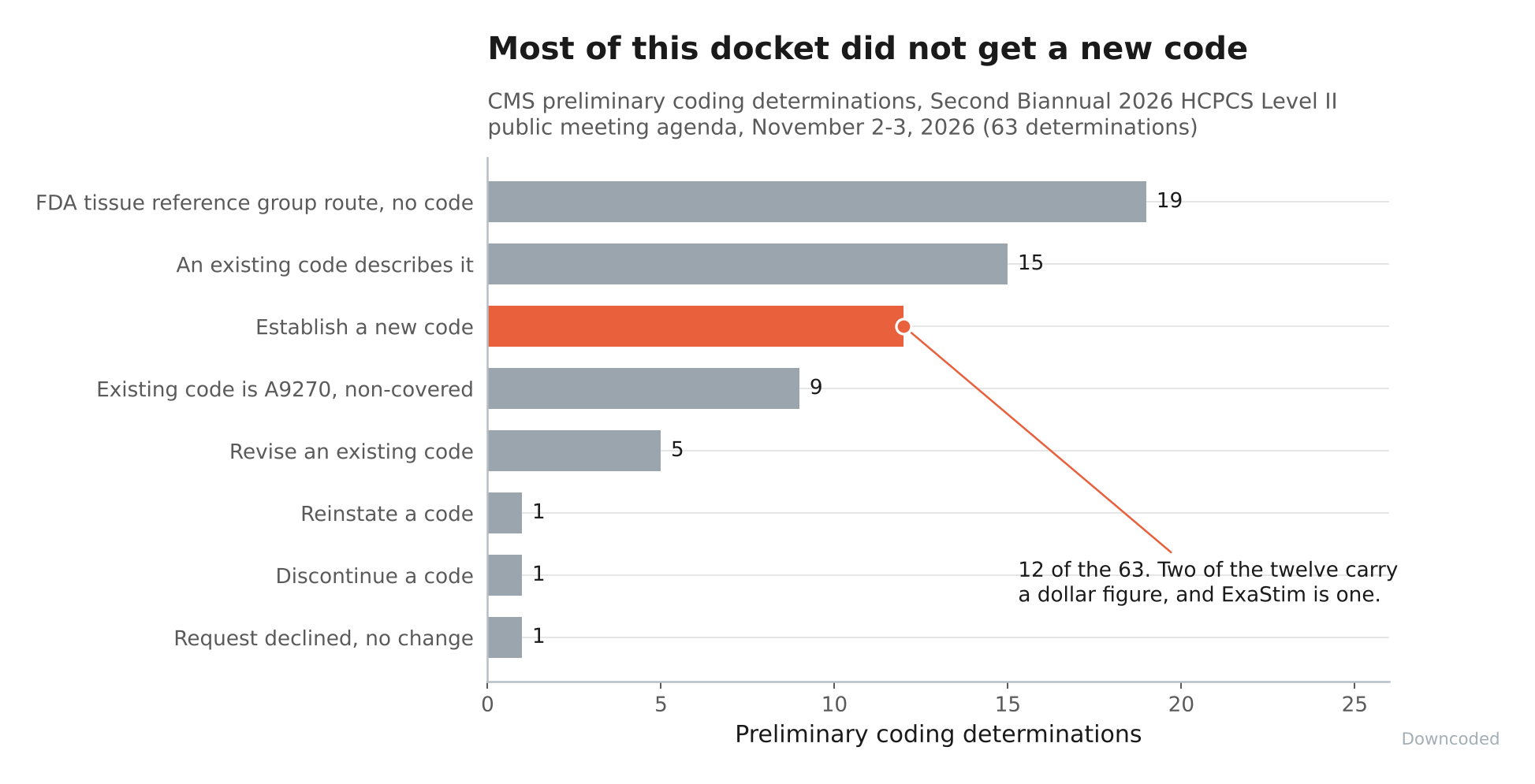
Nineteen went out the FDA Tissue Reference Group door as section 361 products, which ends the coding question instead of answering it.
Fifteen were told an existing code already describes them. Nine more were pointed at A9270, non-covered item or service.
Seven of the twelve new codes are per-unit A codes for wound-care products. Two of the twelve carry a payment determination denominated in dollars, and one of those two was filed by PDAC, Medicare's own pricing contractor.
The other is ExaStim.
A Price, Which Is the Unusual Part
The payment half of this process is younger than the coding half. CMS stood it up in a December 28, 2021 final rule at 86 FR 73860, on an authority Congress wrote into BIPA back in 2000 for exactly this purpose: public consultation on coding and payment for new DME.
So the agenda prices a code that does not exist yet.
Under 42 CFR 414.238(b) a new code with no pricing history gets gap-filled off a comparable one, and CMS picked E0730. Its own comparison table sets ExaStim's 16-channel array beside E0730's 2-channel, 4-electrode one, and notes that E0730 "does not distinguish between programmable and non-programmable devices."
Then the turn that matters to anyone who prices DMEPOS. CMS says it would use E0730 fees "that were not adjusted using information from the DMEPOS Competitive Bidding Program," because devices for this indication "were not available to suppliers engaging in the competitive bidding program."
Unadjusted, E0730's purchase fee runs about $517.05. Anything over $150 in the base period pays as a capped rental under 42 CFR 414.229, so the preliminary schedule is $51.70 a month for months 1 through 3, $38.76 for months 4 through 13, and $542.70 across thirteen months of continuous use (chart below).
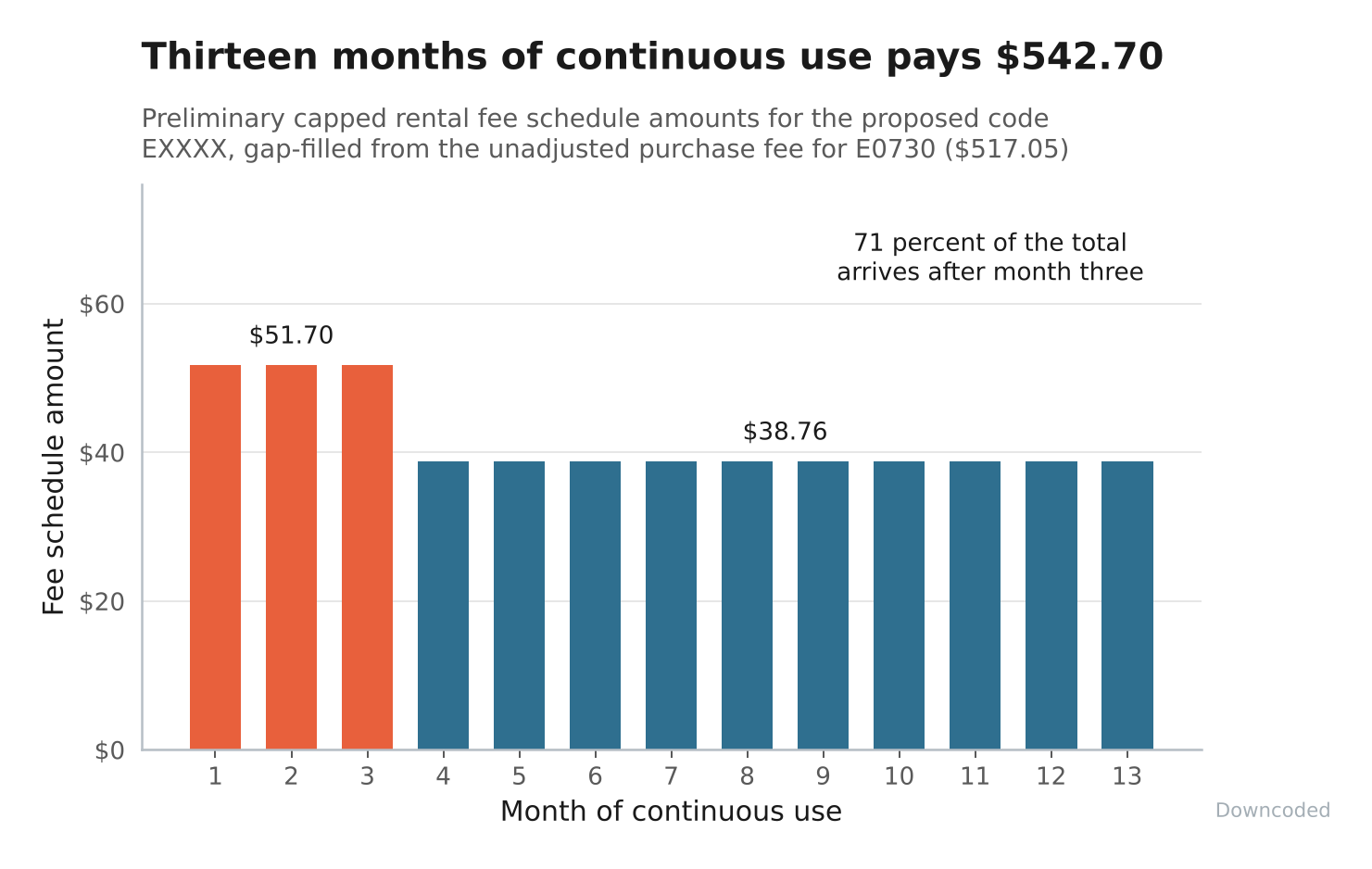
Pricing indicator 36. Seventy-one percent of that total arrives after month three, which puts continuous-use documentation at the center of the code.
The pads got a different answer, and it is the plainer one. CMS put the ReCure electrode pads on existing code A4595, "Electrical stimulator supplies, 2 lead, per month, (e.g., tens, nmes)," with the payment rules that already attach to it.
What Is Actually on the Record
Written comments closed at 5:00 p.m. on November 4.
Three weeks after the meeting, CMS has posted no recording of it. Every biannual meeting back to May 2023 carries one on the public meetings page, and the November 2 and 3 block holds the agenda, the participation guidelines, and nothing else.
Which leaves the October 21 agenda as the entire public record, saying what it always says: preliminary determinations "are not final or binding upon any insurer and are subject to change."
Final determinations publish around February 2027. A code that survives them is effective April 1, 2027.
Final Thoughts
A code is a smaller thing than a clearance and a slower one, and it is the thing that decides whether a device is a product or a protocol. Twenty-three months of cleared devices in this category have had no code of their own to bill.
ANEUVO filed ninety-six days after FDA said yes and got back a descriptor with nobody's trademark in it. Whoever clears into SDO next will bill the line this application wrote.
Thanks for reading.