Who Pays the Bond When Your Surety Does Not?
CRUSH, published Thursday, prints every DMEPOS surety bond collection figure CMS has. Sureties paid $540,000 on $37.5 million referred to them in 2025, and in two DME MAC jurisdictions the suppliers themselves have paid $171.3 million against the sureties' $35.7 million. CMS proposes to strip the surety's defenses and publish a list of sureties it will no longer take bonds from. The bond is still a flat $50,000, sixteen years after Congress told the Secretary to scale it to billing volume.
If you run a DMEPOS operation you have carried a surety bond since 2009, and you have never seen the file CMS keeps on whether those bonds actually pay.
It is in the CRUSH proposed rule, published Thursday at 91 FR 74680, and it reflects badly on everyone in it.
Three disclosures sit inside two pages of preamble.
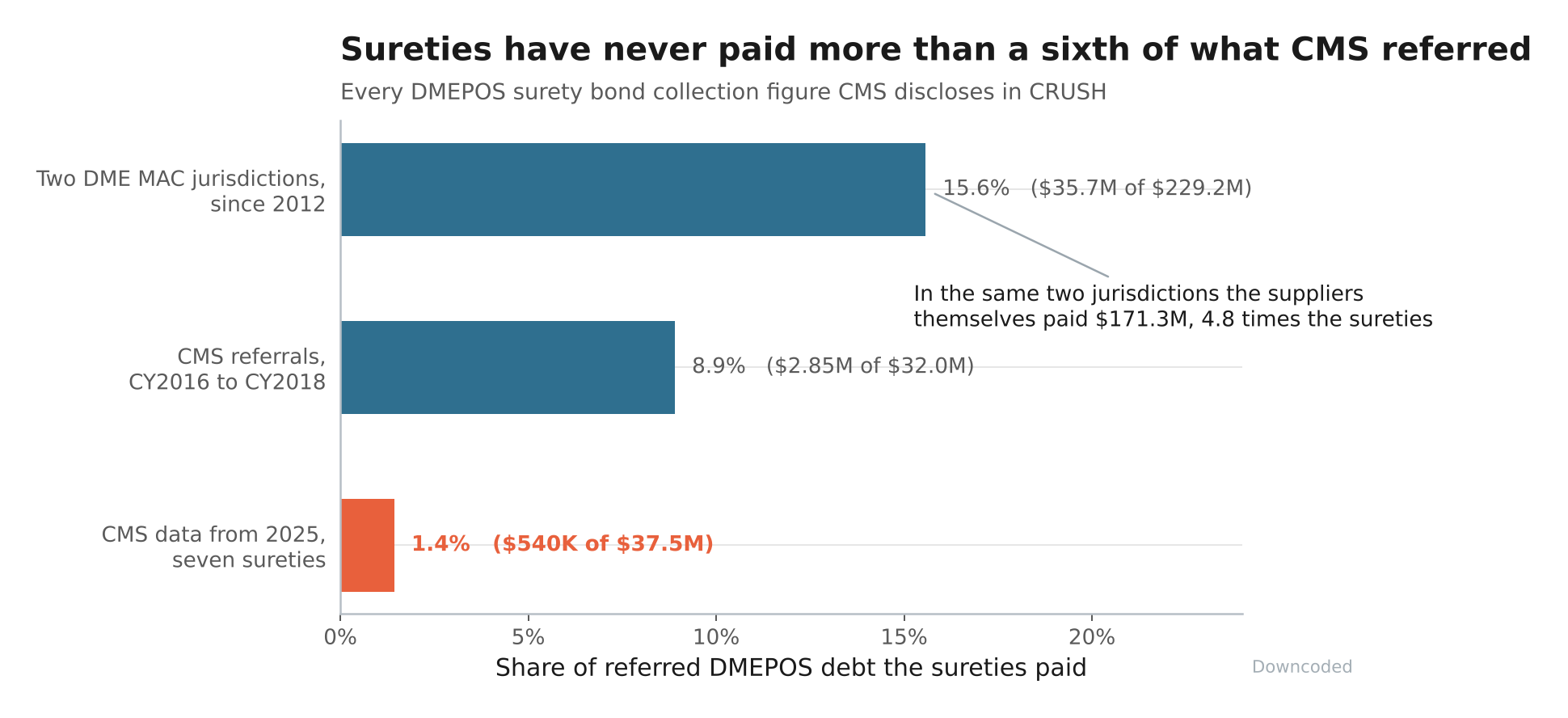
CMS referred roughly $32 million of DMEPOS supplier debt to sureties between CY2016 and CY2018 and collected $2.85 million. Agency data from 2025 shows $37.5 million referred to seven sureties, which together paid $540,000. Two DME MAC jurisdictions have referred $229.2 million since 2012 and been paid $35.7 million.
So 8.9%, 1.4% and 15.6% (chart below). CMS puts the middle one at "no more than 1.5 percent of the amount of debt referred to them" and calls it disconcerting.
"If the surety will not pay, what has the bond been doing since 2009?"
Collecting from you.
In those same two jurisdictions the suppliers themselves paid $171.3 million once their debts went to the surety, 4.8 times what the sureties paid. CMS describes the mechanism without embarrassment: the supplier, worried the surety will cancel the bond and leave it unbonded and revocable, finally pays the debt it was disputing.
This desk has already run three pieces off CMS-6098-P, on the RADV transfer row, the § 422.223 enrollment wave, and the referral and suspension reporting in § 422.503 and § 455.23. Section VII, the DMEPOS half, is the part none of them opened.

The rest of this brief is for subscribers.
The impact tables, the code-level detail, and the rest of the analysis sit past this line.
$50 a month, or $500 a year.
Already a subscriber? Sign in