 Downcoded
How PEPPER Got Rebuilt
The free CMS report that tells a facility where it sits against its peers on the metrics auditors use went dark in 2023. A small Maryland contractor has been putting it back one facility type at a time, and the last of them lands in September.
If you keep a compliance calendar, one line on it has been dead since 2023.
PEPPER is coming back, and for several facility types it already has. A skilled nursing facility will have gone 41 months without one by the time its report lands next month, counting from the last release on April 5, 2023.
Hospices waited 38. Inpatient psych waited 40, and gets its report this month (chart below).
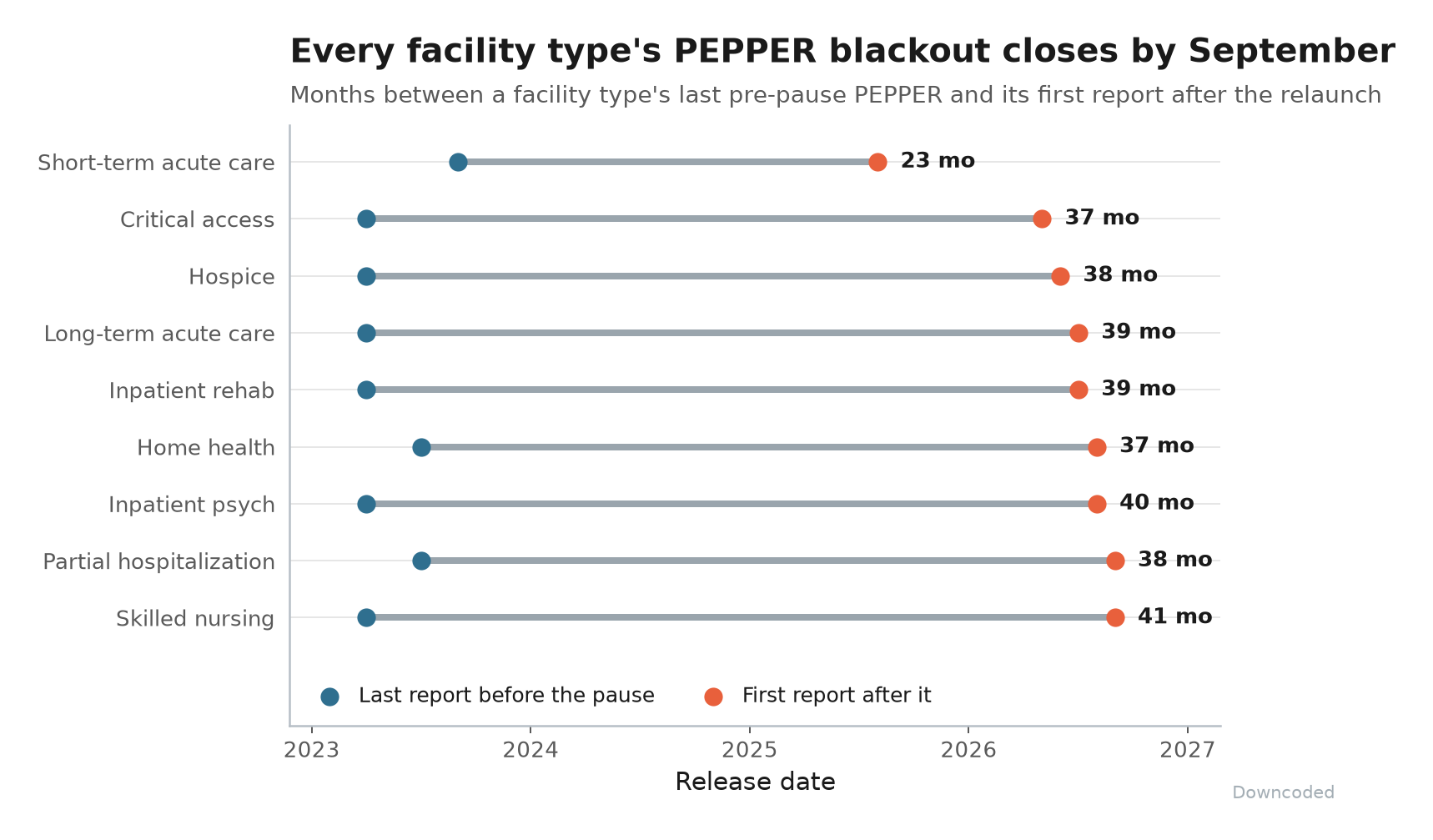
CMS paused distribution of PEPPERs and Comparative Billing Reports on February 6, 2024, saying it wanted to "enhance the quality and accessibility of the reports," and issued a Request for Information on both programs that July. The pause was scheduled to run through fall 2024. It ran a good deal longer, and the thing that came back is better than the thing that stopped.
What a PEPPER actually gives you
One Excel workbook, free, carrying your own facility's Medicare claims statistics on the areas the program considers prone to improper payment, benchmarked three ways: against the nation, against your MAC jurisdiction, and against your state.
The upper control limit is the 80th percentile on every target area. Coding-focused areas carry a lower control limit at the 20th. Land at or above the top line and you are flagged a high outlier; land at or below the bottom line on a coding area and the report is pointing at under-coding, which is the half of PEPPER most people forget is in there.
The current short-term acute care edition runs 24 target areas across the most recent 12 quarters.
Severe malnutrition as the only MCC. Single CC or MCC. One-day stays for medical DRGs and for surgical, two-day stays for both, three-day SNF-qualifying admissions, thirty-day readmissions to the same hospital and to the same hospital or elsewhere.
Where those came from is the reason to care. Some were the focus of OIG audits, some came out of the Payment Error Prevention Program and the Hospital Payment Monitoring Program that state QIOs ran from 1999 through 2008, and the rest the Recovery Auditor program identified on its own.
The target list is a map of where the reviewers have already been.
The guide is careful about what an outlier means: "PEPPER does not identify the presence of payment errors." A high percentile is a place to point your own audit before somebody else points theirs.
One limit worth knowing before you open it. With fewer than 11 numerator discharges in a target area for a period, CMS data rules mean the report shows nothing at all, so a low-volume facility will find real holes in its tables.
Who put it back together
Index Analytics LLC, an 8(a) small business in Windsor Mill, Maryland, working with Integrity Management Services and GovCon Growth Solutions.
CMS awarded the delivery order (75FCMC24F0224) on September 17, 2024 out of a full and open competition that drew four offers, and has obligated $7,447,510.51 against it so far. The order can run to September 2029.
The rebuild is legible in the documents themselves. The August 2025 short-term guide is labeled a "Limited Release" and covers five target areas: stroke intracranial hemorrhage, respiratory infections, simple pneumonia, septicemia, and unrelated OR procedure. The December 2025 edition carries all 24, and adds sixteen pages of historical FY2023 and FY2024 target-area definitions as an appendix.
That appendix is the part we would single out. Any hospital reading a 12-quarter trend line is reading across fiscal years in which the definitions moved (surgical DRGs with CC or MCC and percutaneous cardiovascular procedures both dropped DRGs 246 through 249 for 321 and 322 as of Q1 FY2024). Shipping the old definitions next to the new ones is what separates a trend line you can defend in a meeting from one you can't.
Sort your access out before your month
Access changed while the program was dark, and this is the part that will cost somebody a week if it gets left alone.
Only NPPES Authorized Officials and Access Managers with an active Identity & Access account can get into the PEPPER Portal at all. Everyone else needs to be a Staff End User with the PEPPER business function approved.
The path CMS gives: sign into the I&A System with your existing NPPES or PECOS credentials, request the PEPPER business function for your organization, then have your AO or AM approve it. Request the Comparative Billing Report business function in the same pass, because it is the same form and the same approval.
Home health and inpatient psych are on the board this month. Partial hospitalization, skilled nursing, and the Q2 FY2026 short-term acute care refresh are next month.
After the relaunch finishes, the cadence is quarterly for short-term acute care and annual for everybody else. Miss your annual drop because nobody had a login and you are waiting a year.
Final Thoughts
Peer benchmarking against the specific measures that drive audit selection is not something the market hands out for free. The commercial versions cost real money and largely repackage the same claims data.
Three years is a long outage and some of what a facility would have caught in that window is simply gone. What is back shows more than the 2023 version did, documents its own definitional history so the trend lines hold up, and still costs nothing to pull.
Worth an hour of somebody's Monday.
Thanks for reading.