 Downcoded
Why Your IDR Recovery Timeline Is Out of Date
The Departments released the second-half 2025 federal IDR public use files on July 22. The share of payment determinations landing inside 30 business days went from 29% to 62% in a year, the default wins that padded provider win rates are thinning, and the operations rule takes effect August 3.
The Departments put the federal IDR public use files for the back half of 2025 on the wire July 22, and one line in the supplemental background is worth rebuilding an assumption over.
62% of payment determinations came back inside 30 business days. A year earlier it was 29%.
That happened while volume kept climbing (chart below). Certified IDR entities rendered 1,145,039 payment determinations in the last six months of 2025, up from 698,968 in the same stretch of 2024, and the count decided inside 30 business days went from 203,480 to 707,866.
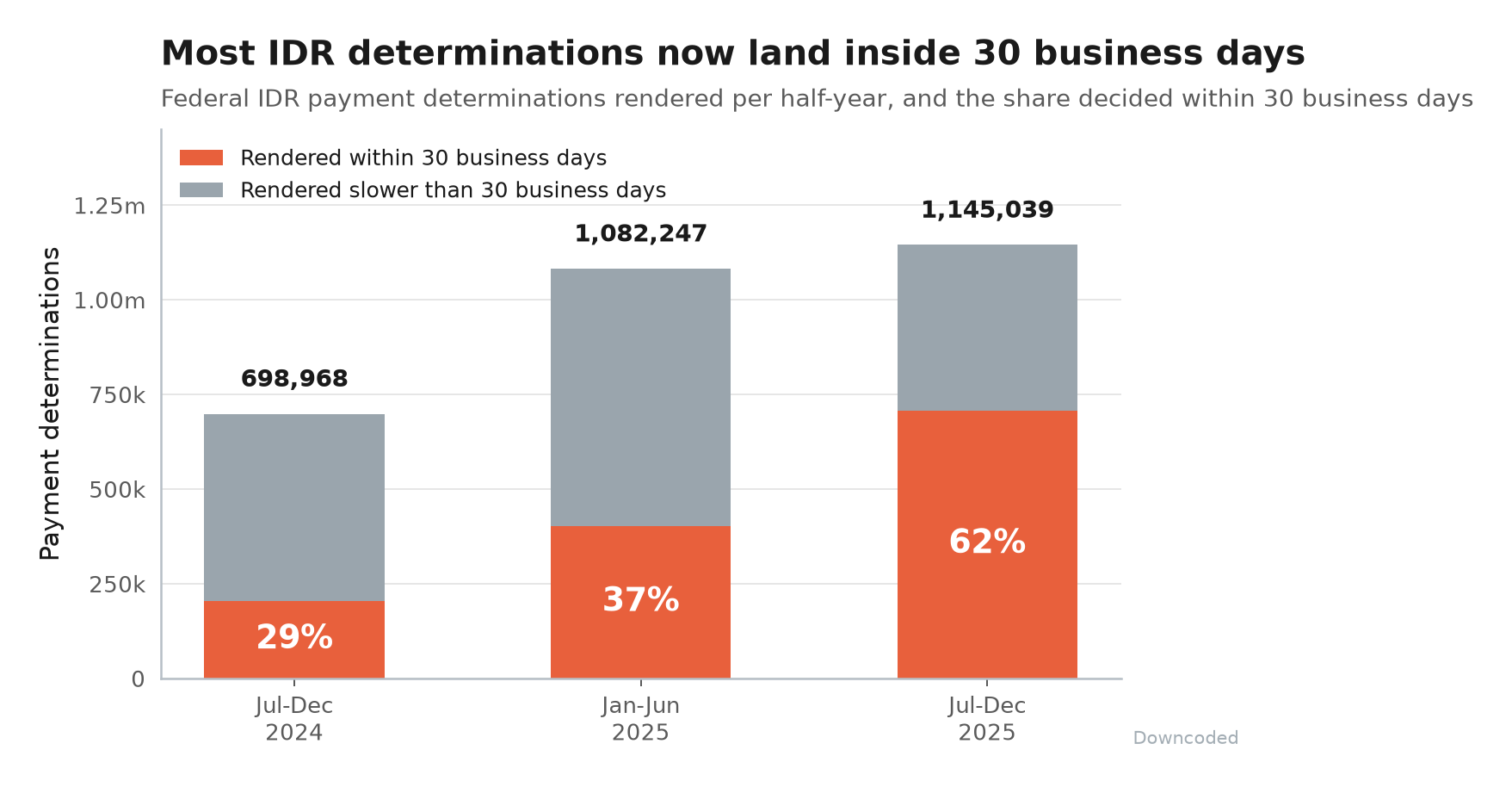
If your out-of-network recovery model still assumes federal IDR is where claims go to sit, it was calibrated on a process that no longer exists.
Where the speed came from
Capacity, mostly. The Departments certified two more IDR entities in June 2025, Capitol Bridge and Livanta, taking the roster from 13 to 15, and both started taking disputes in September.
The portal also got automated validations that screen out ineligible and duplicate disputes before they consume an entity's review hours.
The result is an outfit that now closes more than it takes in.
Disputing parties initiated 1,372,563 disputes in the second half of 2025, up 16% on the first half. Entities closed 1,449,900, about 6% more than were initiated.
As of the end of 2025, 98% of every dispute submitted since the portal opened in April 2022 had either been resolved or was less than 30 business days old. Ninety-two percent were resolved outright.
The free wins are drying up
Providers, facilities, and air ambulance providers prevailed in 85% of determinations, down from 88% in the first half of 2025.
That looks like noise. The composition underneath it isn't.
Default decisions, the ones a party wins because the other side never submitted an offer or never paid its fees, fell to 17% of all determinations from 22% two halves running. Plans are showing up.
And when they show up, they are doing slightly better. The contested win rate for providers slipped to 84% from 87%.
So the headline win rate held roughly flat because a shrinking pool of free wins was offset against a harder contested pool. The marginal dispute you file in 2026 is a worse bet than the one you filed in 2025, even though the top-line number barely moved.
Two other things moved with it. Emergency department services are now 52% of all determinations, up from 40% a year earlier, while radiology fell to 15% from 20% and Radiology Partners dropped out of the top three initiating parties. And the eligibility screen tightened again: 19% of disputes were found ineligible, up from 17% in the first half, with the incomplete 90-calendar-day cooling-off period and a state law or All-Payer Model Agreement superseding the federal process the two most common reasons.
What actually changes Monday
The operations final rule (91 FR 33900, published June 4) is effective August 3, and the applicability dates are staggered enough that reading "effective August 3" as "everything changes August 3" will cost you.
What is live on the effective date:
- The modified QPA disclosure requirements, which apply to any disclosure required to be provided on or after August 3. This is the one that touches your intake: the information plans must hand over with the initial payment or denial changes content, and eligibility screening runs off it.
- The codified definition of a bundled payment arrangement, which restates what was already in guidance.
What is not:
- The new definition of batched qualified items and services applies to disputes whose open negotiation periods begin 90 days after the effective date.
- Open negotiation, IDR initiation, entity selection, the eligibility review itself, withdrawals, batching treatment, offer deadlines, and the subsequent-request suspension all wait on the Departments announcing that the portal functionality exists, then 90 days past that. All of it is anticipated within 24 months of the effective date, released on a rolling basis.
- The CARC and RARC requirement on remittance advice to non-contracted entities is effective but not yet required. Guidance is intended within six months of publication, and is expected to give at least four months to comply.
Final Thoughts
The concentration story hasn't broken, and probably won't. The top ten initiating parties still account for 66% of everything filed, and HaloMD, Team Health, and SCP Health alone account for 38%.
Federal IDR remains a channel that rewards operators who file at volume with clean eligibility, which is the same conclusion anyone reading these files in 2024 reached.
What changed is the clock. A process with a 62% thirty-day rate belongs in a different aging bucket than one with a 29% rate, and the difference between those two assumptions is real cash timing on real out-of-network balances that most models still push out two or three quarters.
Go re-check what your model assumes, then re-check what your eligibility screen does with a QPA disclosure that changes format on Monday.
Thanks for reading.