How Three Sessions a Quarter Became Three a Year
Novitas and First Coast rewrote their trigger point injection LCDs with identical text, effective September 6. The session count in the policy is unchanged. The window it sits in went from three months to twelve, and four other things stopped being covered on the way.
Two Medicare contractors posted the identical sentence for notice on July 23, and it takes effect four Sundays from now.
Novitas Solutions and First Coast Service Options both revised their Trigger Point Injections LCDs, L35010 and L33912, for services performed on or after September 6, 2026. The notice period closes September 5.
Neither document is a new policy number, neither shows up as a new LCD in anyone's alert feed, and the number that matters looks like the number that was already there.
The outgoing policy said trigger point injections "would not usually be performed more often than three sessions in a three month period." The incoming policy says the routine performance of more than three sessions within a rolling 12-month period is not reasonable and necessary.
Same three. Different denominator.
The Cheapest Way to Cut a Benefit by Four
Annualize the old guideline and you get twelve sessions before anyone had to explain anything, and even then the old text only asked that the reason and the substances injected "be evident in the medical record and available to the Contractor upon request."
It was a documentation expectation with a soft edge. Exceeding it was a records problem.
The new text has no soft edge. Three is the routine ceiling on a rolling twelve months. A fourth session is available only "in exceptional, clinically appropriate circumstances," and it requires an attestation submitted with the claim confirming every coverage criterion is met. Five or more sessions per rolling twelve months per beneficiary is a flat limitation with no attestation path at all (chart below).
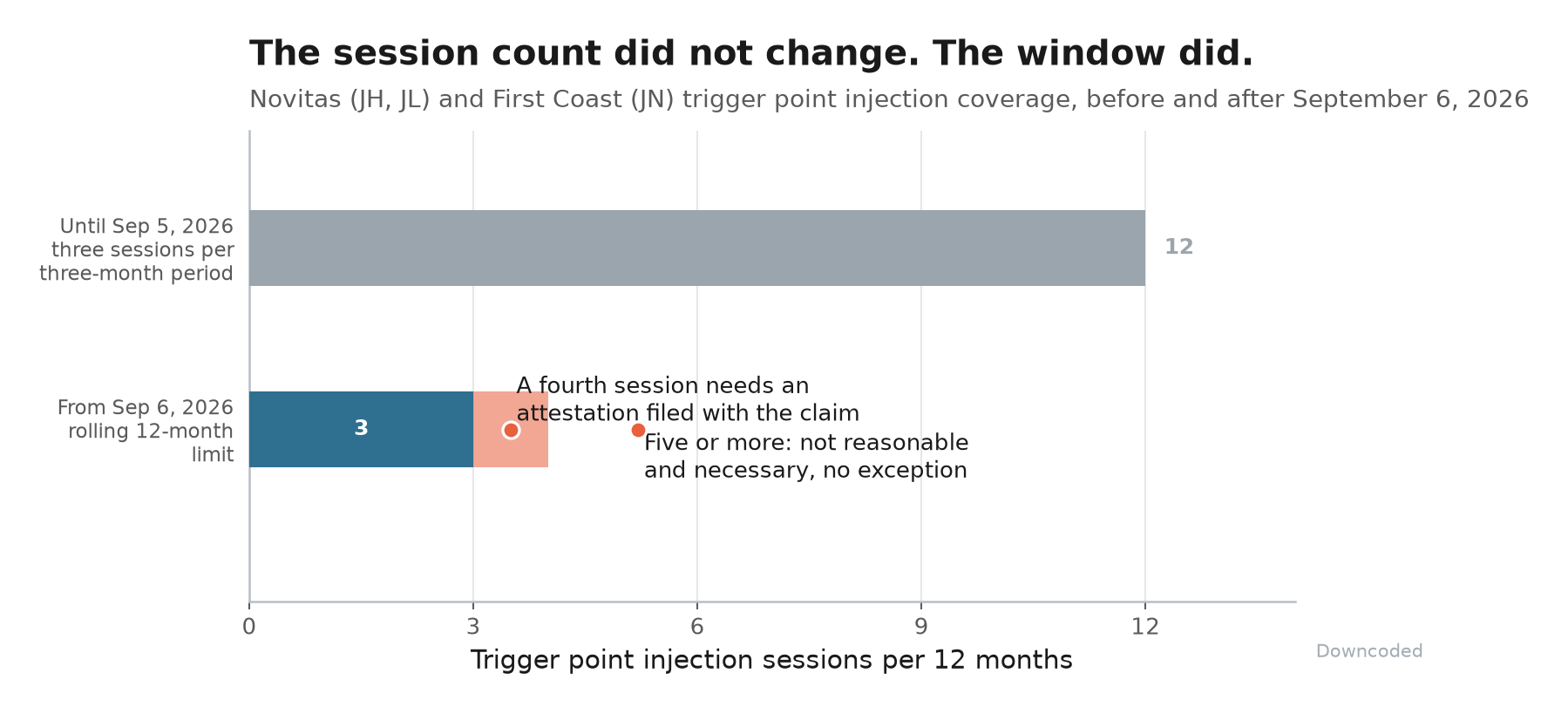
That is a 4x tightening of the frequency benchmark carried entirely by changing one word from month to twelve-month, and it arrives inside a revision to a document that has existed since 2015.

The rest of this brief is for subscribers.
The impact tables, the code-level detail, and the rest of the analysis sit past this line.
$50 a month, or $500 a year.
Already a subscriber? Sign in