 Downcoded
Who Ordered the Catheters?
Urological supplies just became the largest improper payment line in DMEPOS: 74.1% and $885.8 million, more than triple the year before. CMS's own table says the rate turns almost entirely on who is listed as the referring provider, and the compliance page a supplier would go read still quotes last year's number.
Forty-four claims.
That is the entire CERT sample for HCPCS A4353, the intermittent urinary catheter with insertion supplies, in the 2025 Medicare fee-for-service improper payment file. Those 44 claims project to $851,491,178 in overpayments at a 96.0% overpayment rate.
No other single code is close. That one line is 37.6% of every projected DMEPOS overpayment dollar in the file, and the next-largest named code comes in under $180 million.
The Category Nobody Was Warned About
The program-level number went the right way last year. Medicare FFS came in at 6.55% and $28.83 billion, down from 7.66% and $31.70 billion.
DMEPOS went the other way, from 21.4% to 24.1% and from $1.92 billion to $2.27 billion.
One policy group did all of that and then some.
Urological supplies ran 45.2% improper on $257.8 million in the 2024 file. In the 2025 file it is 74.1% on $885.8 million (chart below).
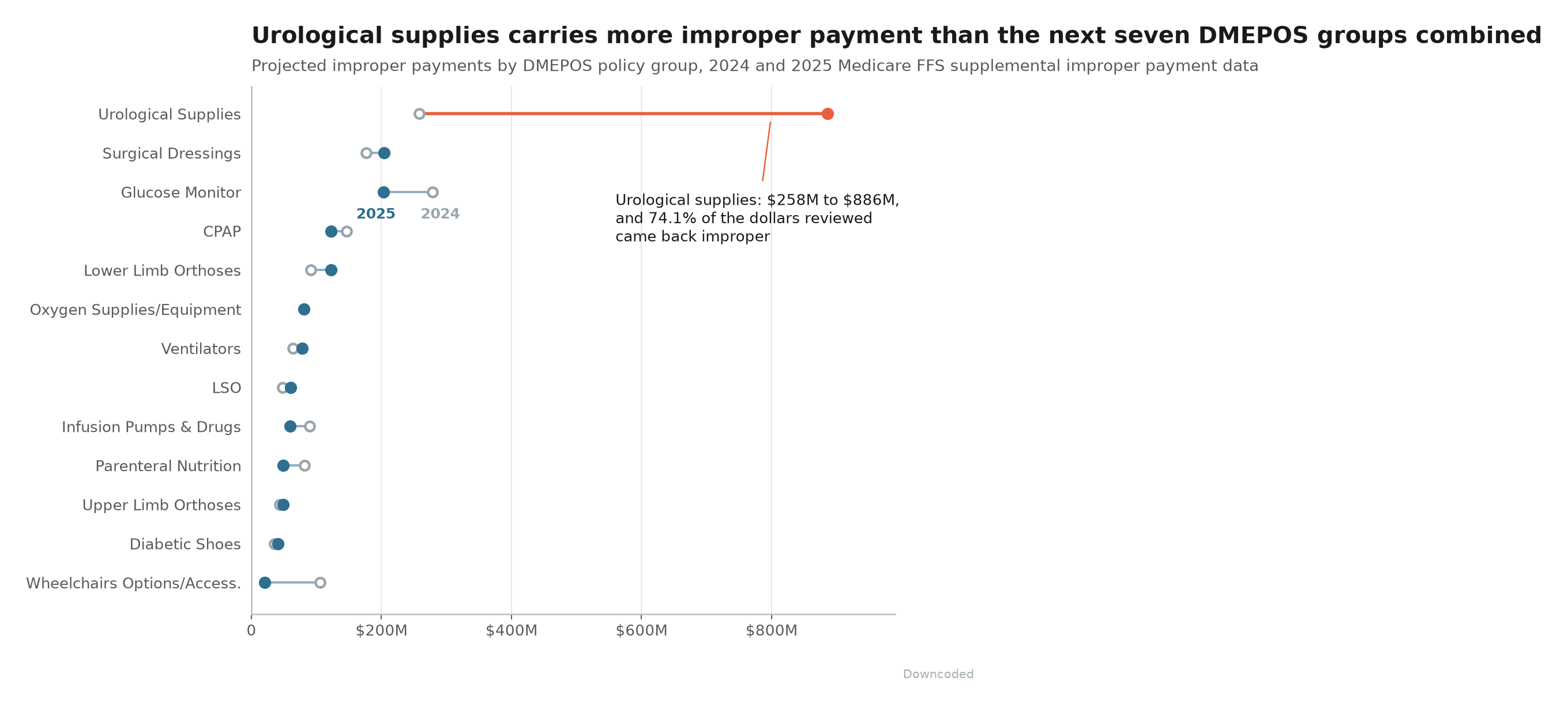
Take urological supplies out and the rest of DMEPOS actually improved, from $1.664 billion to $1.386 billion, down 16.7%.
Sampling windows matter here, so note them. The 2025 rate covers claims submitted July 1, 2023 through June 30, 2024, and the 2024 rate covers the twelve months before that.
So the file that just moved is the first one whose window sits squarely on the catheter surge.
Who Signed the Order
CERT breaks urological supplies out by referring provider, and four rows carry the whole category:
- Family practice: 96.3% improper, $832,363,352, off 141 sampled claims
- Nurse practitioner: 44.1%, $38.1 million, 43 claims
- Urology: 4.5%, $7.9 million, 187 claims
- Internal medicine: 2.9%, $0.8 million, 53 claims
Family practice referrals are 94.0% of every improper urological dollar in the file. A urologist's referral came back clean better than nineteen times out of twenty.
"Why would the same catheter be twenty times cleaner when a urologist ordered it?"
The gap was already visible a year earlier, at 87.2% for family practice against 14.1% for urology. It widened, and the dollars behind it went up six-fold.
The Footnote That Explains It
CMS answers the question in its own table note. The top root cause for urological supplies is "No response" on 73 sampled claims, and CMS flags that many of those claims sat under a payment suspension for Operation Gold Rush, making them zero-dollar errors that never touch the rate.
Gold Rush is the catheter case: 19 defendants, $10.6 billion billed to Medicare for urinary catheters and other DME, run on the stolen identities and confidential medical information of more than one million Americans in all 50 states. Of the roughly $4.45 billion the organization was scheduled to be paid, CMS and HHS-OIG stopped all but about $41 million.
That is what a 96.3% family-practice referral rate looks like from the inside.
Nobody in family practice ordered these supplies. Their NPIs were on the claims.
The error mix says the same thing plainly. 93.7% of the projected improper dollars in urological supplies land in the No Documentation category, against 50.5% for DMEPOS as a whole.
The records were never produced at all.
What the Compliance Page Still Says
Here is the practical part.
CMS publishes a provider compliance tip for urological supplies, and it cites 45.2% and $257.8 million against a last-updated date of February 12, 2026.
Those are the 2024 figures. CMS put the 2025 numbers out in its improper payments fact sheet on January 15, 2026.
The same holds on the other side of the ledger. MLN Connects ran the glucose monitoring supplies tip on August 6, and that page quotes 25.2% and $278.5 million.
The 2025 file puts glucose monitors at 17.3% and $203.4 million, down $75.1 million and 7.9 percentage points.
So the line that improved got the newsletter, and the line that tripled is described to you at 45.2%.
Final Thoughts
Strip the suspension-related rows out of the urological root-cause table and what remains is the ordinary DMEPOS list every legitimate supplier already runs on: coverage-criteria documentation, the refill request, the order, proof of delivery. Those are the errors that will still be sitting there when the suspended claims wash out of the sample.
What changes is where you should expect the reviewer to be standing. The 2027 file will be the first CERT read on claims submitted well after the takedown, and the urological rate is going to move a long way in one direction or the other.
Anyone quoting 45.2% between now and then is quoting a number that was already a file out of date.
Thanks for reading.