Medicare Advantage Got 4% of UnitedHealthcare's 30%
UnitedHealthcare said on September 1 that it would drop 30% of prior authorization requirements on October 1. We counted all five code files against each plan's own September list: Oxford 40.8%, commercial 29.7%, Individual Exchange 29.7%, Medicare Advantage 4.0%. D-SNP members get four fewer codes than Medicare Advantage members, and those four carry 90% of the list's weight.
UnitedHealthcare published a short notice on September 1 with exactly one number in it. Thirty percent of prior authorization requirements, gone October 1, across five plan families.
The notice links five code files and stops there. No counts, no denominator, no breakdown by plan.
So we counted them. All five removal files, parsed against each plan's own prior authorization code list effective September 1.
Three of the five met the number. Two came nowhere near it.
"If one 30% commitment covers five plan families, how does the Medicare one come to 4%?"
What the five files actually say
The removal files are not the same size, and the spread is not subtle:
- Oxford plans: 1,448 codes
- Community Plan: 1,015 distinct codes across seventeen state Medicaid programs
- Individual Exchange: 940 codes
- Commercial: 812 codes
- Medicare Advantage: 70 codes
- Dual Special Needs Plans: 66 codes
Raw counts don't settle anything on their own, because the plans carry different-sized prior authorization lists to begin with. Oxford's September 1 list runs 3,364 codes, Individual Exchange 3,077, commercial 2,550, and the combined Medicare Advantage and D-SNP file 1,706.
Divide, and the announcement checks out three times (chart below). Commercial comes to 29.73% and Individual Exchange to 29.74%.
Two separately published files, built a fortnight apart, landing on the same figure to the second decimal, is a code-counted commitment, executed.
Oxford went further, at 40.8%.
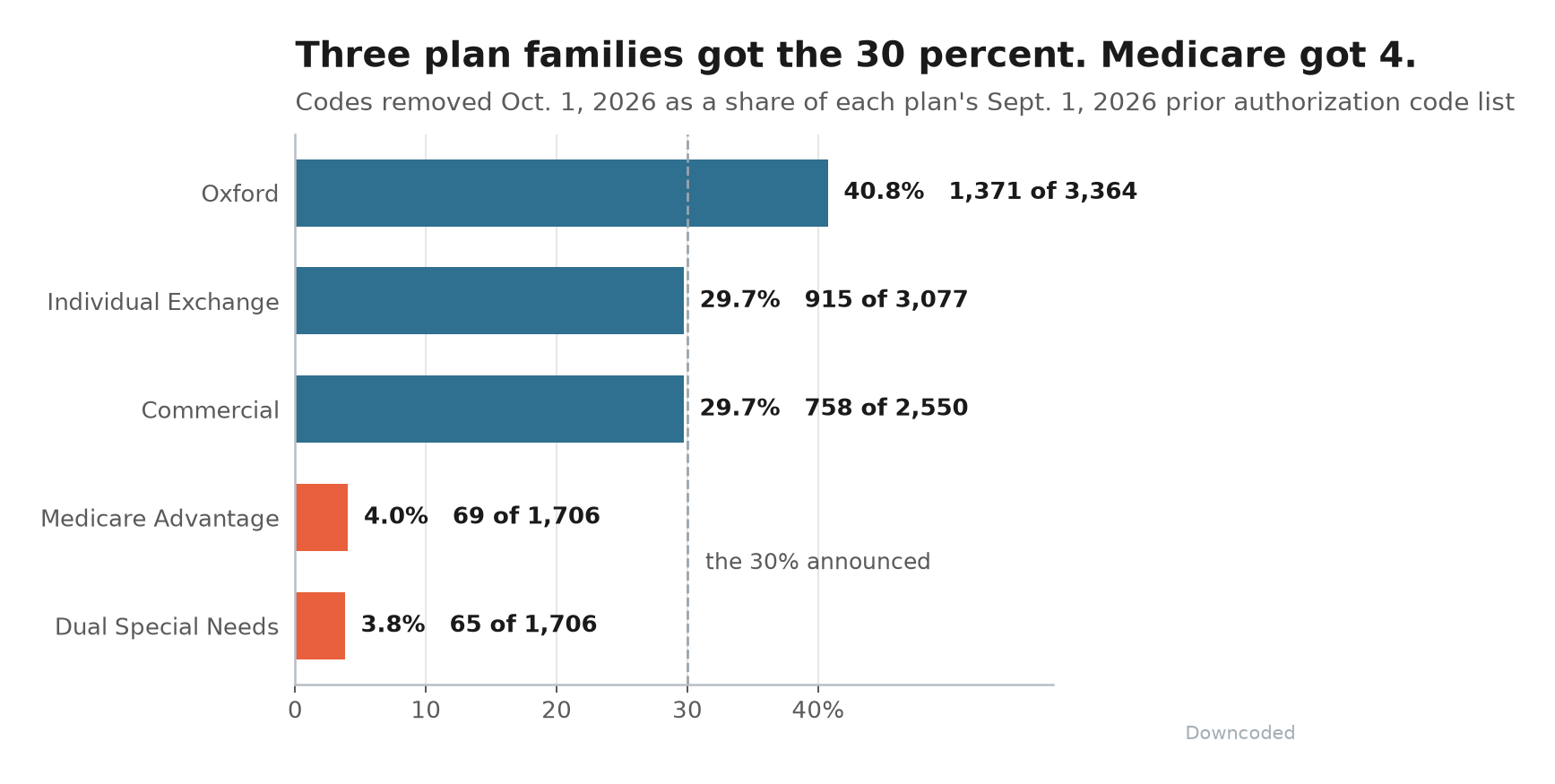
Medicare Advantage came to 4.0%, on 69 of 1,706 codes. D-SNP came to 3.8%.
Community Plan has no single denominator to divide by, because its requirements are published state by state, so we make no claim there.

The rest of this brief is for subscribers.
The impact tables, the code-level detail, and the rest of the analysis sit past this line.
$50 a month, or $500 a year.
Already a subscriber? Sign in