 Downcoded
Medicare's Busiest Enrollment Month Is Also Its Fastest
CMS publishes the stock of unprocessed initial enrollment applications twice a week and never the flow. We diffed all 352 archived builds of both files into arrivals and departures. The physician list takes 69 percent of its year in four months, and those are the four months where the fewest applications fall behind.
Twice a week Medicare publishes the names of every physician whose initial enrollment application its contractors have not finished. The list ran to 8,421 names on July 6 and 4,541 on Monday.
Three and a half years of that file now, and the same question underneath it every summer.
"Does a July application actually take longer than a January one?"
The file as published cannot answer it. It is a stock, and the answer is a flow.
So we pulled all 352 archived builds of the physician file and all 352 of the non-physician file, June 1, 2023 through Monday, and matched each build against the one before it. A name that shows up is an arrival. A name that drops off is a departure. Two earlier editions worked this dataset as a stock, the August 28 pull of the archive and Saturday's letter on the two queues diverging. Neither one turned it into a flow.
Four Months Carry the Year
199,825 physician arrivals and 199,365 departures across 351 intervals, plus 322,793 and 318,754 on the non-physician side. Better than half a million applications have moved through a list that has never held more than 8,446 names at once.
Intake is pure season (chart below).
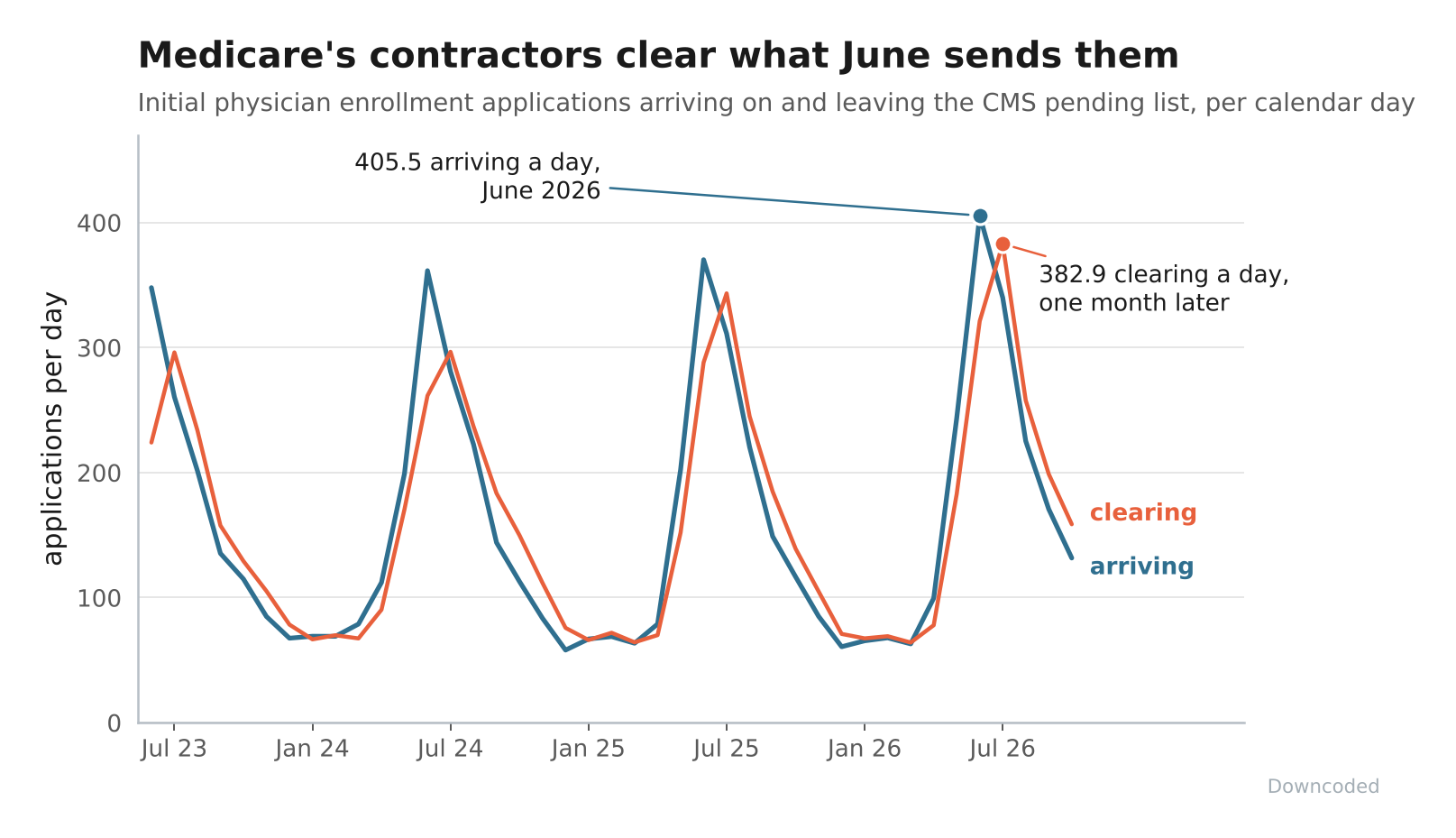
Physician applications arrived at 63.0 a day in March and 405.5 a day in June, a 6.44x swing inside one calendar year. 69.3% of 2026's physician intake, 37,379 of 53,954, landed in the four months from May through August.
The orange line is the part nobody has had. Clearance rides that sawtooth instead of sitting flat underneath it, cresting about a month behind: 64.1 a day in March, 382.9 in July, a 5.98x swing of its own.
Month against month the two series correlate at 0.924, and at 0.926 with clearance lagged one month. Push the lag to two and it falls apart, to 0.539.
The non-physician file does none of this. Its arrivals ran between 228.7 and 274.3 a day through the first nine months of 2026, a 1.2x band.
Saturday's edition showed the two stocks separating. This is the reason.
Nobody Falls Behind in June
So the pile is tallest in July. Where it gets interesting is that July is also when it moves fastest.
Group every arrival by the month it landed and follow it until it drops off. For 2026 physicians:
- January, 2,021 applications: 57.3% gone inside fifteen days, three-quarters gone by 35.
- March, 1,994: 61.5%, three-quarters by 32.
- June, 12,521: 80.2%, three-quarters by 14.
- July, 10,472: 77.9%, three-quarters by 14.
Six times the volume, less than half the upper-quartile wait. Across all 38 monthly cohorts old enough to have resolved, intake rate against the fifteen-day share correlates at +0.825 (chart below).
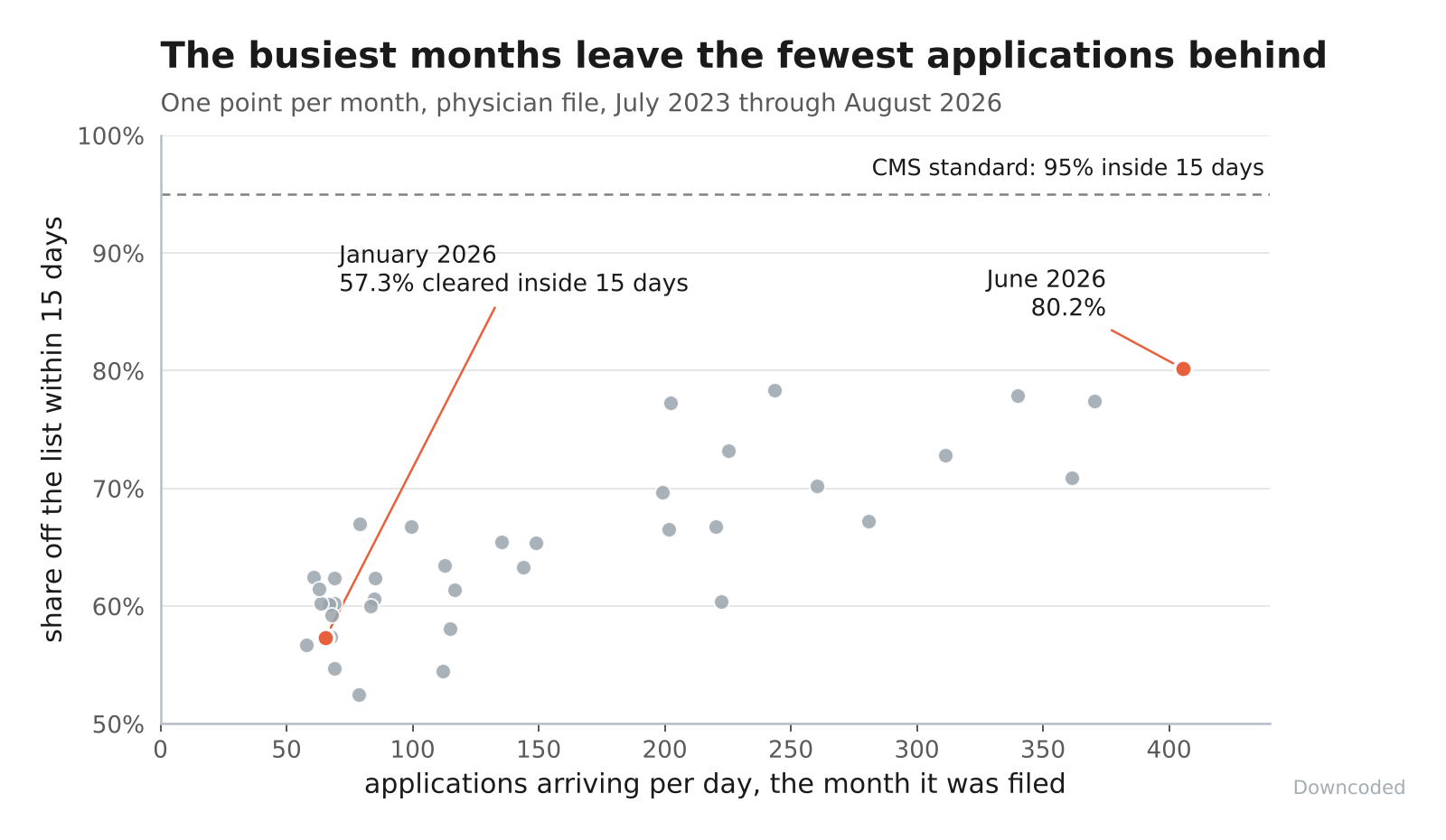
The median barely moves. It sits at eleven to fourteen days all year and correlates with intake at -0.188, which is nothing.
What the season moves is the tail. A January application is no slower through the middle of the distribution, and it is likelier to be one of the ones that falls behind.
First Coast publishes the yardstick CMS set for a CMS-855 filed through PECOS with no site visit, development or fingerprinting: "95% completed within 15 calendar days of receipt."
June 2026 reached 80.2%. January reached 57.3%.
No month in the archive clears that line, and the busiest ones come closest.
Final Thoughts
Two things the file will not tell you. A departure is not an approval, because rejection, return and withdrawal all look identical from outside.
And a spell measures days visible as unprocessed rather than days since receipt, since the gap between a contractor taking in a packet and logging it never enters the data.
What it does tell you is that the quiet months are the slow ones. If you have been timing credentialing around the July crush, the arithmetic runs the other way, and the applications filed into the busiest four months of the year are the ones Medicare gets to.
Thanks for reading.