 Downcoded
The 39 Codes WISeR Stops and the 379 It Touches
CMS publishes the entire scope of its new prior-authorization model in one free guide, now on its seventh version: thirteen service families, 39 codes that need the authorization, 64 ICD-10 indications, and 379 associated codes that get paid or denied on somebody else's decision. Here is what is actually in it.
Thirty-nine codes.
That is the whole list of CPT and HCPCS codes that now route through a private review company, by prior authorization or by pre-payment review, before Original Medicare pays them in New Jersey, Ohio, Oklahoma, Texas, Arizona or Washington.
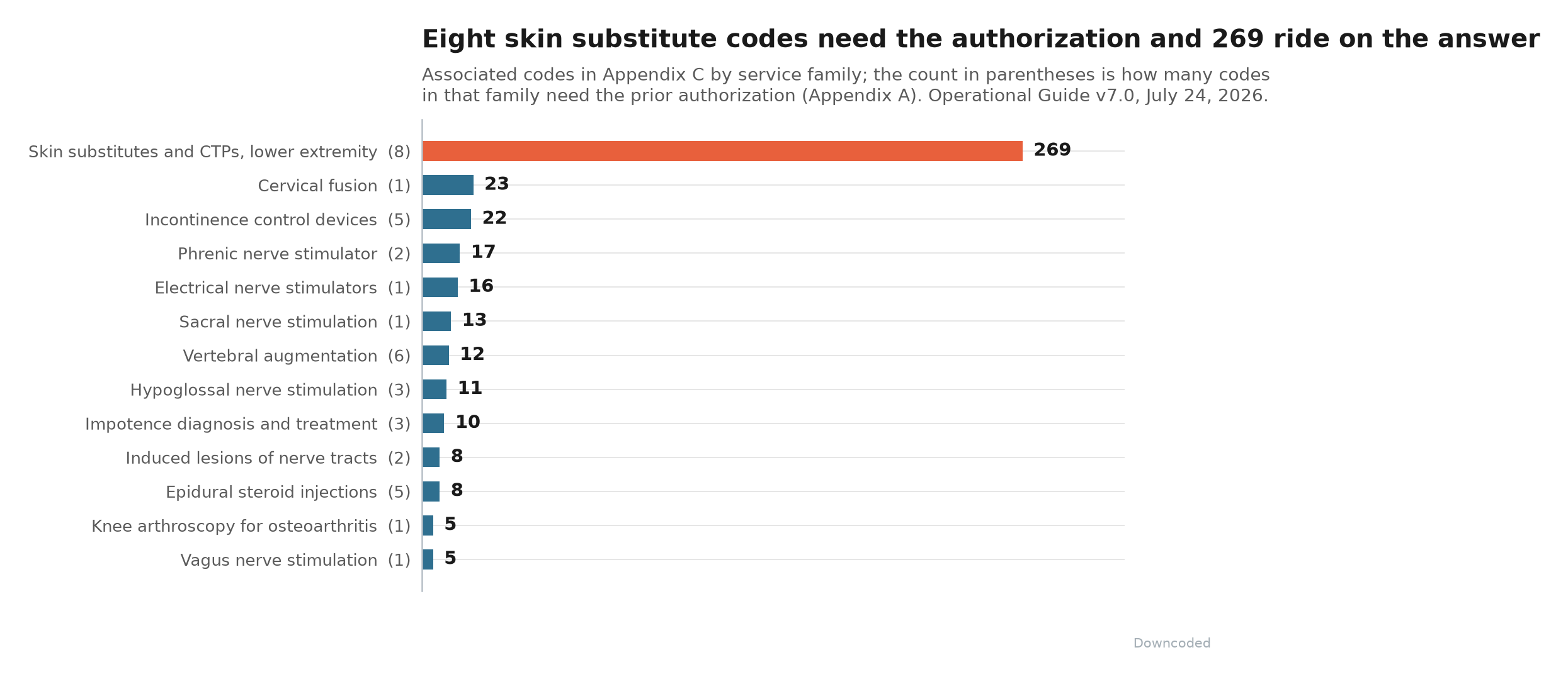
The list of codes that get paid or denied on the strength of those decisions runs to 379, and one service family holds 269 of them (chart below).
Both lists are in the same document, free, no registration and no sales call: the WISeR Model Provider and Supplier Operational Guide, published by the Innovation Center and now at version 7.0, dated July 24, 2026.
"Which of my codes does this model actually reach?"
The model page answers that with three examples. The guide answers it with every code, every indication, and a dated log of every change to either.
What Is Actually In It
The guide carries three appendices, and they do different jobs:
- Appendix A is the authorization list. 39 codes across 13 service families, each one keyed to the NCD or LCD that already governs it, eight NCDs and fourteen LCDs between them. Knee arthroscopy is one code, 29877. Skin substitute application is eight, 15271 through 15278.
- Appendix B is the indication list. 64 ICD-10 codes, and it only covers three of the thirteen families. Vagus nerve stimulation and sacral nerve stimulation are in scope only for the diagnoses named there.
- Appendix C is the associated-codes list. 379 unique codes, 23 of which show up under more than one family.
Everything else a biller needs sits in the body.
Determinations come back in 3 calendar days standard and 2 days expedited.
An affirmed decision's unique tracking number is good for 120 calendar days from the decision date, which is the number your scheduling team needs more than any of the others.
The 379 Is the Part That Bites
Section 7.3 is where a chart-review question becomes an accounts-receivable question.
Associated items and services never go through prior authorization themselves. They get paid if the primary service was affirmed or paid, and they get denied if the primary service was non-affirmed or denied.
The guide is blunt about the timing: those claims "may be automatically denied or denied on a post-payment basis."
So the exposure is wider than the authorization list by roughly ten to one. Of the 379 associated codes, 18 are anesthesia codes and 276 are alphanumeric HCPCS, which is mostly implanted devices and product codes.
The lower-extremity skin substitute family is the outlier and it is not close.
Eight application codes need the authorization. 269 codes ride on the answer, and 234 of those are the Q-coded products themselves.
Seven Versions, Mostly Subtractions
The cover page carries a version history, and that is the part worth saving.
Seven versions between October 10, 2025 and July 24, 2026, each with a date and a description of what moved. Read down the column and the direction is consistent: CPT 22585 came out in December, C5271 through C5278 came out as skin substitute codes in February, ICD-10 G47.33 came out as a vagus nerve stimulator indication in the same version, and Q4100 and Q4106 came out of the associated list in April.
Two families never started. Deep brain stimulation was delayed because the first-stage codes sit on the Inpatient Only list, and percutaneous image-guided lumbar decompression was delayed over its coverage-with-evidence-development approvals.
Our read is that a model you can diff version over version is a model you can plan against, and almost nothing else in prior authorization gives you that.
The Exemption List Turns Over Today
Section 5 is the one to forward.
Since July 2026 the participants have been exempting providers automatically on demonstrated compliance, at the individual NPI level rather than the group or facility level. The floor is 10 prior authorization requests across WISeR services in an assessment period plus a minimum affirmation rate the participant sets and posts publicly. Exemption then applies across Part A and Part B, every WISeR service, every site of care.
Providers get added to the list quarterly, notified before the quarter starts, and today is a quarter start.
And there is a claims-side catch that will cost somebody a clean claim rate this month: where the exempted NPI goes depends on the setting.
Office and home, the rendering provider field. Ambulatory surgery center, the referring or ordering provider field. Outpatient department, the operating provider field.
Exemption lasts at least a year, gets retested with no more than 10 additional documentation requests annually, and comes with 60 days of notice before it is taken away.
Final Thoughts
We noted yesterday that the Innovation Center's own update feed carries exactly one WISeR row, the June 2025 announcement.
The model's change log lives somewhere better. It is on the cover page of a PDF reissued six times since it first appeared, and it names every code, every indication, and every date one of them moved.
Prior authorization programs do not usually hand you the list. This one does, in full, with the diagnoses attached and the collateral spelled out.
Anyone billing in the six states can open the guide this afternoon, pull Appendix C, and find out how many of their own codes are sitting downstream of a decision somebody else makes in three days.
Thanks for reading.