 Downcoded
The Twenty Hospitals That Won All Five Residency Rounds
Section 126 of the Consolidated Appropriations Act, 2021 put 1,000 Medicare-funded residency slots on the table, and CMS posted the final 200 on Monday. Join all five award files and 224 hospitals won something. Twenty won in every round, and they hold 269.23 of the 1,000 DGME slots and 242.45 of the 1,000 IME slots between them.
Medicare ran out of section 126 residency slots on Monday.
CMS posted the Round 5 results for section 126 of the Consolidated Appropriations Act, 2021, the provision that made 1,000 additional FTE resident cap slots available at no more than 200 a year starting in fiscal 2023.
Round 5 was the last 200. Ninety-nine hospitals across 31 states split them, effective July 1, 2027.
The results shipped the way all five rounds have shipped: a ZIP file with an awardee list, a remaining-applicant list, and a short instructions file. Tomorrow's MLN Connects gives it one line.
So we pulled all five ZIPs and joined them on the CCN.
"Which hospitals won this thing more than once?"
Twenty Never Lost
224 hospitals took at least one slot across the five rounds. Most won once and never again: 91 one-time winners, 51 that won twice, 39 three times, 23 four times.
Twenty went five for five (chart below).
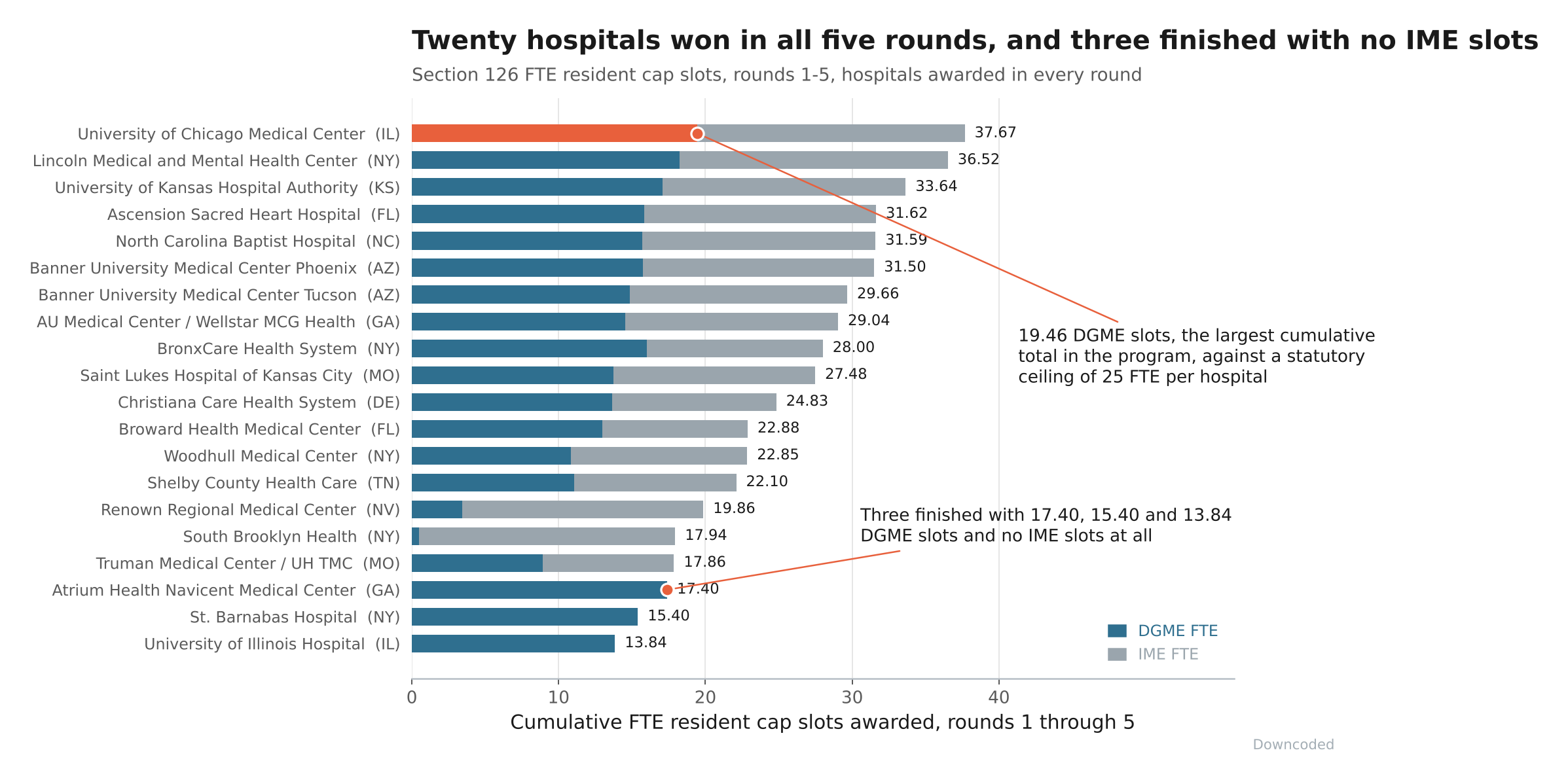
Those twenty are 8.9 percent of every hospital that ever won a section 126 slot, and they hold 269.23 of the 1,000 DGME FTE and 242.45 of the 1,000 IME FTE. Call it a quarter of the program, won by one hospital in eleven.
University of Chicago Medical Center leads at 37.67 combined, and its 19.46 DGME total is the largest any hospital accumulated against the statute's 25 FTE ceiling. Lincoln Medical and Mental Health Center is second at 36.52.
New York holds five of the twenty. Three of those five, Lincoln, Woodhull and South Brooklyn Health, are NYC Health + Hospitals facilities.
The other two are BronxCare Health System and St. Barnabas Hospital.
How You Win One
The contest has a published rulebook, which is why the same names keep clearing it. A hospital has to qualify in at least one of four categories:
- rural, or treated as rural under the law
- training residents in excess of its GME cap
- in a state with a new medical school or branch campus
- serving a geographic health professional shortage area
CMS reserves at least 10 percent of the slots for each of the four, and no single hospital may take more than 25 FTE across the whole program. Then it ranks the applications by HPSA score, highest first, and works down the list until the 200 are gone.
That ranking step is the entire game.
GAO's December read of the first three distributions found the lowest winning score in each round ran 11 to 15 on a scale that tops out at 25. Round 5's winning scores ran 11 to 22, median 16.
The floor held for five years, and a hospital using an HPSA score has to attest that at least half of its residents' training time happens inside it.
Psychiatry took the largest share of the final round at 60.29 of the round's 400 combined DGME and IME FTE, ahead of surgery at 55.60 and internal medicine at 55.57. In Round 4 psychiatry took 86.91, the biggest share of that round too.
Every Award Has Two Halves
Section 126 raises two caps, and the award file gives them separate columns.
The DGME cap feeds the per-resident-amount formula. The IME cap feeds the teaching adjustment that rides on inpatient DRG payments.
At the same hospital, the two numbers do not have to match.
Read the bottom of the chart. Three of the twenty finished the whole program with DGME slots and no IME slots at all:
- Atrium Health Navicent Medical Center, 17.40 DGME and 0.00 IME
- St. Barnabas Hospital, 15.40 and zero
- University of Illinois Hospital, 13.84 and zero
And the mirror image: South Brooklyn Health holds 17.45 IME FTE against 0.49 of DGME.
If you are the one building the cost report exhibit for July 2027, that split is the thing to get right before anything else.
Three of these twenty book a cap increase on one line and nothing at all on the other. A fourth books half a slot.
What a Slot Is Worth
GAO priced the whole program last December: CMS estimated the new positions "will cost $1.8 billion over the first 9 years." Spread across 1,000 positions that is $1.8 million a position, an average rather than an annual rate, since the slots phase in across five rounds and July 2027 is the last cohort to arrive.
Run the twenty hospitals' 269.23 DGME FTE through that figure and you get something on the order of $485 million. A bit of an oversimplification for time: a DGME check is the per-resident amount times capped FTEs times Medicare patient load, IME runs off its own formula, and neither one lands the same way twice.
For scale, GAO's read of 2023 cost reports puts the median section 126 recipient at $4,443,798 of DGME, $10,823,754 of IME, and $15,410,127 of total GME in a single year. Medicare paid roughly $22 billion across more than 1,400 teaching hospitals that year.
Final Thoughts
Five rounds, five ZIP files, column headers that moved between rounds. The program's own record of who it funded exists only as a join nobody at CMS published.
Do the join and the answer is a short list of hospitals that treated a Medicare application cycle as a standing institutional capability rather than a one-time shot.
They wrote the HPSA attestation five times. They kept a program in the queue every year from fiscal 2023 through the last round.
There is no Round 6. What those twenty built now sits in their cap, permanently, starting July 1, 2027.
Thanks for reading.