 Downcoded
Two Hospitals Got $303 Million From a Misplaced Decimal
HHS-OIG posted its Phase 3 Provider Relief Fund audit on Monday, finding $657,938,721 in potential overpayments across 165 sampled providers and telling HRSA to go collect it. Two acute-care hospitals are $303.7 million of that, both because a revenue figure was keyed three orders of magnitude too small and the manual review that caught it did not stick.
If your organization filed a Phase 3 Provider Relief Fund application, HRSA decided what you were owed from five numbers somebody on your team typed into a portal.
For roughly 95% of applications it never opened the documents behind them.
The audit of what that produced went up on the OIG site Monday: $657,938,721 in potential overpayments across 165 sampled providers, with a recommendation that HRSA go get it back.
"How much of a $658 million federal overpayment finding is a typing error?"
Most of it.
Where the $655.7 Million Came From
OIG sorted the statistical sample's overpayments into five causes, and one of them swallows the chart (below).
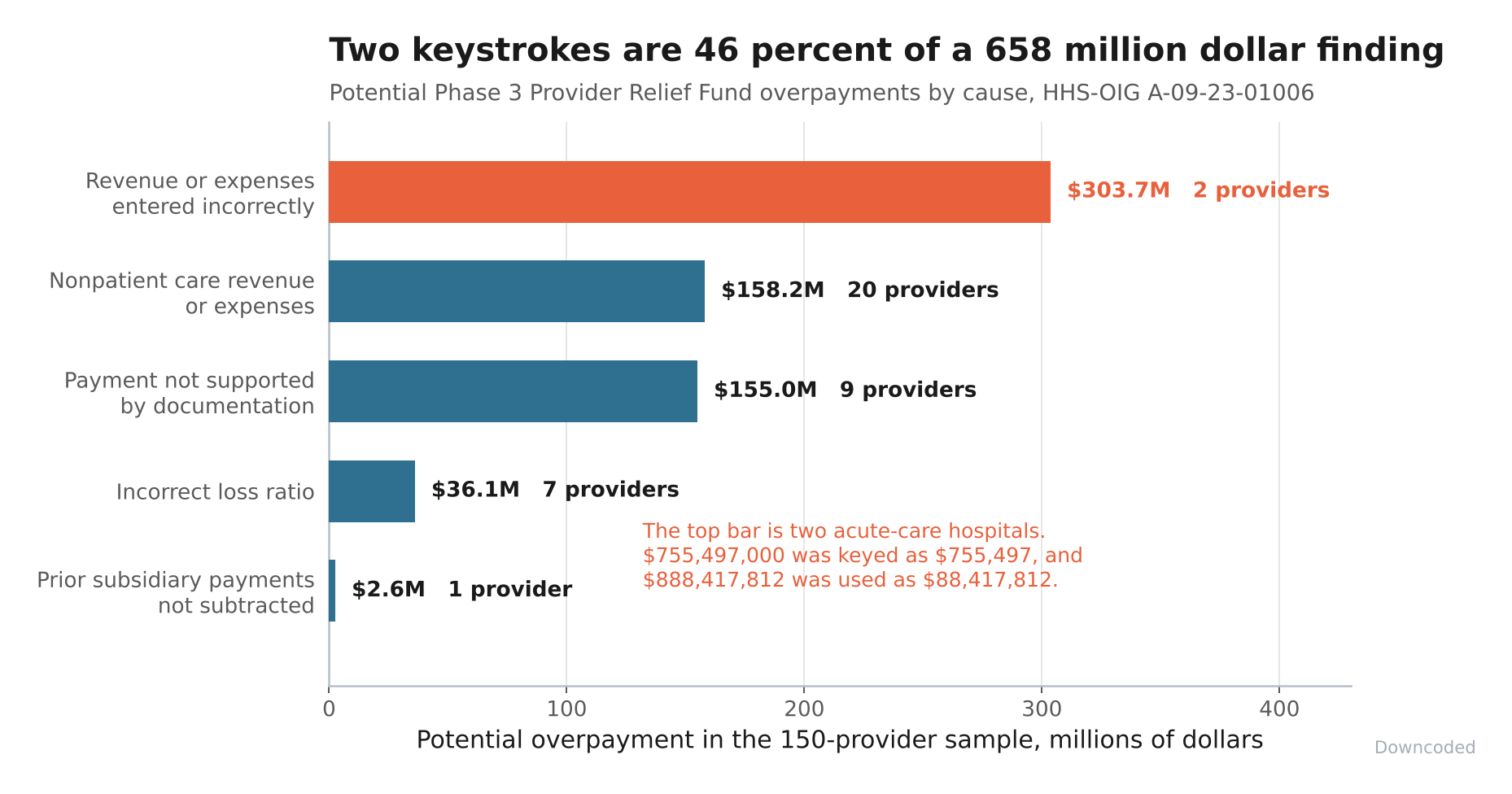
Two providers, both acute-care hospitals, carry $303,667,826 of the $655,651,947 found in the 150-provider sample. That is 46.3%, more than the other four causes put together, and both are keystrokes a reviewer had already caught.
On the first application, HRSA's contractor flagged the operating revenues from patient care for the first two quarters of 2020 as wrong, corrected the second quarter and left the first.
The right figure was $755,497,000. The one used was $755,497.
Losses appeared out of nowhere and the hospital was overpaid $166,030,734.
On the second, the contractor spotted the typo, adjusted the quarterly figure to $888,417,812 to match the hospital's own financial statement, and HRSA calculated the payment on $88,417,812 anyway. Overpayment: $137,637,092.
The rest of the finding is the ordinary stuff:
- $158,154,511 to 20 providers whose patient care figures included things that were not patient care. Non-340B pharmacy revenue, capitation, third-party activity and bad debt on the revenue side; advertising, collection agency fees, travel and, at one sampled multispecialty practice, alcoholic beverages on the expense side.
- $155,037,071 to nine providers whose revenue was never supported by an appropriate document at all. One outpatient specialty provider organized as an S corporation sent in a Form 1040.
A wrong loss ratio accounts for $36,148,722 across seven providers, and one medical group kept $2,643,817 because it left three subsidiaries off its application and the manual review did not go looking.
Nobody Is Extrapolating This One
When OIG ran the same audit on Phase 2 in March 2024, it found $18.4 million of overpayment in its sample and projected $159.4 million across the program, 3.3% of the dollars it audited.
This time it declined. The lower limit of the two-sided 90-percent confidence interval came in below the overpayments already sitting in the sample, so the report publishes no program-level estimate and recommends recovery only from the providers it actually opened.
The $658 million is a list of 45 named providers.
Whether you are on it comes down to the sampling design, and that answers more cleanly than you would expect (chart below).
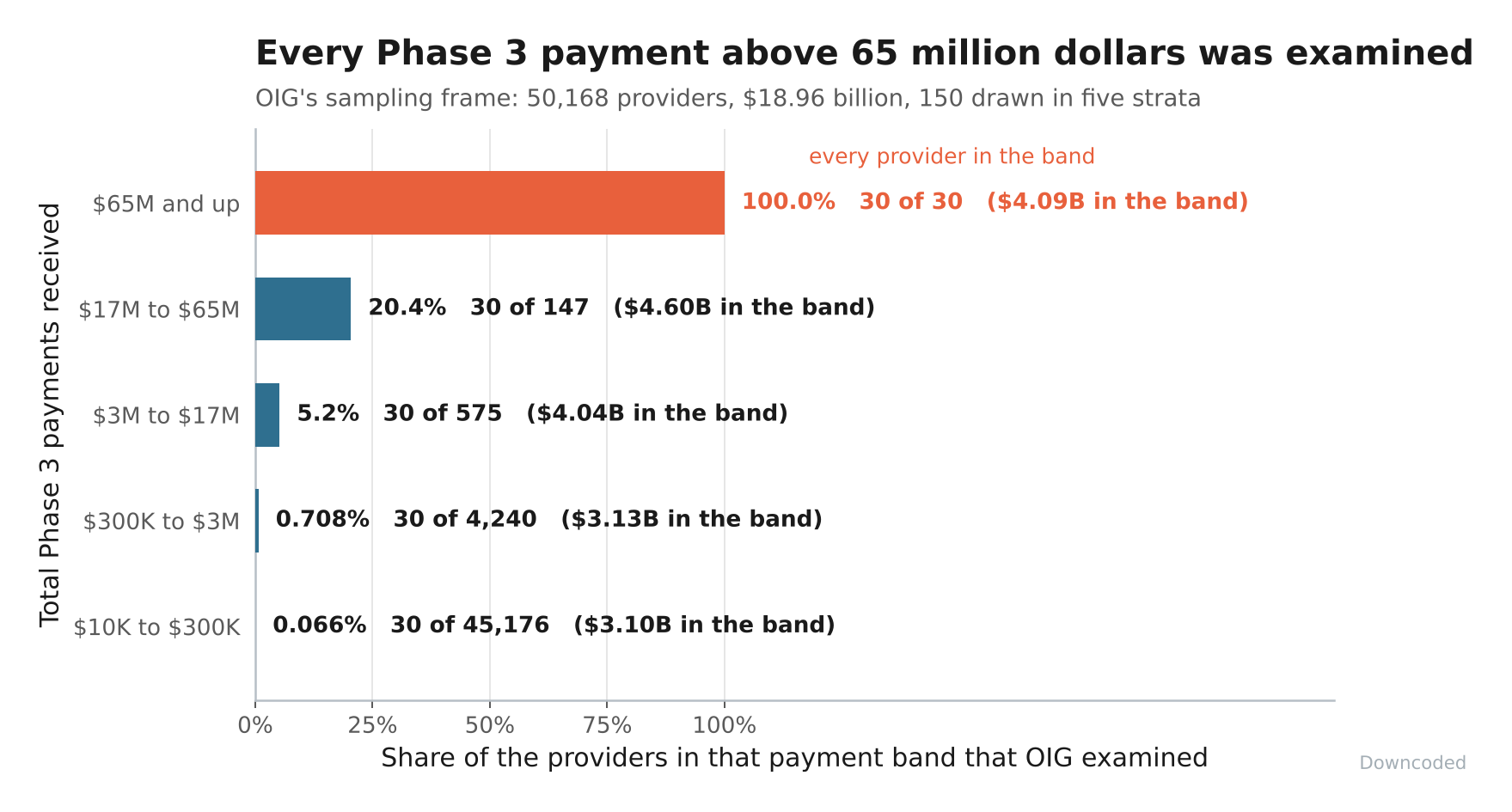
OIG took 50,168 providers holding $18,959,584,563 and cut them into five bands by payment size, then drew 30 from each. The top band, providers paid $65 million or more, contains exactly 30 names.
Every Phase 3 payment in the country above $65 million was examined.
At the other end, among the 45,176 providers paid between $10,000 and $300,000, the odds of being pulled were one in 1,506.
That also explains where the two decimal points live. An overpayment cannot be bigger than the payment it came out of, so both hospitals received more than $65 million, which puts both of them inside the census.
Two of the thirty largest Phase 3 recipients in the country were overpaid because three zeroes went missing.
$324 Million Walked Out Before Publication
The draft went to HRSA on June 30 under a different title: "HRSA Made Nearly $1 Billion in Potential Overpayments." It recommended recovery of up to $982,942,270.
HRSA answered on August 14 with an arithmetic complaint (one error and ten cases of what it called "rounding early") and one fact that mattered. Two sampled providers had already returned their money in full, $9,128,686 and $314,874,863.
That $324,003,549 is the entire distance between "nearly $1 billion" and the title that published.
On the other 46 sampled providers, HRSA says it will review the documentation "pending available resources" and seek repayment as appropriate. It used that phrase twice in a two-page memo.
One more number before you model your own exposure.
The same sample carries $131,319,346 of potential underpayments to 26 providers, and no recommendation is attached to a dollar of it. The Fiscal Responsibility Act of 2023 rescinded the unobligated PRF balances and HRSA stopped paying, so the errors only run one direction now.
Final Thoughts
None of this started as a billing decision. Congress told HHS to move the money through "the most efficient payment systems practicable," HRSA took self-reported revenue at face value on 19 applications in 20, and a program that pushed $145.9 billion out the door was always going to reconcile afterward.
Afterward turned out to be six years, and it arrives at the organizations that filed the applications. If your finance team still has the Phase 3 working papers in a box, this is a good week to find out which five numbers went into the portal and what document is sitting behind each one.
Thanks for reading.