What Makes an Organ a Medicare Organ?
OIG put $379.9 million on CMS's presumption that any organ a transplant center ships out the door went into a Medicare patient, and said the statute forbids it. Four weeks earlier CMS finalized that same presumption for organ procurement organizations, effective October 2028, and booked $1.28 billion of savings against it.
Twelve of the 180 organs in the OIG sample were never transplanted into anybody.
One of them was never surgically removed at all, because the organ procurement organization that came to collect it determined the donor was not deceased. The transplant center reported it as a Medicare usable organ anyway, and Medicare paid its share of acquiring it.
Nobody miskeyed anything. Every center OIG asked said it had followed the manual, every MAC said the same, and the manual says exactly what they said it says.
HHS-OIG issued OAS-25-07-124 on September 1 and posted it two days later. Across cost reporting periods ending 2017 through 2022, it estimates Medicare paid certified transplant centers $379.9 million for organs that never went into a Medicare enrollee. That is 27.0% of the $1.41 billion those 122 centers drew for organ acquisition inside the audit frame, and the bottom of OIG's own 90 percent interval still lands at 15.7% (chart below).
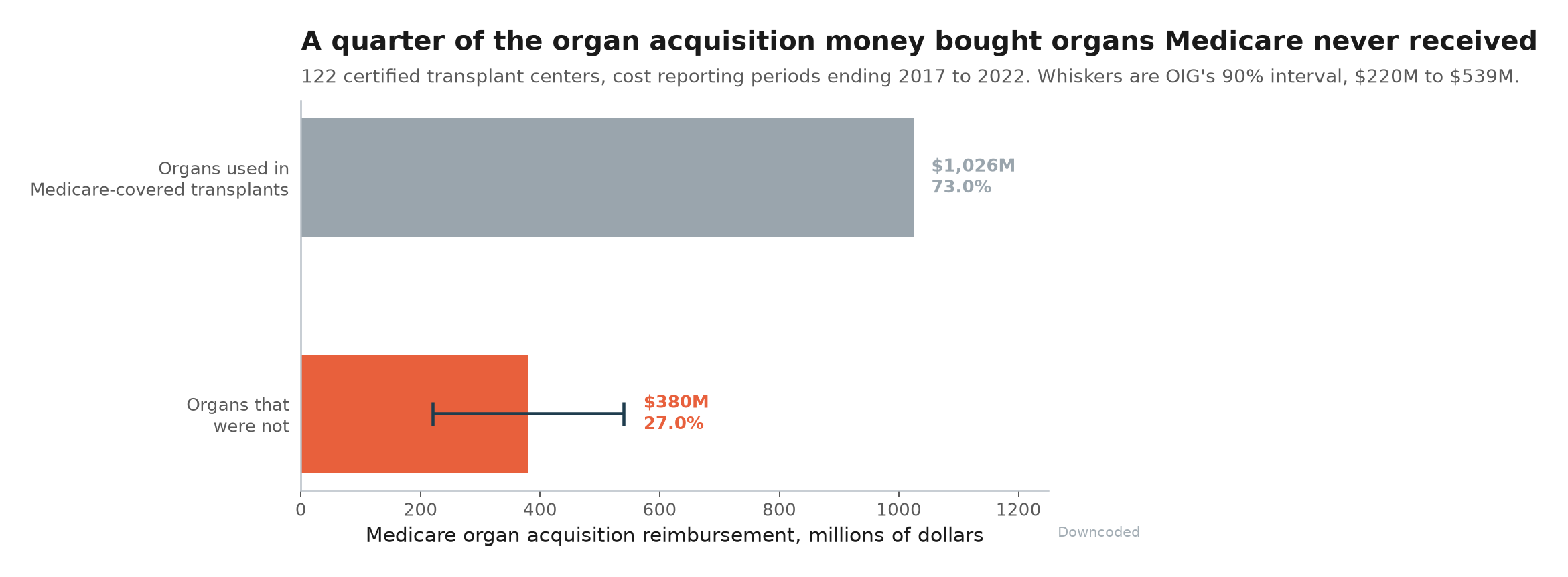
The desk ran the topline yesterday. What follows is the mechanism underneath it, and the rule CMS finalized four weeks earlier that answers the same question the other way.
For scale: Medicare reimbursed transplant centers $3.31 billion for roughly 39,000 organs in CY 2023, against $1.27 billion and about 22,000 organs in CY 2011. Cost up 160%, volume up 77%, across roughly 250 certified centers.
The Ratio Is the Whole Game
Organ acquisition is a pass-through, and the pass is computed per organ type on Worksheet D-4 of the CMS-2552-10, after indirect costs land on Worksheet B.
Take the center's accumulated organ acquisition costs, multiply by Medicare usable organs / total usable organs, then subtract the revenue the center collected for organs it transferred to an OPO or another center. Unusable organs stay in the cost pool and stay out of the ratio, because Medicare keeps sharing in them.
So the numerator is the money. Every organ that lands in it drags a slice of the whole cost pool onto Medicare's side of the ledger.
And PRM-1 chapter 31 § 3115 tells centers to count any organ furnished to another OPO or center as Medicare usable. Not the ones that turned out to be transplanted into Medicare enrollees. All of them.
That instruction is a leftover. When the ESRD benefit arrived in 1972, Medicare assumed most kidney recipients would be enrollees, which was cheap and roughly true.
Hearts, lungs, livers, pancreases and intestines got added to the same paragraph, and the assumption came with them.

The rest of this brief is for subscribers.
The impact tables, the code-level detail, and the rest of the analysis sit past this line.
$50 a month, or $500 a year.
Already a subscriber? Sign in