 Downcoded
Your LCD Feed Fired 406 Times and Meant It 50
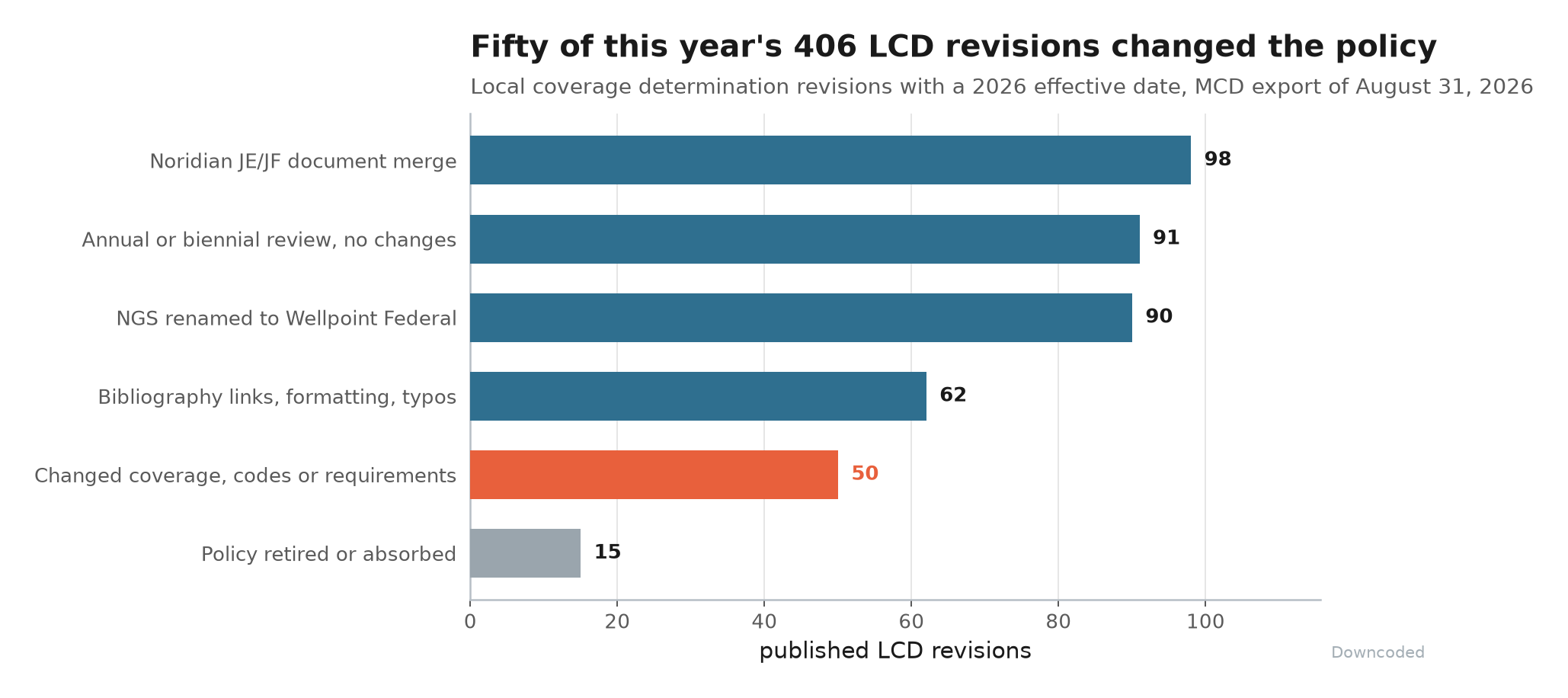
Medicare published 406 local coverage determination revisions with a 2026 effective date. We classified every one off the contractor's own revision note, and 50 of them changed coverage, codes or requirements. The other 356 are a corporate rename, a document merge, and a lot of bibliography links.
Two local coverage determinations go into effect this morning. First Coast's L33912 and Novitas's L35010, both titled Trigger Point Injections, both posted for notice on July 23 and effective today, both declaring the same second reason for change: "Other (reduce improper payment)."
By effective date they are the 48th and 49th revisions this year that changed a Medicare coverage policy.
Medicare has published 406 LCD revisions carrying a 2026 effective date. We read every one of them this morning.
"How much of the coverage churn your team tracks is coverage?"
What the 406 actually were
The Medicare Coverage Database ships a full export of every current LCD once a week, and inside it is lcd_x_revision_history, the table where each MAC narrates what it did to a policy and why. 7,875 rows, one per published version.
Pull the rows with a 2026 effective date and you get 406. Bucket them by what the contractor itself wrote, and 50 describe a change to coverage indications, a code list, provider qualifications or documentation requirements (chart below).
Those 50 revisions land on 40 distinct policies, against 858 active LCDs in the same export. So roughly 1 in 21 of Medicare's local coverage policies was substantively touched this year.
The other 356 break down cleanly, and every one of them still produces a version bump, a new PDF, and an alert:
- 98 are Noridian folding its JF policies into its JE documents so the two jurisdictions share one policy number. Half of that count is a retirement, half is the surviving document gaining a line of contractor information.
- 91 say some version of "annual review, no changes were made."
- 90 are one sentence about a name.
- 62 are broken bibliography hyperlinks, formatting passes and typo corrections.
- 15 retire a policy into another policy.
The rename took five months to finish
National Government Services became Wellpoint Federal on April 1, 2026. The provider notices were emphatic that nothing operational moved: no change to payer IDs or claims processing, no re-enrollment.
The Coverage Database agrees, in identical language, 90 times across 88 policies:
"Effective 4/1/2026, the Contractor Information field has changed from National Government Services to Wellpoint Federal. There are no changes to coverage on Local Coverage Determinations and Billing and Coding Articles."
82 of those landed in April. The rest are scattered across February, May, July and August, so a monitoring feed watching Wellpoint policies was still catching a five-month-old rename last month.
Noridian's merge is the same shape with better paperwork. Its own retirement notice says the quiet part outright: "Per the Centers for Medicare & Medicaid Services (CMS), this update is considered non-substantive and does not alter the intent of coverage or non-coverage outlined in any LCD."
Nobody is hiding anything here. CMS knows these are not changes, and it labels them: 74 of the 88 renamed policies carry "Change in Corporate Name" in their declared reason-for-change field, and another 9 carry "Change in Affiliated Contract Numbers."
Two months produced nothing at all
Volume and signal come apart across the calendar (chart below).
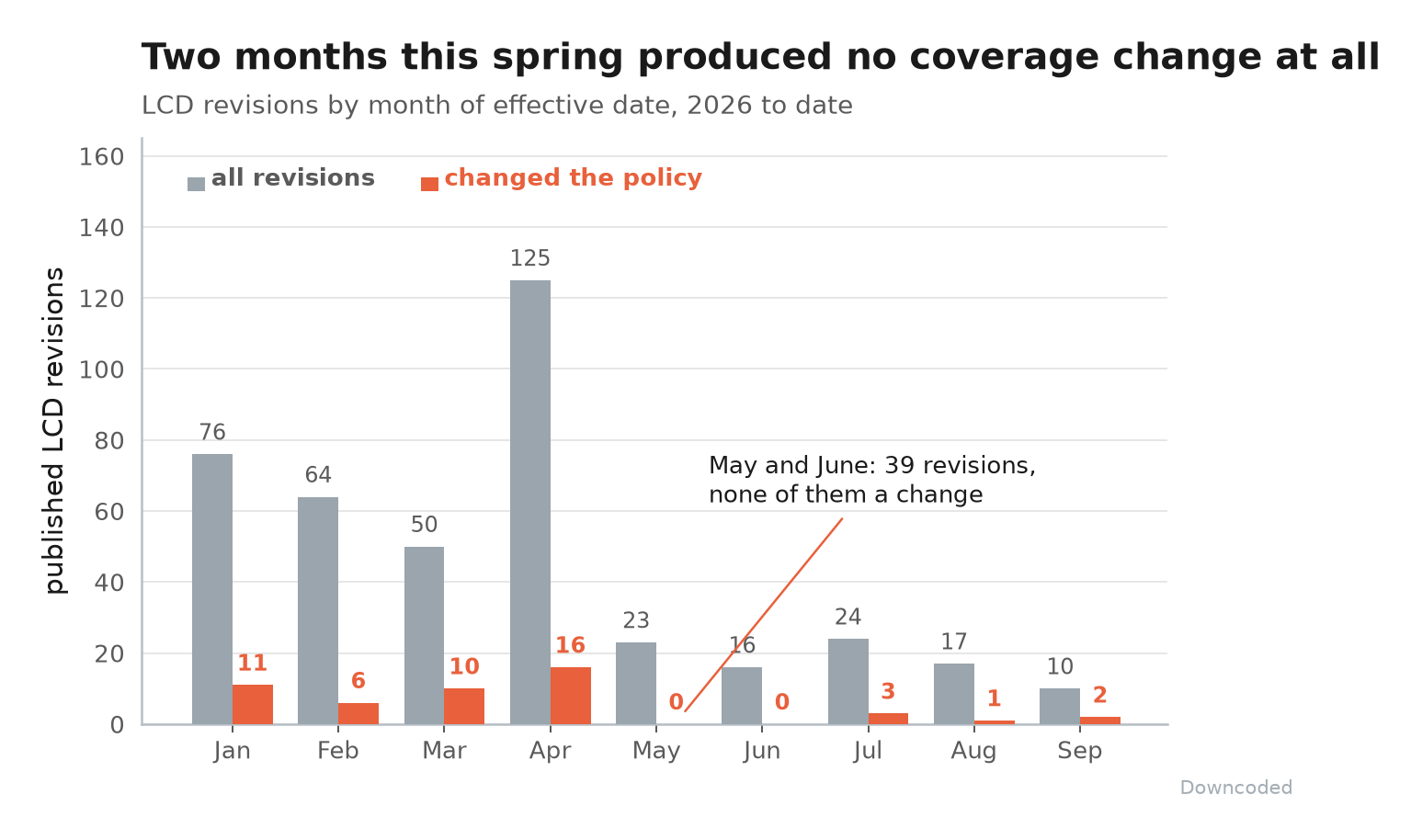
April is the busiest month of the year at 125 revisions, almost entirely on the back of the rename batch, and it carries 16 real ones.
Then May and June together produced 39 revisions and not a single coverage change. Every one is an annual review that found nothing, a grammatical cleanup, a dead bibliography link, a rename, or a retirement.
Anyone who spent those two months reading LCD updates read nothing.
What today's two are doing
Which is what makes this morning worth the attention it costs.
L33912 sits at version 23 with four published revision entries behind it; L35010 is on version 50 with nine. Both were proposed for comment on February 19 and posted for notice on July 23, which is 45 days of notice to the day, the full 21st Century Cures Act clock for a restrictive revision.
And both declare two reasons for change:
- Creation of Uniform LCDs, within a jurisdiction for First Coast and with another jurisdiction for Novitas. Two MACs converging on one trigger-point policy.
- Other (reduce improper payment), which is a contractor naming improper payments as the reason it rewrote a policy.
That second label is the entire population. Across the 953 reason-for-change rows on the current version of the 882 LCDs that carry one, exactly two mention improper payment.
A MAC that tells you it tightened a policy to cut improper payments has told you where its next audit interest sits. The related billing and coding articles start at 20552 and 20553.
Final Thoughts
None of this argues for watching the Coverage Database less. The 50 are exactly the revisions that reprice a service line, and missing one costs more than reading 356 that do nothing.
It does argue for filtering on the revision note and the reason-for-change field rather than the version number. The signatures are stable and short: a contractor rename, a jurisdiction merge, "annual review, no changes," a bibliography link, a retirement into another policy.
Five string matches take 88% of the volume off your desk.
Most coverage-monitoring work is still built on the version counter, because that is the field that is easy to watch. The field worth watching is the one where a contractor writes down why it bothered.
Thanks for reading.