 Downcoded
Who Writes the Edits Your Lab Claims Have to Clear?
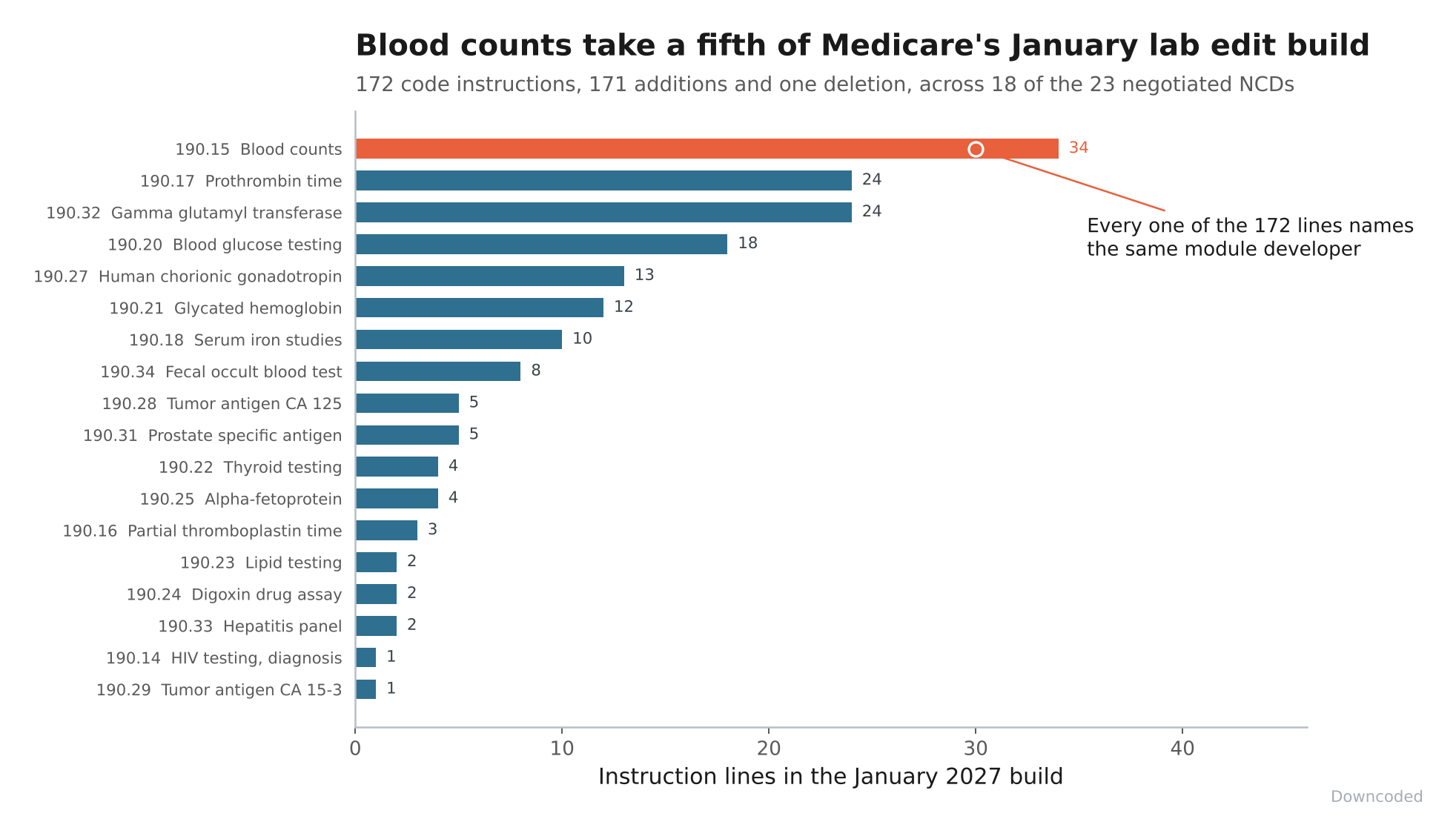
Medicare's laboratory NCD edit module has been deciding whether a CBC or an A1c gets paid since April 2003. Every one of the 172 instruction lines in its January 2027 build names the same Arlington contractor, and the federal spending record still files that contractor under a different name.
In 2001, a negotiated rulemaking committee spent a long time arguing about which diagnoses justify a blood count, and CMS published the result on November 23 of that year at 66 FR 58788, running 103 pages.
Twenty-three national coverage determinations came out of it, numbered 190.12 through 190.34, covering the tests a clinician orders without thinking: lipid panel, thyroid, A1c, PSA, iron studies, prothrombin time.
Then somebody had to turn all that into software.
That software went live on April 1, 2003, and chapter 16 of the claims processing manual still calls it by the plain name it was given then: the laboratory edit module. It lives inside the Medicare shared systems, and it is the reason a lab claim denied in Fresno is denied the same way in Buffalo.
"So who maintains it?"
The Column Nobody Reads
Every quarter CMS issues a recurring change request announcing what moves in the next build. The current one is Transmittal 13952 / CR 14614, issued September 16, implementation January 4, 2027.
Open it and you get the standard business requirements grid: a numbered requirement, then a row of checkboxes across A/B MAC, DME MAC, and the four shared system maintainers.
Those columns are empty here. All 24 requirements land in the last column, the one headed Other, and the cell reads the same thing every time.
Inclined Advanced Analytics.
Go down into the spreadsheet the CR links, and the pattern holds all the way: 172 instruction lines, every single one of them with that name in the Responsibility cell.
CMS does not write these edits. A contractor does, and CMS prints the contractor's name in the manual system for anyone who scrolls right.
What Runs Through It
Take the 53 CPT codes named in the header rows of that spreadsheet and look them up in Medicare's CY2024 Part B utilization file. 51 of them have a national row.
Those 51 codes carried 104,337,533 services and $1,089,556,567.72 in allowed amounts in one year, and four tests account for 72.8 percent of the money (chart above): TSH at $228.5 million, the lipid panel at $227.0 million, CBC with differential at $199.0 million, and hemoglobin A1c at $138.5 million.
That is physician and supplier claims only, so it understates the program.
You already know the feel of this from the other side. A screening diagnosis on an iron panel, a denial that cites medical necessity, an appeal that turns entirely on whether one ICD-10 code sits on the covered list or the not-medically-necessary list.
Those lists are the module.
Twenty-Three Years, One Agency
The federal spending record files the company under its older name, Fu Associates, Ltd., which is still the legal entity: searching the award system for "Inclined Advanced Analytics" returns nothing at all.
Under the old name there are 43 prime contract awards worth $255,658,172.02, going back to August 2003, and $254,198,930.13 of that, 99.4 percent, comes from CMS.
The named ones map neatly onto the places this desk reads every week:
- $84,995,851.15 across two task orders for operations and maintenance of the Health Plan Management System, the pipe every Medicare Advantage and Part D plan files through.
- $7,831,962.09 on a 2008 contract whose subject line is literally "MCD, NCD, LCD Clinical Lab Edit Table", the edit table in question.
- $13,368,976.00 and then $12,545,471.16 on Medicare Coverage Information Management, the second of which runs to September 12, 2027.
- $17,326,013.51 on Part C and Part D risk score and payment validation, awarded last September.
The firm is in Arlington, has been working in the public sector since 1981, is a woman-owned small business, and was renamed from Fu Associates to Inclined on October 21, 2024 under Lena Trudeau, who bought it the year before. Its own capabilities page says it validates "an average of 100 million healthcare records monthly."
The manual system caught up with the rebrand quietly. The August 2024 edition of this same quarterly CR says Fu Associates in the Responsibility column.
The July 2025 edition says Inclined. Nothing else on the page changed.
What a Quarterly Build Looks Like
The January 2027 build is 171 additions and one deletion across 18 of the 23 NCDs, drawn from 86 distinct ICD-10-CM codes, and Blood Counts alone takes 34 of the 172 lines (chart below).
Most of it is the October 2026 ICD-10-CM update finally reaching the edits. A code can be valid on October 1 and still not be on the right list in the module until the January build installs, which is the quiet reason a perfectly coded claim bounces in the fourth quarter and pays in the first.
One line in the file is worth sitting with. C759, malignant neoplasm of endocrine gland unspecified, gets added to the covered list for serum iron studies with an effective date of October 1, 2015, the day ICD-10 started.
Somebody found an eleven-year-old gap and wrote the instruction to close it retroactively.
And one code, K7683, intestinal failure-associated liver disease, had to be added to 12 different NCDs in the same build, because a new diagnosis does not arrive attached to a single test.
Final Thoughts
Revenue cycle spends a lot of attention on the MACs, and the MACs are the wrong address for this one. They install what they are sent, and so do the shared system maintainers.
The actual list of diagnoses that will clear your A1c in January was assembled in an office on Fairfax Drive, published in a spreadsheet, and attached to a change request almost nobody opens.
That is not a complaint about the arrangement. It has run quarterly for twenty-three years, and the edits are uniform nationwide, which was the entire point of the 2001 rulemaking.
It is worth knowing whose work you are appealing against.
Thanks for reading.