 Downcoded
Mississippi's Anesthesia Cut Is Three Times the National One
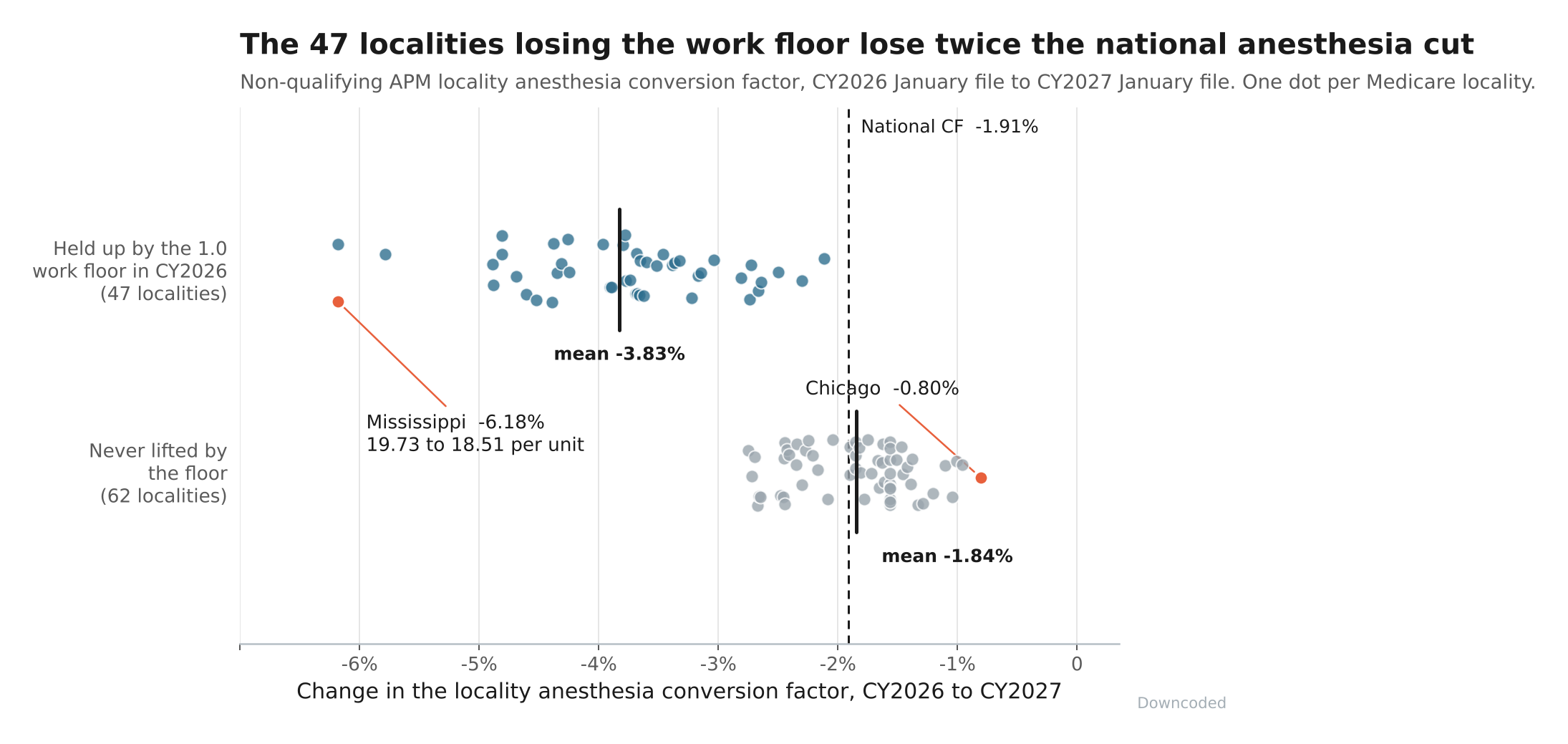
CMS posted the CY2027 rate files on November 10 and the rule prints one anesthesia number: a 1.9 percent cut. The locality table underneath it splits that into 109 different cuts, and the 47 localities losing the expiring 1.0 work floor average exactly twice the national figure. Mississippi loses 6.18 percent.
If you bill anesthesia in Jackson or Little Rock, the CY2027 number in every rate summary you have read this month is wrong for you by a factor of three.
CMS posted the January relative value file on November 10. The final rule behind it, at 91 FR 71653, gives anesthesia pricing exactly one sentence: the CY2027 nonqualifying APM anesthesia conversion factor is 20.1056, against 20.49754 for CY2026.
Call it 1.9 percent.
That is the national figure, before geography. Geography lives in ANES2027.csv, 109 rows, one per Medicare locality, and it turns that single number into 109 different ones (chart below).
The One Fee Schedule That Prints Your Price
Anesthesia is the only family on the physician fee schedule where you can read your own rate straight off a CMS file.
Everything else routes through RVUs. The rule says as much twice over: anesthesia codes "are valued using base units and time units, unlike all other PFS services," and "anesthesia services do not have RVUs or payment amounts listed in our payment files."
So CMS publishes a locality table instead. Base units plus time units, times the number in your row, and Pub. 100-04 chapter 12 section 50 handles the time half: reported minutes divided by 15, rounded to one decimal place.
Four time units an hour. Hold onto that.
Where the Other Two Points Come From
Every one of the 109 localities falls. None holds, none rises.
The spread is what the national number hides. Chicago gives up 0.80 percent.
Mississippi and Arkansas give up 6.18 percent each.
Sort the 109 by one question, whether the 1.0 statutory work GPCI floor was propping their work index up in CY2026, and the distribution comes apart on its own. The 47 localities standing on that floor average -3.83 percent, which is 2.00 times the national figure. The other 62 average -1.84 percent.
All 47 land worse than the national number. Only 22 of the other 62 do, and the two groups barely overlap at all: the floored run from -2.11 to -6.18, everyone else from -0.80 to -2.75.
Section 6208 of the Consolidated Appropriations Act, 2026 extended the floor "through December 31, 2026," and CMS built Addendum E to match.
Last year's file carried two work columns, one with the floor and one without. This year's carries one, headed 2027 PW GPCI (without 1.0 Floor).
Two localities drop below 1.000 that the floor never lifted in the first place: Virginia, sitting at exactly 1.000 and landing at 0.997, and Minnesota at 0.999.
What That Is Per Hour
Mississippi's conversion factor goes 19.73 to 18.51. A dollar and twenty-two cents a unit.
At four time units an hour, that is $4.88 per hour of anesthesia time, before a single base unit is counted. A room running 1,000 anesthesia hours a year hands back $4,880 on the time side alone, and the groups carrying that are in the states with the thinnest commercial mix to cover it.
Chicago's version of the same arithmetic is $0.72 an hour.
One more thing, if you maintain the locality table by hand. The columns swapped.
CY2026 printed the qualifying APM factor in column 4 and nonqualifying in column 5, and CY2027 reverses them. A paste by position loads the wrong rate into all 109 rows, in the direction that overstates what you are owed.
Final Thoughts
The work floor sits on the lame-duck extender list alongside the ambulance add-ons and the telehealth flexibilities, so Congress may well put it back before the files go live. Nothing has passed yet, and CMS has already published January on the assumption that it does not.
The national number is honest arithmetic and it tells you almost nothing. Payment happens at the locality level, and for 47 localities the locality level is twice as far down. The file that says so went public six days ago and runs 4,650 bytes.
Thanks for reading.