 Downcoded
Why Does a Tier 1 Steroid Need a Prior Auth on Half of Part D?
CMS refreshed its free formulary file this week. It carries the prior authorization flag for 6,170 drugs across all 5,518 Part D and Medicare Advantage drug plans, and prednisone is flagged on 2,569 of them. Fifty-six drugs are flagged on every plan in the country, and CMS's own manual explains why. The 2027 edition lands October 15.
The 5 mg prednisone tablet sits on tier 1 of 259 of Medicare Part D's 328 formularies. It is about as ordinary as a drug gets.
And 150 of those 328 want a prior authorization before the pharmacy fills it.
That is a count, not an impression from somebody's work queue. It comes out of a public file whose newest edition CMS's catalog stamps September 23, whose zip went onto the CDN on the 17th, and whose text files inside were written on the 14th.
Weighted by plan, those 150 formularies belong to 2,569 of the 5,517 Part D and Medicare Advantage drug plans your patients actually carry.
"Why would a plan put an edit in front of a tier 1 steroid?"
What Is Actually In The File
The release is called the Monthly Prescription Drug Plan Formulary and Pharmacy Network Information, and it is eight tables. The one doing the work here is the Basic Drugs Formulary: 1,129,364 rows, one per formulary per drug, spanning 328 formularies and 6,170 RxNorm products.
Every row carries the same five things:
- a cost-share tier
- a quantity limit flag, with the amount and the day supply attached
- a step therapy flag
- a prior authorization flag
- a selected-drug flag, marking the products picked for the Medicare Drug Price Negotiation Program
The Plan Information table joins those formularies to 5,518 plans under 691 contracts, county by county, with employer group plans and PACE excluded.
(One plan, H6874-001-000, points at a formulary ID that has no rows in the drug table, which is why every plan-weighted number here stops at 5,517.)
So "does this plan require a prior authorization on this drug" has a public, machine-readable, monthly answer, published under a plain government-works license.
The download is a 2.29 GB zip, which is why most people bounce off it. 2.28 GB of that is the pharmacy network table, split across six parts.
The formulary table itself is 59 MB of pipe-delimited text.
Across all 1,129,364 rows, 28.56% carry the prior authorization flag and quantity limits run 39.04%. Step therapy, the control everyone complains about loudest, is 1.07%.
The Answer Is In Chapter 6
Okay, so, the prednisone question.
Prednisone is a Part B drug when it is immunosuppression following a Medicare-covered transplant, and a Part D drug every other time. The plan cannot tell which one it is looking at, so it puts an edit in front of the claim to find out.
CMS says this in its own manual, naming the drug. Chapter 6 of the Medicare Prescription Drug Benefit Manual, section 20.2.2, "Part D Sponsor Due Diligence in Prior Authorization of Part B Versus Part D Coverage Determination":
"for cases in which prednisone is prescribed for a condition other than immunosuppression secondary to a Medicare-covered transplant, and this is indicated on the prescription, a sponsor may cover the drug under Part D without seeking further information from the prescribing physician."
Appendix C of the same chapter is blunter about the transplant drugs themselves. A sponsor should not make the pharmacy collect a Part B rejection first, because that "would be disruptive to beneficiaries and pharmacies."
Instead, in CMS's words, "a prior authorization requirement would be appropriate."
That guidance shows up in the file exactly where you would expect. 56 drugs carry the flag on all 5,517 plans, and 33 of them are the two classes Chapter 6 routes through a Part B question:
- nine hepatitis B vaccine presentations, across Recombivax, Engerix-B and Heplisav-B, where Part B pays for the high and intermediate risk patient and Part D pays for everyone else
- 24 presentations of tacrolimus, cyclosporine, mycophenolate, sirolimus, everolimus and azathioprine
Oral cyclophosphamide, Appendix C's oral anti-cancer case, is two more. The flag on a transplant immunosuppressant is a benefit-routing question wearing the same one-character column as a utilization control.
The Part You Cannot Guess
Narrow to the 2,503 drugs carried on at least 300 of the 328 formularies, and the picture piles up at both ends (chart below).
1,282 of them are flagged on no plan at all. Fifty-six are flagged on every one.
That leaves 290 drugs sitting between a quarter and three quarters of the plans, and those are the ones where knowing the drug tells you nothing about the edit:
- vericiguat (Verquvo), on 68.9% of plans
- clozapine ODT, 61.9%
- the xanomeline and trospium capsule (Cobenfy), 55.4%
- injectable methotrexate, 30.2%
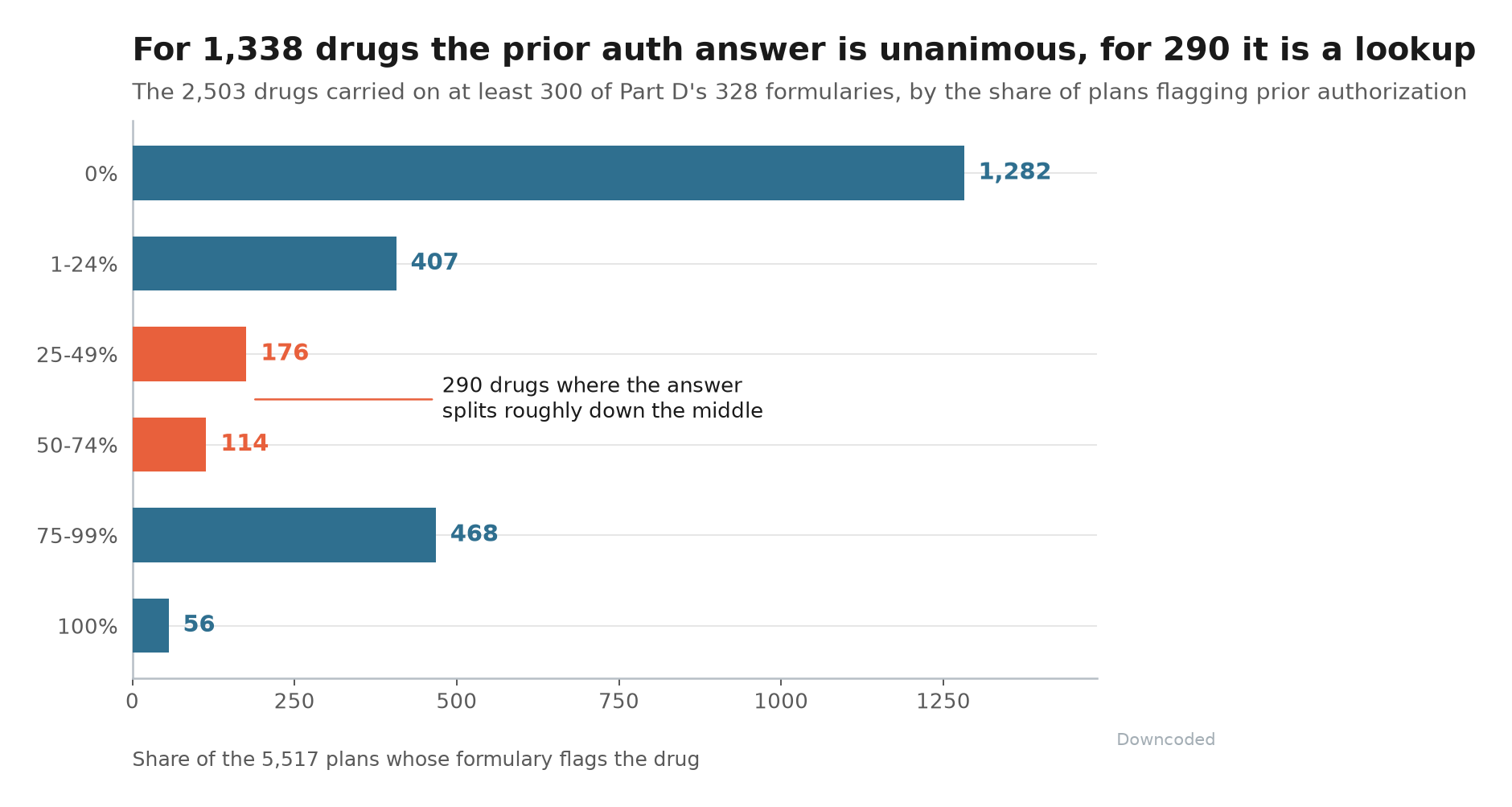
The formularies themselves are less varied than the reputation suggests. The lightest one flags 5.1% of its rows for prior authorization and the heaviest flags 38.8%, with a median of 28.1%.
The variation lives inside the drug list, one product at a time.
Final Thoughts
The next release is the one worth a calendar entry. CMS's posted schedule puts it on October 15, the same day the enrollment window opens, and it is the first file carrying contract year 2027 formularies.
Your patient-access team can have the 2027 prior authorization list for every plan in its market 78 days before any of those rules adjudicate a claim.
None of this makes an authorization easier to win, and the file carries the flag rather than the criteria sitting behind it. What it removes is the guessing.
Those edits were never secret. They were parked 2.29 GB down a page almost nobody visits, and the answer for every plan your patients carry is one download away.
Thanks for reading.