 Downcoded
How Centene Picks the TINs That Get a Gold Card
Centene opens a national gold card program in November to more than 160,000 providers, and it grades eligibility at the ordering and referring tax ID level, using historical utilization management data. Prenotification replaces the authorization, routing through Availity or Evolent depending on the service, and 70.9% of the members the card can reach sit in state-regulated Medicaid.
If Centene is in your payer mix, something is coming in November that you cannot apply for.
On October 13 the company announced its National Performance-Based Gold Card Program, opening to more than 160,000 qualifying providers for select outpatient services.
Participation is by invitation. There is no form, no attestation, no portal button.
So the first question in a revenue-cycle shop is not whether to sign up. It is which of your entities Centene has been grading.
The Card Sits on an Ordering TIN
The program page answers that in one sentence the announcement coverage mostly skipped:
"Eligibility is assessed at the Ordering/Referring Tax Identification Number (TIN) level using historical utilization management performance data."
Two words there carry the whole operational load.
The unit is the TIN. A group billing under four tax IDs gets four separate verdicts, and a physician who moved between two of them in March carries nothing across.
The graded party is the ordering or referring entity. The practice that sent the patient is the one with the performance record; the imaging center, the infusion suite and the ASC that perform the service sit downstream of it.
That inverts the usual front-end question.
Your scheduler already checks whether a service needs authorization. For Centene, the answer now depends on an attribute of somebody else's tax ID.
What Replaces the Authorization
Qualifying providers "may no longer be required to obtain prior authorization for designated outpatient services." They file a prenotification before rendering instead, and Centene is explicit about what that buys: providers "may proceed with Gold Card eligible services without waiting for an authorization determination."
Two channels, split by who owns the review:
- Availity for the general case.
- The Evolent portal for services Evolent manages. Centene's own plan bulletins name Evolent Specialty Services "the utilization management partner of Centene," and its code lists are live, including the endovascular revascularization set that moved to Evolent review on October 1.
A cardiology practice and a general internal medicine practice holding the same card will be filing prenotifications in two different systems.
The scope is deliberately narrow. The card covers "designated outpatient services identified by Centene," never inpatient, and the service list is not public yet. Five requirements it explicitly does not waive:
- Medical necessity
- Member eligibility
- Benefit coverage
- Network participation
- Claims submission requirements
Centene also reserves utilization review, audits and program integrity activity. The review moves downstream of the service, and those five bullets are where it lands.
Worth saying plainly, because it is the part that is easy to be cynical about and should not be: the program was built on feedback gathered anonymously from providers across 24 states, and COO Susan Smith's stated test for it is "the real-world needs of those delivering care every day." The criteria Centene published, approval history, documentation quality, compliance with medical policy and adherence to regulatory requirements, are things a practice can actually see in its own data.
Most of the Book Behind the Card Is Medicaid
Centene's Form 10-Q for the quarter ended June 30 puts at-risk membership at 25,885,400.
Set aside Medicare PDP, a standalone drug plan with no outpatient medical benefit for an outpatient program to reach, and the book a gold card can touch is 17,082,400. Medicaid is 70.9% of it (chart below).
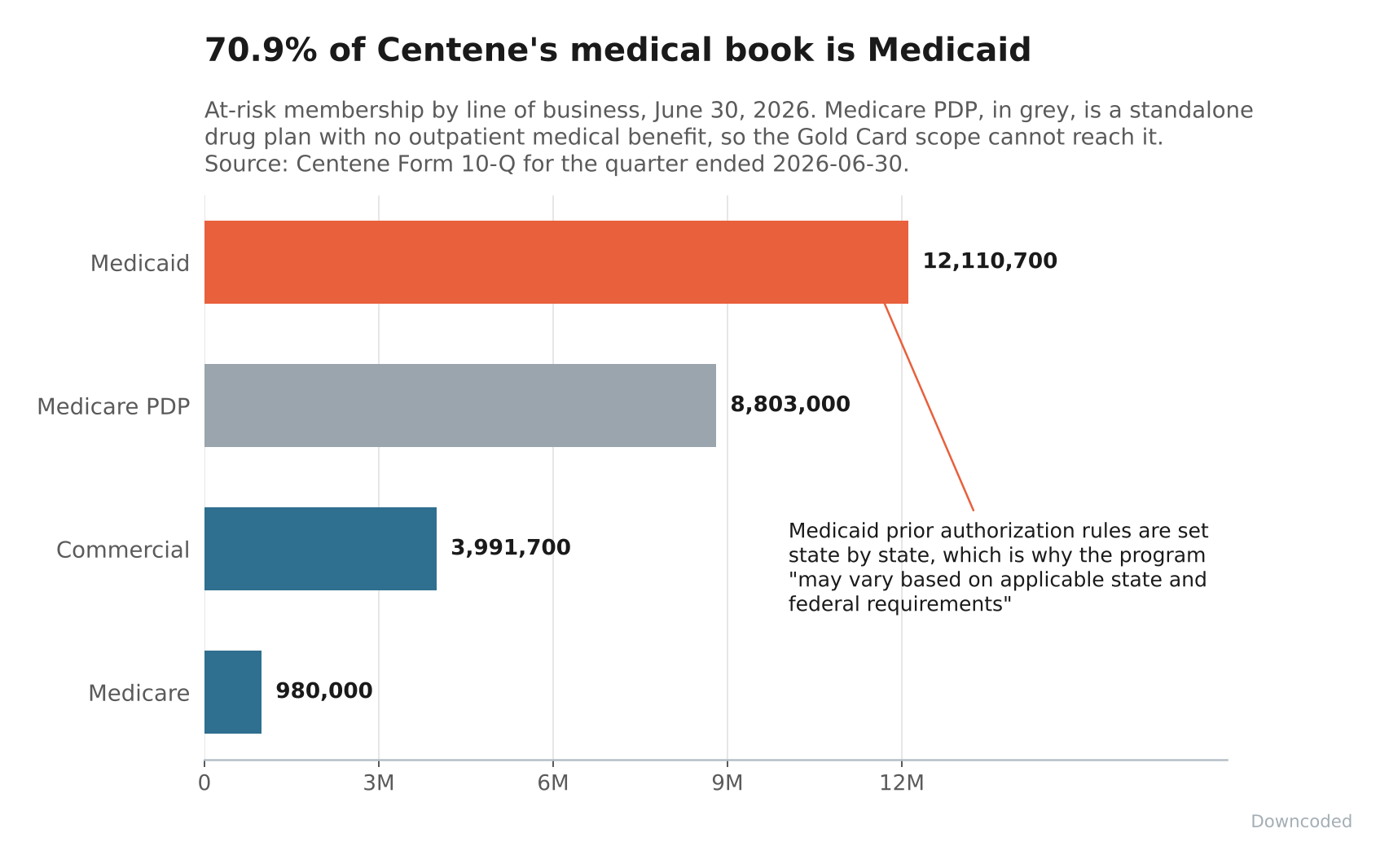
That is the arithmetic behind the single hedge in the release: "Program operation may vary based on applicable state and federal requirements."
Medicaid prior authorization is a state instrument. A national performance-based program lands in Ohio, Georgia, Texas and California as four programs, with four sets of constraints on what a plan may waive and for how long. Assume the card one of your TINs holds in one state behaves differently from the card the same TIN holds in another, and ask provider engagement for the state-specific scope rather than the national summary.
Final Thoughts
Three weeks ago we read Centene's California prior authorization metrics filings, the ones CMS-0057-F made it publish, where it disclosed in its own numbers that appealing its Medicare Advantage denials worked four times out of five. Five days ago we printed Medicare's own version of gold carding, the hospital outpatient exemption that has quietly run since 2020 and reached 257 outpatient departments in FY2024.
This is the largest published entry in that lineage so far. One hundred sixty thousand providers, criteria stated in public, and an eligibility unit specific enough to check against your own org chart this week.
What to do before the letters go out is short and unglamorous. List your ordering and referring TINs. Work out which carry Centene volume. Confirm somebody in the shop can file an Availity prenotification and, separately, an Evolent one. The invitations are going to arrive addressed to tax IDs, and the practices that already know which of theirs are in play are the ones that will notice what changed.
Thanks for reading.