 Downcoded
How We Catch the Change Nobody Announced
The policy changes that cost the most rarely come with a press release. The Downcoded method, end to end: where changes surface, how the diff works, and how a diff becomes a dollar figure.
The policy change that costs you the most this year probably won't be announced.
It will be a revised coverage article that adds one documentation requirement to a code family you bill every week. Or a quarterly fee file that reprices forty codes, of which three are yours.
The first place most practices encounter it is a denial, sixty days after it took effect.
The document was public the whole time. Somebody just had to read it.
This post is the method: where changes actually surface, how we catch them, and how a caught change becomes a dollar figure. We're publishing it because the method is the product, and you should know what you're reading.
Where changes actually surface
Five public surfaces carry essentially every payer policy change that matters, and they leak in a reliable order:
- The Federal Register CMS docket. Rulemaking lands here first, with a public API, typically ahead of the press releases and always ahead of the trade summaries.
- CMS transmittals and MLN articles. The operational layer: change requests that rewrite the contractor manuals. A transmittal is policy becoming billing reality.
- The Medicare Coverage Database. Every LCD, NCD, and coverage article across all twelve MAC jurisdictions. Local coverage changes surface on a weekly clock: captured Sunday night, displayed Thursday, with full downloadable datasets refreshing the same day.
- The commercial bulletins. UnitedHealthcare's Network Bulletin, Aetna's OfficeLink Updates, and Cigna's policy updates, monthly, public, and long. The industry treats them as junk mail. They are contract amendments in newsletter costume.
- The quarterly fee files. The PFS relative value files and HCPCS quarterly updates, where repricing happens without a single sentence of prose.
None of this is secret. All of it together is roughly two thousand pages a month, which is why nobody reads it end to end, and why the enterprise platforms that do charge what they charge.
The diff is the signal
Reading the documents is the wrong frame anyway. What matters about the September edition of a coverage policy is how it differs from the August edition, and no human reader holds the August edition in memory.
So the pipeline archives every version of every document it watches, and when a new version appears, compares them. Most diffs are noise: reformatting, typo fixes, a renumbered section.
The filter that separates signal from noise is the next step.
From diff to dollars
Every changed passage gets mapped to the billing codes it governs. A diff that touches no code is trivia, and a diff that touches a code family gets priced: the affected codes joined against utilization and RVU data, multiplied through fee schedules, modeled for the practice shapes that bill them (diagram below).
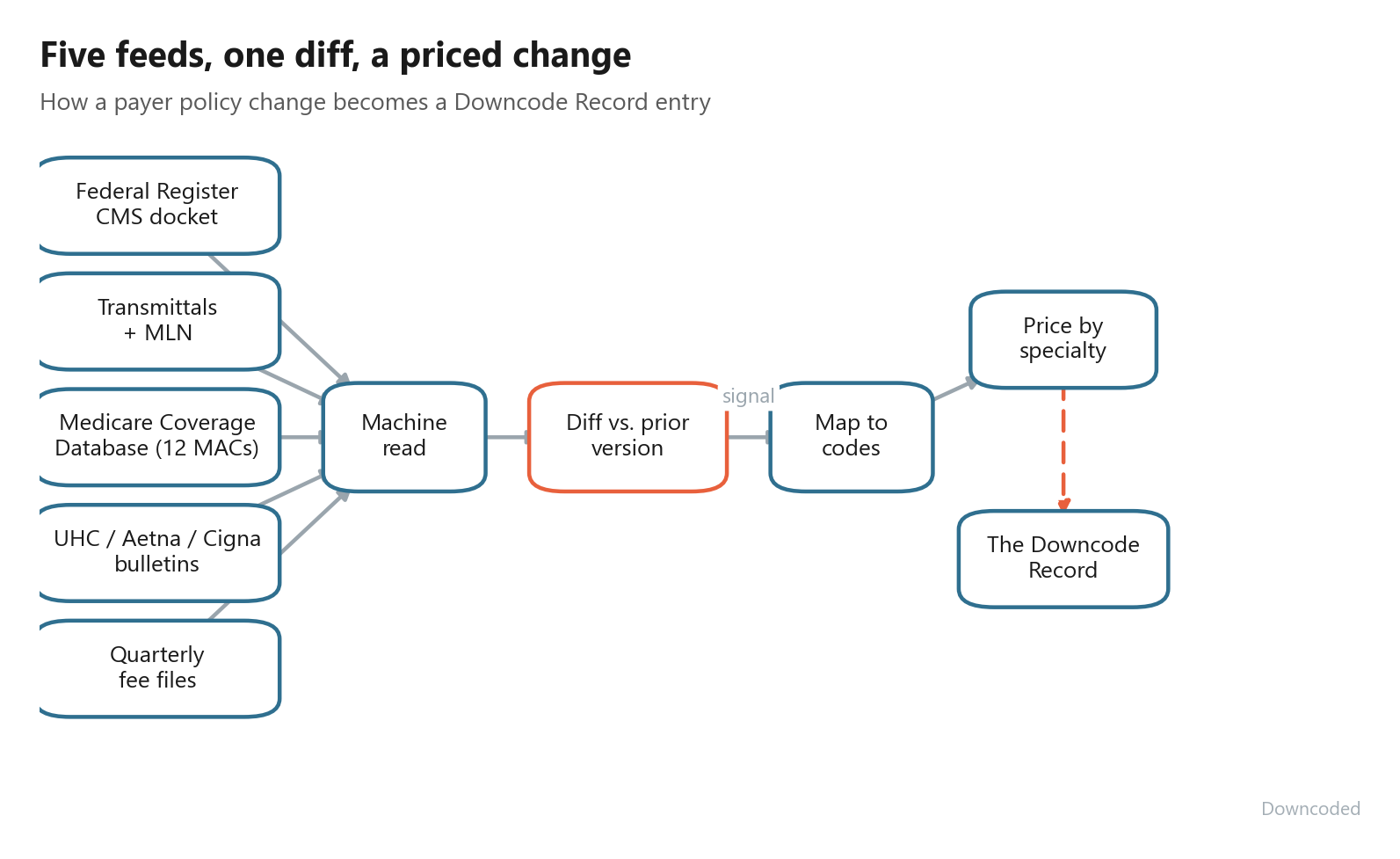
The output is the number this publication exists to print: what the change costs a practice of a given specialty mix, stated in dollars, before the effective date rather than after the denial spike.
And each priced change accumulates into the Downcode Record, the running table of every change we've tracked with its modeled impact.
Single changes are news. The record is the asset.
What the model doesn't see
Honesty section, because a method post that skips it is marketing:
- Your contracts. We price the rule as written against public fee schedules. Your negotiated rates, carve-outs, and payer mix are yours; the model gives you the public-rate impact to apply them to.
- Commercial behavior between bulletins. What a commercial payer publishes monthly is what we can diff. Conduct that never reaches a bulletin, silent edit or claims-system behavior, is invisible until it shows up in industry denial data.
- Denial outcomes. Payer-by-payer denial and overturn rates live in proprietary consultancy datasets built from client claims. We work from the public record, and we say so when a question needs data we don't have.
A model that admits its inputs beats a model that doesn't, and ours are listed above.
Final Thoughts
Revenue-cycle teams already know the feeling this method replaces: the retroactive discovery, the denial that traces back to a document revision from two quarters ago, the meeting where somebody asks why nobody caught it.
Catching it was never a talent problem. It's a volume problem, and volume problems are what machines are for.
The judgment, which changes matter, for whom, and what to do before the effective date, is the part that stays human, and it's the part we write.
Thanks for reading.