How Your Group's Revalidation Clock Outranks Your Own
The November editions of Medicare's revalidation files went into the data catalog today. On 1,755,967 reassignment rows the practitioner's due date reads TBD while the group they bill through carries a real one, 85% of those group dates have already passed, and the practitioners behind them billed $68.4 billion of Part B in 2024.
CMS dropped the November editions of its three revalidation files into the data catalog today.
The reassignment list is the one worth opening. Every row on it pairs one practitioner with one group they reassign benefits to, and every row shows two revalidation due dates side by side: the group's, and the practitioner's own.
Look up your own row and the odds are overwhelming that only one of those two dates exists.
1,755,967 of the file's 3,672,532 rows pair a dated group with a practitioner reading TBD (chart below). Another 1,895,803 rows have TBD on both sides. The cell where you and your group both carry a real date holds 12,020 rows, three tenths of one percent of the file.
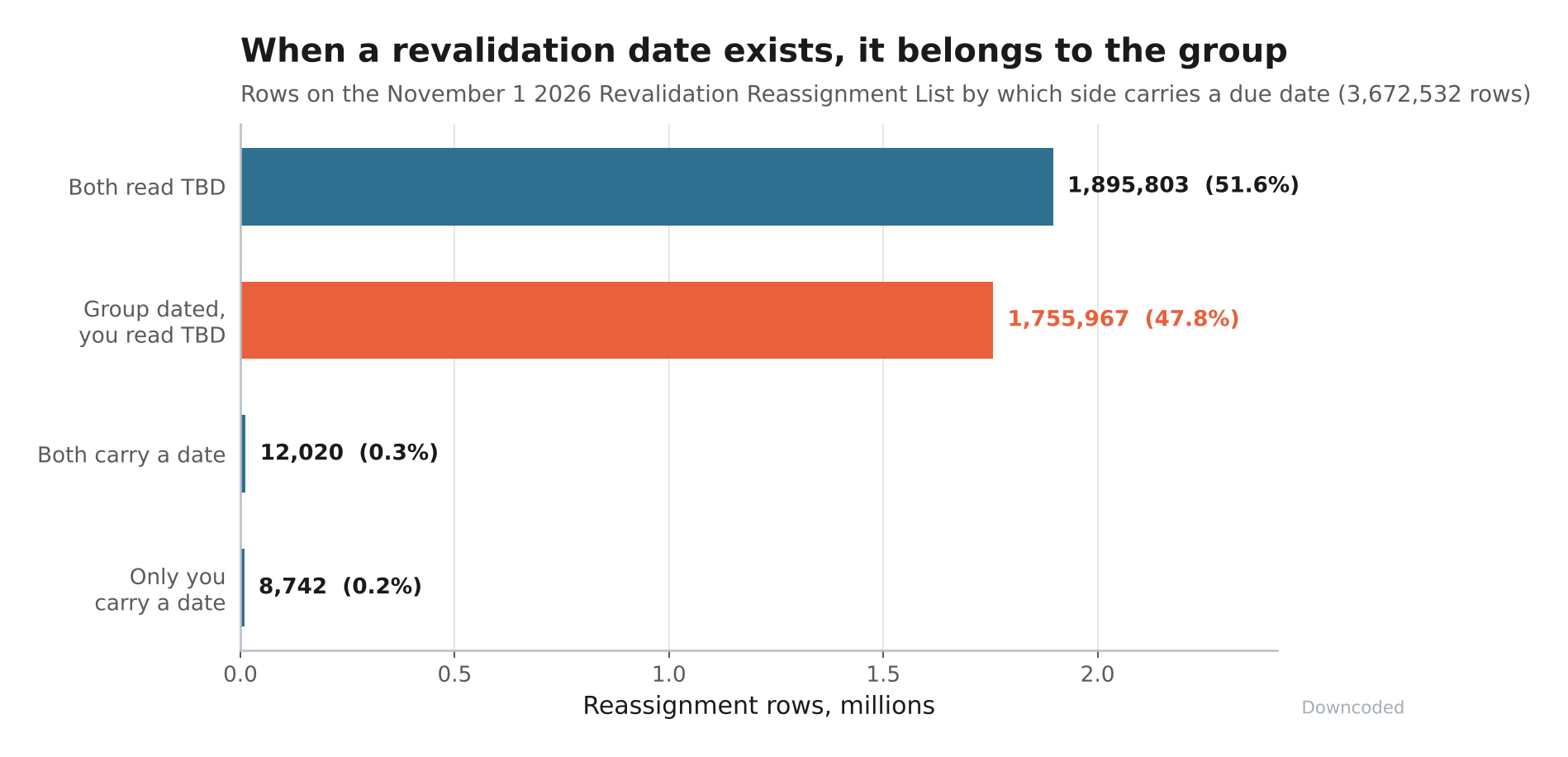
When a date exists anywhere on a row, 99.5% of the time it belongs to the entity that bills and not to the person who rendered the service.
"Whose revalidation clock is actually running, and what happens when it ran out two years ago?"
The Date That Isn't Yours
257,212 distinct group enrollments sit on the November file. 112,640 of them carry a real date and 144,572 read TBD.
Of the dated ones, 95,780 are already in the past.
That is 85% of every group date on the list, and the median one expired 734 days ago.
48,629 of them, better than half, are more than two years gone. The oldest came due on 07/31/2023.
Those 95,780 groups carry 1,409,966 reassignments between them. On 1,400,269 of those rows, 99.3%, the practitioner's own date reads TBD.

The rest of this brief is for subscribers.
The impact tables, the code-level detail, and the rest of the analysis sit past this line.
$50 a month, or $500 a year.
Already a subscriber? Sign in