 Downcoded
The 154,137 Codes Behind a Ninety-Second DRG
AKASA took the inpatient mid-cycle autonomous on October 2, the one stretch of the revenue cycle that still ran on a person reading the chart. The code set it picks from had turned over the day before, to 154,137 live entries and a new grouper.
Every other stretch of the revenue cycle went to software years ago. Eligibility, prior auth, claim status, remit posting, worklists, appeals.
One stretch held out. The one where a person reads the chart after discharge and decides what the hospital gets paid.
On October 2, AKASA said that stretch is done holding out. The South San Francisco company announced an autonomous platform for the inpatient mid-cycle, meaning medical coding and clinical documentation integrity, running without a coder in the loop on the encounters it takes.
The company had been selling AI prebill review, which is the comfortable half of the problem: look at what a human coded and flag what looks wrong. Coding the chart yourself is the other half.
"Which part of the mid-cycle was actually the hard part?"
What the Mid-Cycle Actually Decides
Six days ago the inpatient code set turned over. CMS's FY 2027 files put 74,879 billable ICD-10-CM codes and 79,258 ICD-10-PCS codes in front of every inpatient coder in the country, both for discharges on and after October 1.
That is 154,137 live codes, counted out of CMS's own two files this week.
Downstream of whoever picks from them sits the MS-DRG Grouper, Version 44, new on the same date. CMS describes what the grouper reads in one sentence: a case goes to an MS-DRG "based on the reported diagnosis and procedure codes and demographic information (age, sex, and discharge status)."
Nothing else about the stay reaches it. Not the physician's note, not the nursing documentation, not three days of labs. Only the codes somebody chose (chart below).
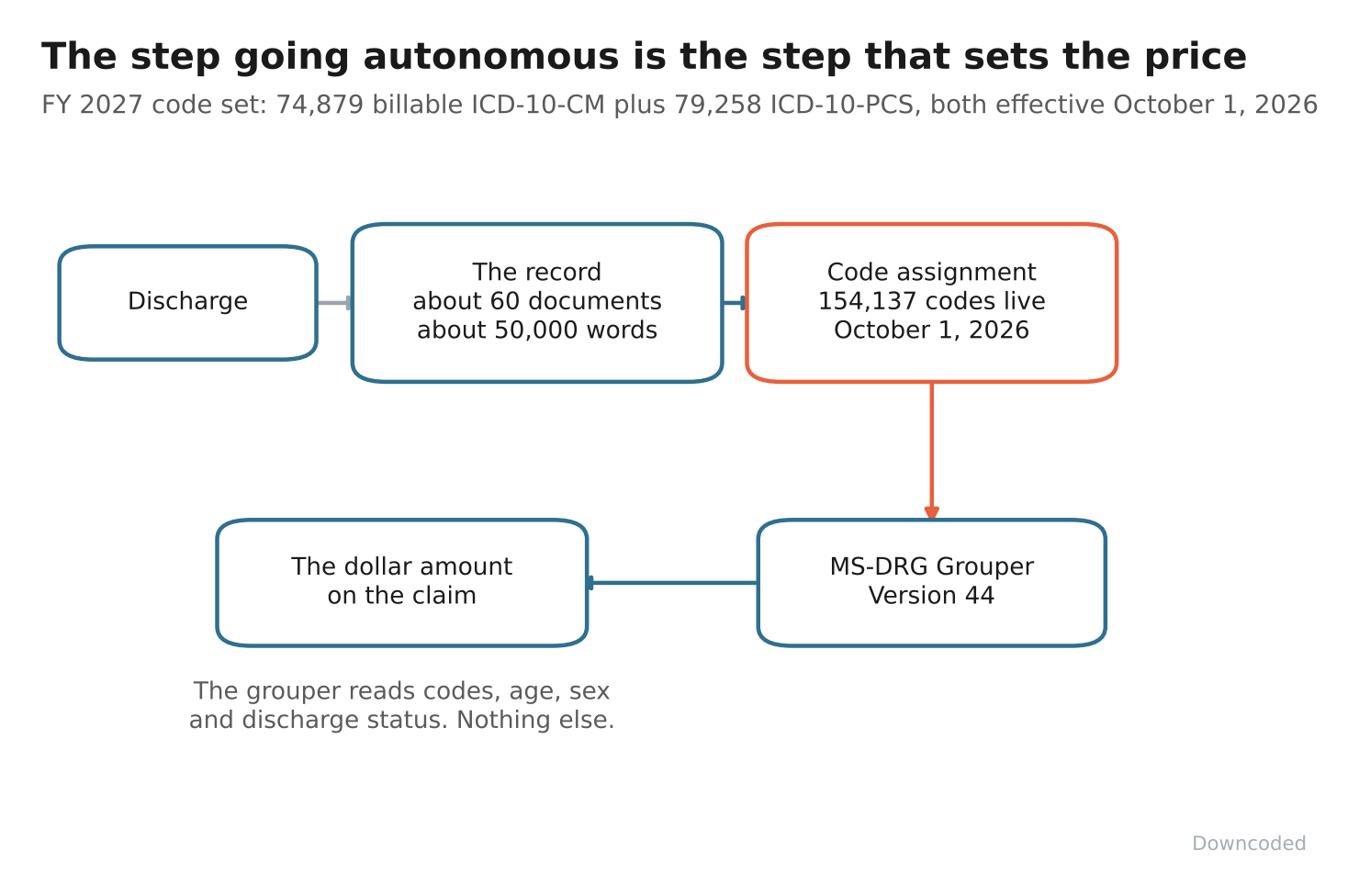
So the mid-cycle is the pricing step. Charge capture records what happened and claim submission transmits it; the dollar amount is fixed at the moment the codes are selected.
That is why this stretch stayed human long after the rest of the cycle stopped being human. And it is why taking it autonomous is a different kind of claim than taking a worklist autonomous.
What AKASA Says It Measured
Everything in this section is the company's own number, published in its announcement.
Its platform codes an inpatient encounter in under 90 seconds post-discharge, against the 30 to 60 minutes it cites for a person. Third-party blinded evaluations, AKASA says, had the AI match or exceed human coders on MS-DRG assignment, principal diagnosis, clinical quality capture and present-on-admission accuracy, across the encounters making up 65% to 85% of a typical health system's inpatient volume.
Scale, also self-reported: customers representing more than $180 billion in aggregate net patient revenue and roughly 10% of U.S. inpatient discharges, with inpatient volume up nearly 6x over the past year. Cleveland Clinic chief digital officer Rohit Chandra and Nebraska Methodist Health System CFO Jeff Francis are both quoted in the release.
The throughput line is the one to sit with. Reporting on the launch puts certified coders at 4 to 6 complex charts a day, and 3 to 4 at high-acuity teaching hospitals, against encounters running about 60 documents and 50,000 words apiece.
Co-founder and CEO Malinka Walaliyadde: "An autonomous mid-cycle has been a holy grail in our industry. Today, AKASA is making it real."
The Number Nobody Has Yet
GAO went looking for independent accuracy evidence on exactly this class of tool in July, and came back light.
Its July 16 science and tech spotlight, GAO-26-109116, found the share of surveyed clinicians using AI for clinical documentation or medical coding rose from 21% in 2024 to 28% in 2026, and that relatively few independent studies evaluate how accurate those tools are. The consequence GAO names is the one a revenue-cycle director would name first: inaccurate output lands as over-reimbursement or under-reimbursement.
Credit where it belongs. AKASA's own announcement cites that GAO review, alongside a 2025 npj Health Systems paper putting reported manual coding error rates as high as 20%.
A vendor that hands you the skeptical citation is doing something more interesting than marketing.
A blinded third-party evaluation against human coders is the right instrument for this, and the version of it that gets published is the one the whole field gets to argue with.
Final Thoughts
154,137 is not a number a person holds in their head. It never was. Coders hold a working set and look up the rest, and the looking up is most of the 30 to 60 minutes.
What changes when the look-up takes 90 seconds is less the coder's job description than the auditor's. A DRG that arrives faster than anyone can read the chart behind it can only be checked on a sample you pull yourself, against documentation you read yourself, on a schedule you set. The shops already running a real coding audit program are the ones who will be able to say whether any of this holds in their own data, on their own case mix, by this time next year.
That is a good position to be in, whichever way the answer goes.
Thanks for reading.